Selling on print-on-demand platforms is exciting until you receive a DMCA takedown notice, a trademark complaint, or worse, a lawsuit.
Copyright and trademark law applies to every design you upload, regardless of whether you drew it yourself, sourced it from Google Images, or generated it with AI.
The good news: staying on the right side of the law is entirely manageable once you understand the rules.
This guide covers the core legal concepts POD sellers need to know, the most common mistakes that get stores shut down, and a practical workflow you can follow from ideation to post-launch monitoring.
Copyright, Trademark, and Personality Rights: What Each One Covers
These three legal concepts often get lumped together, but they protect different things and require different responses from you as a seller.
Copyright protects original creative expressions: artwork, photos, text, music, characters, graphics, and layouts, whether digital or hand-drawn. It arises automatically the moment a work is created in most countries. Registration is not required for protection, though it helps with enforcement and statutory damages in places like the US.
Trademark protects brand identifiers: names, logos, slogans, distinctive packaging, and sometimes even shapes or colors associated with a brand. Sports team logos, fashion house wordmarks, and entertainment studio names are all trademark territory. Unlike copyright, trademark protection is tied to commercial use within specific product categories, which is why even a seemingly generic phrase can be protected if it has been registered for clothing or drinkware.
Trade dress and personality rights come into play when you use recognizable product designs, celebrity names, faces, or likenesses without permission. Even if a celebrity’s face is not trademarked, using their likeness on a product to imply endorsement can expose you to personality rights claims under many jurisdictions.
One more thing worth knowing: POD platforms themselves shift legal responsibility to you in their terms of service. Every major platform states that you must own or have rights to everything you upload, and they reserve the right to remove designs or close accounts for infringement.
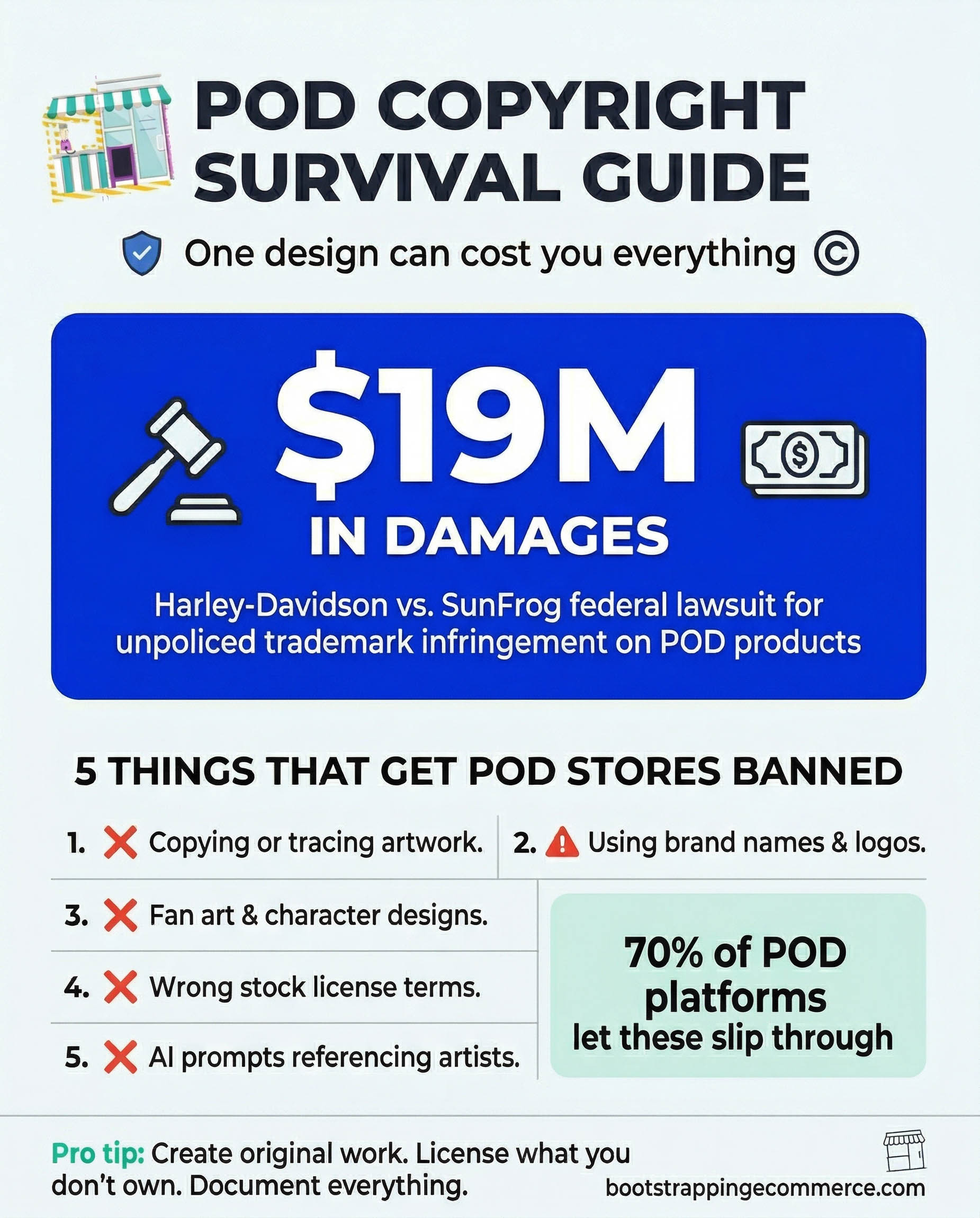
POD Copyright Survival Guide Infographic
High-Risk Behaviors That Get POD Sellers in Trouble
Most infringement in POD is not deliberate. It happens because sellers underestimate what counts as protected. Here are the behaviors that consistently lead to takedowns and bans:
- Copying or tracing existing artwork. Pulling images from Pinterest, Instagram, Behance, or Google Images and making small changes does not make the design yours. This is still infringement.
- Using brand names, logos, or slogans without a license. Sports teams, movie studios, bands, fashion labels, and game brands are all protected by trademark and sometimes copyright. There is no workaround here short of an actual license.
- Fan art and character-based designs. Creating merchandise inspired by movies, anime, games, or TV shows is generally treated as an unlicensed derivative work, even if you redrew every element yourself.
- Using stock assets outside their license terms. Many stock assets are licensed for personal use only, or explicitly exclude print-on-demand and merchandise. Using them commercially breaches the license.
- AI-generated designs referencing named artists or brands. Prompts like “in the style of [artist name]” or designs based on branded characters are treated as unauthorized derivatives on most major marketplaces and get removed.
Platform Policies, Bans, and Real Lawsuits
Understanding the stakes matters. This is not just about losing a listing.
Platforms including Printful, Printify, Redbubble, Merch by Amazon, and Etsy all have IP policies that prohibit copyrighted, trademarked, or look-alike designs. Repeat offenses result in permanent account bans.
Compliance teams and automated tools increasingly scan uploads for known logos, characters, and brand elements.
Despite this, research suggests roughly 70% of POD companies still allow protected imagery to slip through their systems, which exposes both platforms and individual sellers to legal action.
The consequences at the seller level can be severe. Harley-Davidson won a federal lawsuit and over $19 million in damages against POD site SunFrog specifically because the platform failed to police infringing designs using Harley’s marks.
Takedowns typically begin with DMCA notices or trademark complaints. Unresolved or repeated issues can escalate to claims for statutory damages, lost profits, and attorneys’ fees.
Some platforms also proactively ban entire categories to limit their own exposure: certain franchises, celebrity imagery, AI art “in the style of X,” and specific adult content categories are commonly on those lists.
Safe Sources for Your POD Designs
There are four reliable paths to designs you can sell with confidence.
Create from scratch
Original illustrations, typography, photography, hand-lettering, and patterns you design yourself are the safest assets. They are your IP from the moment you create them and can be registered to support future enforcement.
Commission work with the right contracts
When hiring freelancers or designers, use written contracts that clearly transfer commercial rights, ideally exclusive rights, for POD usage. The contract should also cover sub-licensing rights, since uploading to a marketplace technically involves licensing the design to that platform.
Use licensed content correctly
Purchase from reputable stock sites that explicitly allow POD and merchandise use. Look for extended commercial licenses specifically, and keep copies of your receipts and license terms.
For fan-type content, official licensing deals with agencies that manage sports teams or entertainment IP are the only safe route. “Fair use” is not a reliable defense for commercial merchandise.
Public domain and open licenses
Works whose copyright has expired or that have been explicitly dedicated to the public domain can be used freely, though you should verify status through reliable databases and confirm that no active trademarks or personality rights are implicated.
For Creative Commons-licensed work, check whether commercial use is permitted, whether attribution is required, and whether “no derivatives” or “share alike” clauses restrict your use case.
Trademarks, Phrases, and Trending Niches
Text-based designs carry their own trademark risk that many sellers overlook.
Before finalizing any phrase-based design, search trademark databases: the USPTO in the US, the EUIPO in the EU, and the WIPO Global Brand Database for international coverage.
Common words can be trademarked within specific product classes. A phrase that reads as generic in everyday language might be fully protected for T-shirts, hoodies, or mugs.
Parody designs are a common source of overconfidence. Some jurisdictions do protect parody, but the design typically needs to be clearly humorous or critical and must not confuse consumers about the product’s origin.
Most sellers significantly overestimate how much protection the parody defense offers in a commercial context.
Trending memes, slogans from TV shows, viral hashtags, and political campaign phrases may be protected by copyright, trademark, or personality rights, especially when tied to specific public figures or brands.
Marketplace policies frequently forbid political campaign merchandise using protected logos, celebrity images, or party symbols, even in cases where the legal position is ambiguous, simply to reduce platform risk.
AI-Generated Designs: What the Rules Actually Look Like in 2026
AI tools have become a standard part of the POD design workflow, but they introduce layered risks that are still evolving across both law and platform policy.
There are three main risk areas:
- Training data exposure. AI models may have been trained on copyrighted works. This is primarily the model provider’s legal issue, but it can affect platform policy decisions about AI content.
- Prompt-based derivatives. Prompts referencing specific artists, franchises, or brands can produce outputs that are recognizable derivatives of protected works.
- Evolving marketplace rules. Platforms are actively updating policies on AI-generated content, and rules are not consistent across platforms.
Some platforms now explicitly remove AI images that imitate an artist’s style or a brand’s visual language, even when no logo appears, and may suspend stores that repeatedly upload such content.
The emerging best practice is to use AI outputs as starting points rather than final designs. Substantially transform the output with manual editing, vectorization, and original composition.
Avoid prompts referencing specific artists, brands, or copyrighted characters, and focus on descriptive, generic artistic directions instead. Also check the commercial licensing terms of the generator you are using: paid and free tiers often differ, and some restrict reselling raw outputs or require attribution.
A Practical 5-Step Workflow to Stay Compliant
Step 1: Ideation with low-risk themes
Build your catalog around evergreen, brand-independent themes: hobbies, occupations, pets, generic humor, nature, and abstract design. These niches do not rely on third-party IP and carry the lowest risk at every stage.
Step 2: Clearance searches before you design
For text designs, search trademark databases plus the marketplace’s own IP policy pages for your phrase. For visuals, run reverse image searches on key elements to make sure you are not unintentionally replicating existing works. Do this before investing time in a full design.
Step 3: Create and document
Save layered source files, drafts, and timestamps to establish originality if it is ever questioned. Keep copies of all licenses, invoices, and communications with rights holders in a dedicated folder for each design. This documentation becomes your evidence if you ever need to contest a claim.
Step 4: Review platform compliance before you publish
Read each POD provider’s acceptable use policy and IP guidelines before launching new categories, and revisit them at least quarterly. Platform rules change, and categories like AI art, wall art, and children’s products often have additional restrictions. Avoid categories explicitly listed as prohibited.
Step 5: Monitor and respond post-launch
Respond quickly to any takedown notice, and consult legal counsel when receiving formal complaints or repeated DMCA claims. Periodically audit your catalog to remove designs that may have become risky due to new trademarks, policy updates, or clarified case law.
Documentation and Risk Management for Growing POD Stores
If you are running a multi-platform catalog or scaling to a meaningful volume of SKUs, informal record-keeping is not enough. Consider building these habits into your operation:
- IP register. Maintain a simple log listing each design’s name, creation date, creator, source files, licenses used, and where it is published.
- Register your flagship IP. For bestselling logos or slogans, copyright and trademark registration is worth the investment. It deters copycats and significantly strengthens your enforcement position.
- Written agreements with collaborators. Anyone contributing designs, whether a freelancer, influencer, or co-creator, should have a signed agreement defining ownership, revenue sharing, and authorization for POD use.
- Automated screening tools. Larger operations increasingly use content recognition tools to scan uploads and detect known IP before listings go live.
- Annual legal review. An IP-savvy lawyer can help align your catalog and internal processes with evolving laws and platform rules, particularly around AI and international sales.
Final Thoughts
Copyright infringement in print-on-demand is not a minor technicality. It can result in store closures, legal claims, and in serious cases, significant damages.
But the path to staying compliant is not complicated: create original work, license what you do not own, document everything, and stay current with the platforms you sell on.
The sellers who build sustainable POD businesses treat IP hygiene the same way they treat product quality: as a baseline requirement, not an afterthought.