OD margins or Printful for premium print quality. If you have no audience yet, start with Redbubble for marketplace traffic. If you sell a mix of digital and physical products, Sellfy is the better fit.
Danny Duncan’s Virginity Rocks line has done over $150 million in lifetime merch sales. The platform a creator picks is worth millions over a career, and yet most guides on this topic are written by the platforms themselves.
I spent the last few weeks running test stores through every platform below. I priced a $25 tee on each, connected YouTube Merch Shelf where the option exists, and checked which ones actually handle international VAT without handing you a spreadsheet.
The ecommerce platforms for creators that made my shortlist fall into three categories, and the difference matters:
- Creator-native all-in-ones (Sellfy): built for creators with existing audiences
- Full ecommerce plus POD combos (Shopify plus a print partner): built for scale
- POD backends and marketplaces (Printify, Printful, Redbubble): fulfillment engines or built-in traffic
Shopify is my top pick for most creators aiming north of six figures. The right call depends on whether you already have an audience or are building one from scratch.
With social commerce sales projected to hit roughly $605 billion by 2027, the platform decision is no longer cosmetic.
Creator Platform Comparison at a Glance
| Platform | Best For | Starting Price | POD | Merchant of Record |
|---|---|---|---|---|
| Shopify | Scaling a full brand | $29/mo | Yes (Printful, Printify, Gelato) | No, you own tax |
| Fourthwall | Merch and memberships | Free | Yes (built in) | Yes |
| Spring | Social-audience merch | Free | Yes (built in) | No |
| Payhip | Digital, coaching, courses | Free | No | EU/UK VAT only |
| Gumroad | Simple digital sales | Free | No | Yes (global) |
| Stan Store | Social creators | $29/mo | No | No |
| Podia | Courses and coaching | $39/mo | No | No |
| Big Cartel | Indie artists | Free | Via Printful | No |
Who This Guide Is For
This guide is written for creators with an audience: YouTubers, streamers, podcasters, TikTok creators, and newsletter writers who want to launch or scale merch. If you are running a pure DTC brand with no creator audience, a traditional Shopify vs. BigCommerce comparison will serve you better. If you are at enterprise scale with 7+ figures in merch revenue, you need custom tooling beyond this list.
The five platforms below cover the range from zero-audience artists (Redbubble) to seven-figure creator brands (Shopify). Pick based on where you are today, not where you hope to be in two years.
What Is an Ecommerce Platform for Creators?
An ecommerce platform for creators is software that lets you sell products directly to your audience, usually with tighter social integrations, lower operational overhead, and simpler tooling than traditional DTC ecommerce platforms.
In practice, creator ecommerce splits into three overlapping categories:
- Full storefront platforms (Shopify, Fourthwall) give you a branded store, checkout, and customer data. You own the relationship.
- POD backends (Printify, Printful) produce and ship physical products when orders come in. You still need a storefront in front of them.
- Marketplaces (Redbubble) bring their own buyer traffic in exchange for taking a platform fee and owning the customer relationship.
How to Choose the Right Creator Platform
Before you scan the list, get clear on three things, because they decide which category you actually belong in.
Where your audience is. If you already have followers on YouTube, Twitch, or TikTok, you want native social integrations so checkout lives where your fans already are. If you have no audience yet, marketplace traffic matters more than storefront polish.
What you’re selling. Physical merch, digital downloads, memberships, and coaching each reward different tooling. A platform that nails digital products can be clumsy with print-on-demand, and the reverse is just as true.
Who handles tax. This is the line most creators ignore until their first EU or UK sale. Some platforms act as Merchant of Record and remit VAT and GST for you. Others hand you the compliance and the spreadsheet. For an international audience, this single factor can outweigh fees.
The platforms below are ordered roughly by how broad their use case is, not by a single “best” ranking. The right pick is the one that matches your answers above, so read each section against your own situation rather than chasing the highest rating.
1. Shopify – Still the Best Overal Ecommerce Platfor

Rating: 4.8
Starting price: $29/month
Print-on-demand support: Yes (Printful, Printify, Gelato, SPOD)
Shopify is still the top pick for creators selling physical products – especially those making a killing with print-on-demand. It’s your 1 stop shop for all ecommerce functionality, reliable integrations, and scaling up when your shop takes off.
Pricing Breakdown
| Plan | Monthly Price | Key Features |
| Basic | $29 | 2 staff accounts, basic reports, 1% transaction fee |
| Shopify | $79 | 5 staff accounts, standard reports, 0.6% transaction fee |
| Advanced | $299 | 15 staff accounts, advanced reports, 0.5% transaction fee |
| Starter Plan | $5 | Sell via social/media only, no full store |
| Trial | $1/month for 3 months (then regular pricing) |
Note: Additional costs for themes, apps, and third-party tools may apply.
Key features:
- YouTube Merch Shelf via the Google & YouTube Shopify app, with sales visible inside YouTube Analytics
- Native sales channels for TikTok, Instagram, Facebook, Pinterest, and Etsy
- Printful, Printify, Gelato, and SPOD all integrate directly, so picking a print partner is a 10-minute decision
- 8,000+ apps covering subscriptions, upsells, analytics, and CRM
The Starter plan is the most underrated creator move on Shopify. For $5/month, I had a working link-in-bio checkout live in under 30 minutes. Moving up to Basic and pairing it with Printify Premium, I priced a Bella+Canvas 3001 at $25 against an $8 Premium base cost and watched the order route through automatically.
What we like about Shopify:
- Deepest app ecosystem on this list (8,000+ plugins)
- Direct YouTube Merch Shelf integration via the Google & YouTube app
- Starter plan at $5/month makes link-in-bio selling cheap to test
- Integrates natively with every major POD partner worth using
What we don’t like about Shopify:
- No native Twitch integration
- You own your tax compliance, which gets painful once you sell to the EU
- Transaction fees stack if you don’t use Shopify Payments
- Theme customization can eat a weekend to match your brand
Verdict
Shopify is the go to option for creators who already know print-on-demand like the back of their hand and want to take their brand to the next level.
2. Fourthwall – Best for Creators Who Want Versatility
Rating: 4.7
Starting price: Free
Print-on-demand support: Yes (built in)
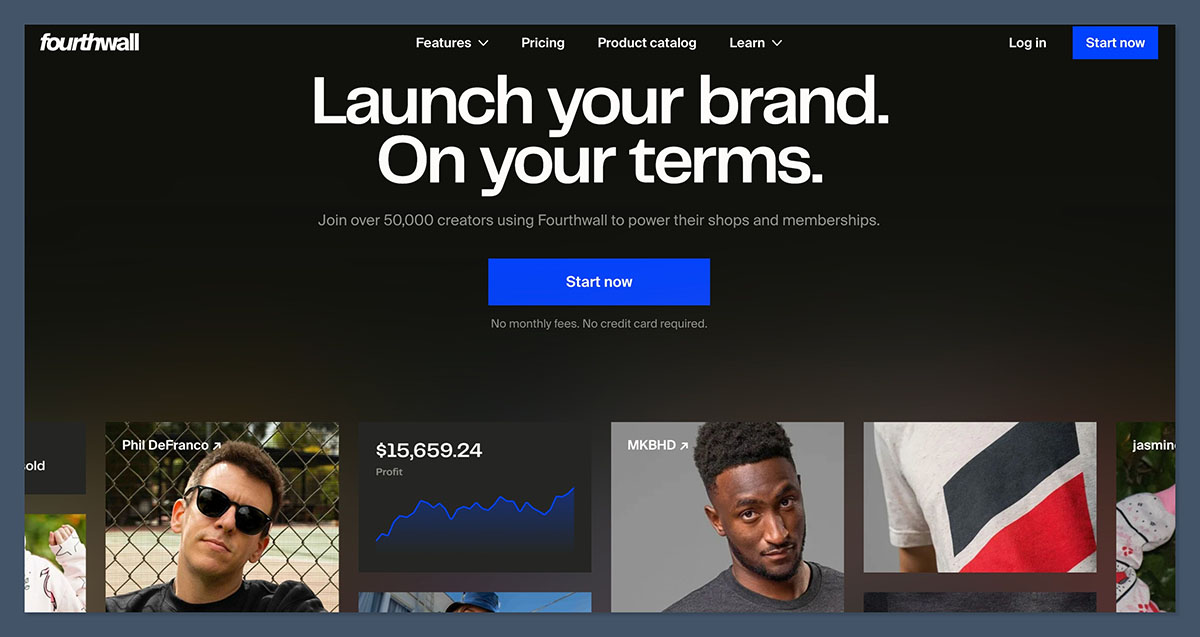
Fourthwall is easily one of my favorite platforms for creators these days, for one main reason, it takes a lot of the work out of monetizing your brand. You can launch a custom storefront, and sell premium POD products straight from Fourthwall’s catalog, alongside memberships, digital products, and other physical items too.
You don’t even have to handle taxes on your own, because Fourthwall acts as your Merchant of Record. Plus, they deal with customer support from the products sourced from their collection.
| Plan | Monthly Price | Transaction Fee | Features |
| Free | $0 | 5% on digital products | Full access to all features, POD merch, memberships, donations, and more |
| Pro | $19 per month | 0% fees on digital product | Advanced analytics, unlimited team members, improved customer support, and more online storage. |
Note, there will also be standard payment processing fees to consider.
Pros
- Built for creators, not generic ecommerce sellers
- Merch, digital products, memberships, and tips all live in one store
- No monthly fee to get started
- Built-in POD with premium quality products.
Cons
- Less flexible than Shopify for creators who want a huge app ecosystem
- Free plan still takes 5% on digital products and memberships
Verdict
Fourthwall is ideal if you want to sell more than merch without turning your store into a second job. It’s especially strong if your business mixes physical products, digital extras, memberships, and fan support, because that’s exactly what the platform is built to handle.
3. Spring – Best for Merch Creators with Social Audiences
Rating: 4.6
Starting price: Free
Print-on-demand support: Yes (Built-in)
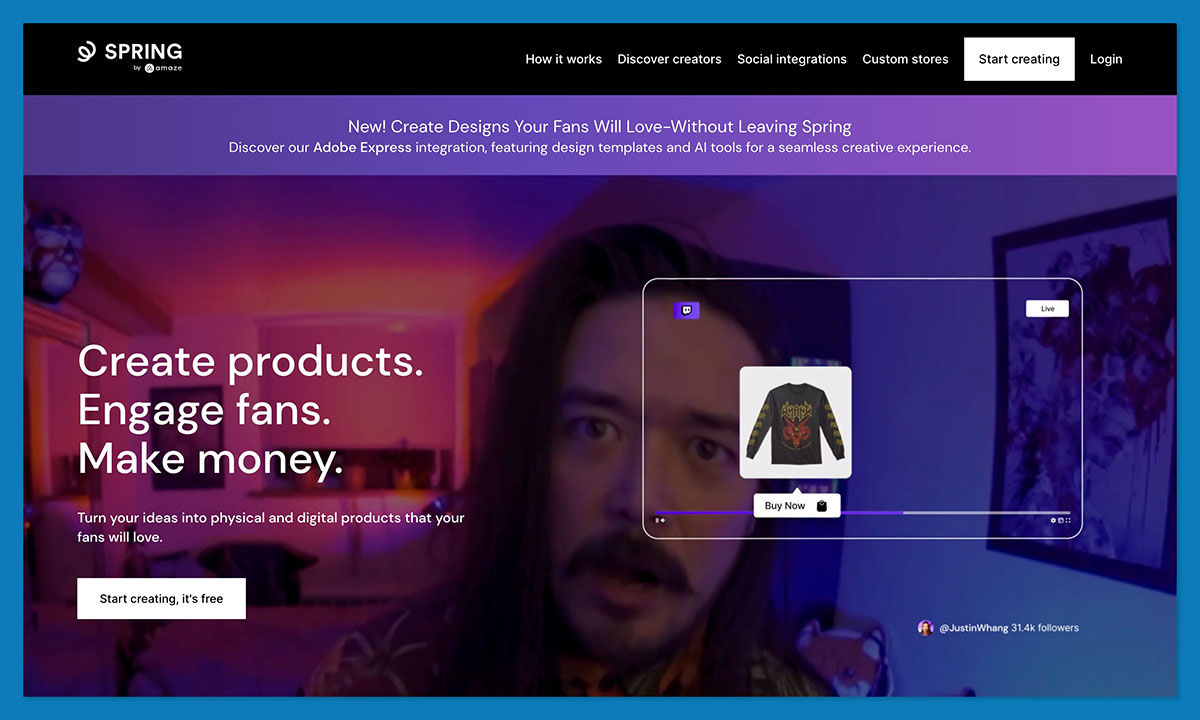
Spring is a creator-first platform designed for selling merch and digital content with zero upfront costs. It’s especially strong for creators who want to monetize through social platforms, with integrations for YouTube, TikTok, and Instagram.
Pricing Breakdown
| Plan | Monthly Price | Transaction Fee | Features |
|---|---|---|---|
| Free | $0 | Variable margin | Built-in POD, digital products, social integrations |
Spring makes money by taking a cut of each sale—no subscription required.
Key features:
- 50+ products including apparel, accessories, and home decor
- Integrations with YouTube, TikTok, Twitch, Instagram, Streamlabs, and Discord
- Campaign-based model built for quick drops, limited runs, and fundraisers
- Boosted Network listings on Amazon, eBay, Walmart, Etsy, and others (opt-out available)
I uploaded a design, picked a base tee, set a retail price, and had the product live inside a few hours. Compared to a Shopify plus Printify stack, Spring feels older. The design tools are clunkier and the admin has not had a meaningful refresh in years.
What we like about Spring:
- Zero upfront cost and no monthly subscription
- Hosted storefront included; you don’t need a separate Shopify or website
- Deep social integrations (Twitch Merch, Streamlabs, YouTube, Discord)
- Boosted Network expands reach to external marketplaces automatically
What we don’t like about Spring:
- Creator payout delay complaints are frequent (G2 reviews document balances stuck below the $25 threshold)
- Higher effective base costs than Printify or Printful
- Limited storefront customization and no direct ecommerce integrations (Shopify, WooCommerce)
- Color accuracy and print quality vary; sample before launching
Spring works if you want zero commitment and a storefront plus fulfillment in one tool. If you can stomach $5 to $29/month for a Shopify plus Printify stack, that combination gives you more control and better margins.
Verdict:
If you want a fast, no-risk way to sell merch and digital products directly through your social profiles, Spring is one of the easiest and most creator-friendly platforms available.
4. Payhip – Best for Digital, Coaching & Courses
Rating: 4.4
Starting price: Free
Print-on-demand support: Not built-in (manual workaround only)
Payhip is a flexible ecommerce platform designed for creators selling digital content, coaching services, or online courses. While it doesn’t offer native POD support, it’s powerful for selling content-based products.
Pricing Breakdown
| Plan | Monthly Price | Transaction Fee | Features |
| Free | $0 | 5% | Full access to features, EU VAT, digital delivery |
| Plus | $29 | 2% | Custom domain, email marketing, coupons, no feature limits |
| Pro | $99 | 0% | All features, priority support |
All plans include unlimited products and bandwidth.
Break-even on Plus is roughly $967/month in revenue. Break-even on Pro is roughly $3,500/month.
Key features:
- Sells digital downloads, courses, coaching, memberships, and physical products
- Embeddable checkout buttons for link-in-bio or your existing site
- Automatic EU and UK VAT collection and remittance
- Affiliate program, coupon codes, and pay-what-you-want pricing built in
- Every feature unlocked on every plan (no feature-gating)
I set up a test store with a PDF guide and a membership tier in under 30 minutes. The interface is clean, and the VAT handling is the closest any platform on this list comes to fully hands-off tax compliance for EU/UK sellers.
What we like about Payhip:
- Free plan has zero feature restrictions and no revenue cap
- Automatic EU/UK VAT collection removes the biggest pain point for international sellers
- Supports digital, physical, memberships, and courses in one dashboard
- Pricing is fully transparent; upgrade decisions are math, not feature gates
What we don’t like about Payhip:
- No API (limits advanced integrations)
- Not a true global Merchant of Record beyond EU/UK
- Storefront customization is simpler than Shopify or Sellfy
- Payment processor fees (Stripe/PayPal) still apply on top of Payhip’s transaction cut
Verdict:
If your business is based on digital products or services like coaching or online courses, Payhip is a very cost-effective and easy-to-use tool. Just don’t expect to be running a print-on-demand store here without some extra effort.
5. Gumroad – Best for Simple Digital Sales
Rating: 4.3
Starting price: Free
Print-on-demand support: No
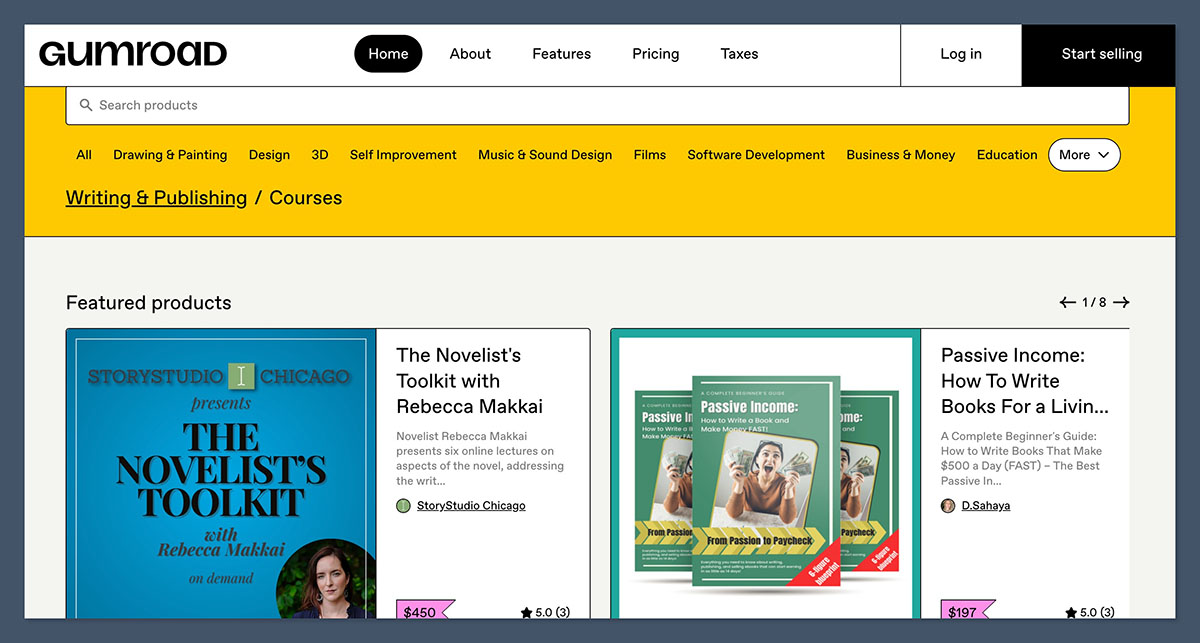
Gumroad has long been a go-to for creators looking to sell stuff like ebooks, music, presets, or other digital downloads. It’s clean, minimal and gets the job done – especially if you want to sell a lot of stuff fast with no fuss setup.
Pricing Breakdown
| Revenue Level | Fee Charged By Gumroad |
| $0–$1,000/month | 10% + Stripe/PayPal processing |
| $1,000–$10,000 | Sliding scale fee (down to 3%) |
| $10,000+ | ~3% + processing fees |
Key features:
- Sells digital downloads, courses, memberships, subscriptions, and license-keyed software
- Merchant of Record globally since January 2025; handles all sales tax, VAT, GST
- Built-in email marketing and audience tools
- Custom domain support on the free plan
- Marketplace discovery via Gumroad Discover (higher fee in exchange for traffic)
I listed a test PDF and a $29 membership in under 15 minutes. Checkout is clean. The fee math is where it stings: on $1,000/month in direct sales, you pay Gumroad roughly $100 plus processing. On $10,000/month, roughly $1,000. Every month.
What we like about Gumroad:
- Easiest setup on this list (minutes, not hours)
- True global Merchant of Record handles all tax compliance
- No monthly fee, so risk is zero until you make sales
- Supports recurring revenue and license-keyed products natively
What we don’t like about Gumroad:
- 10% + $0.50 fee has no volume discount and no cap
- 30% Discover marketplace fee is brutal if traffic skews that way
- Platform fee is kept on refunds (significant for high-ticket or high-refund products)
- Limited storefront customization compared to Shopify or Sellfy
Verdict:
Gumroad is a great choice for creators selling digital products or starting out with no upfront costs. It’s not designed for ecommerce power users but it shines in simplicity.
6. Stan Store – Best for Social Creators
Rating: 4.2
Starting price: $29 a month
Print-on-demand support: No
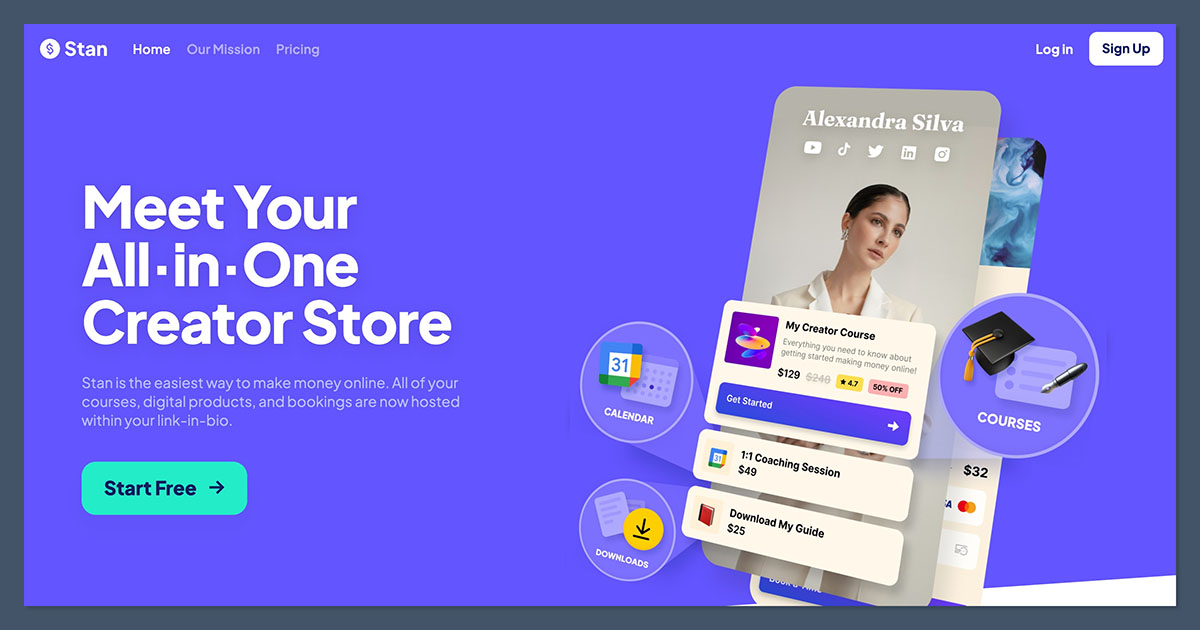
Stan Store is designed for social media creators who want to monetize their TikTok, YouTube or Instagram profiles. It combines link-in-bio functionality with tools to sell digital products and coaching offers.
Pricing Breakdown
| Plan | Monthly Price | Features |
| Creator | $29 | Sell digital products, downloads, appointments |
| Creator Pro | $99 | Includes upsells, advanced analytics, course features |
No transaction fees on either plan – all your earnings are yours.
Key features:
- Mobile-first storefront optimized for link-in-bio traffic
- Sell digital products, courses, memberships, and 1:1 coaching bookings
- AutoDM automation for Instagram
- Zero platform transaction fees (Stripe/PayPal processing applies)
- Integrations with ConvertKit, Mailchimp, and Zapier
I set up a Stan Store with a booking calendar and a $29 ebook in under 15 minutes. The mobile experience is the cleanest on this list, and that’s the whole point.
What we like about Stan Store:
- Cleanest mobile checkout of any creator platform tested
- Zero transaction fees on both plans
- Coaching bookings, courses, and digital products in one dashboard
- AutoDM is a genuinely useful Instagram funnel tool
What we don’t like about Stan Store:
- No free plan (you pay from day one after the 14-day trial)
- No custom domain support
- No SEO tooling; designed for social traffic only
- Creator Pro’s $99/month pricing is steep unless you’re using the marketing stack fully
Verdict:
Stan Store is the best option if your main audience is on social media and you’re selling digital products or services. But it’s not the right tool if you want to build a full-fledged ecommerce store selling physical goods.
7. Podia – Best for Online Courses & Coaching
Rating: 4.1
Starting price: $39 a month
Print-on-demand support: No
Podia is designed for educators, coaches and digital entrepreneurs. It offers a sleek user interface and full support for selling online courses, webinars and digital files – but no physical product support.
Pricing Breakdown
| Plan | Monthly Price | Features |
| Free | $0 | 8% fee per sale, 1 download, email capture |
| Mover | $39 | Unlimited products, no transaction fees, custom domain |
| Shaker | $89 | Affiliate marketing, webinars, advanced analytics |
All paid plans include unlimited email subscribers and hosting.
Key features:
- Build a website, sell courses, downloads, memberships, and coaching in one place
- Built-in email marketing (up to 100 subscribers free; paid add-on scales with your list)
- Community features included on both plans
- Affiliate program on Shaker
- Free migration assistance on Shaker annual
I launched a test course with video lessons, a downloadable workbook, and a paid community in about an hour. Podia’s simplicity is the pitch; it also means no quizzes, no assignments, and no drip content scheduling.
What we like about Podia:
- Genuine all-in-one for course creators (no Kajabi-level complexity)
- Built-in email marketing saves a separate Mailchimp or ConvertKit subscription
- 30-day free trial with no credit card required
- Digital downloads and courses live side by side in one dashboard
What we don’t like about Podia:
- No free plan anymore; cheapest option is $33/month annual
- Course features are intentionally simple (no quizzes, no assignments, no drip scheduling)
- 5% transaction fee on Mover plan stacks on top of Stripe/PayPal fees
- Video hosting limits tightened in late 2024
Verdict:
If your creator business is focused on teaching, webinars or coaching, Podia offers a clean and powerful back end to help you deliver and monetize your content without any plugins.
8. Big Cartel – Best for Indie Artists & Merch
Rating: 4.0
Starting price: Free
Print-on-demand support: Yes (via Printful, manual setup required)
Big Cartel is perfect for artists and small shop owners who want to run minimalist stores and sell creative products or print-on-demand merch. It’s not fancy, but it’s functional and free for up to five products.
Pricing Breakdown
| Plan | Monthly Price | Products Allowed | Features |
| Free | $0 | Up to 5 | Basic themes, custom domain, order tracking |
| Platinum | $9.99 | Up to 50 | More design features, custom code |
| Diamond | $19.99 | Up to 500 | Priority support, full customizations |
Big Cartel has all the features you need to sell your art and merch online. No transaction fees – just straight up credit card processing via Stripe or PayPal.
Key features:
- No transaction fees on any plan (only Stripe/PayPal processor fees)
- Custom domain support on Platinum and Diamond
- POD integration via Printful and Printify
- Shippo integration for shipping labels on paid plans
- Clean, artist-focused themes and checkout
I set up a test store with three products in under 15 minutes. The design is deliberately minimal, which is exactly why artists keep using it.
What we like about Big Cartel:
- Genuinely free plan for up to 5 products, with custom domain on paid tiers
- Zero platform transaction fees
- Simple, artist-focused themes that look clean out of the box
- No scaling surprises: flat monthly pricing regardless of sales volume
What we don’t like about Big Cartel:
- No abandoned cart recovery on lower tiers (Diamond only)
- Hard 500-product ceiling on the top plan (forces migration if you grow)
- No built-in email marketing, blog, or advanced SEO
- Limited app ecosystem vs. Shopify
If you’re a creator who just wants something simple to sell merch or handmade items, Big Cartel is worth a look. It’s perfect for small product lines and easy-peasy setups.
The Ultimate Verdict: Which one is for You?
So. We’ve got a quick rundown on which platform will suit your business best, based on what you’re selling and how much tech you want to deal with.
| Creator Type | Best Platform |
|---|---|
| Selling print-on-demand merch | Shopify or Sellfy |
| Selling merch and memberships | Fourthwall |
| Selling coaching and digital services | Payhip or Podia |
| Monetizing Instagram/TikTok audience | Stan Store |
| Selling ebooks or downloads | Gumroad |
| Artist with a small catalog | Big Cartel |
| Launching a full-scale brand | Shopify |
The platform you pick all depends on what you’re selling and how hands-on you’re willing to be with the tech side of things.
Try one that fits your goals for now, give it a whirl, and make sure it lets you focus on what really matters – creating, not fighting with the computer.