I’ve been in marketing long enough to remember when working with influencers was just a matter of: “send them a sample and pray for a tag.” No dashboards. No metrics. Just hope.
Today, influencer marketing still works (incredibly well), but for different reasons. The influencers got smarter. So did the audiences. They can smell a fake collab a mile away. What still cuts through is authenticity – that sense of “hey, I actually use this thing.”
The numbers prove it: 86% of shoppers admit they’ve bought something because an influencer mentioned it. Nearly half do it monthly. Think about that. Every other person scrolling your feed is buying based on trust, not ads.
The problem is, finding the right influencers is chaos. I’ve run campaigns that looked perfect on paper but tanked in real life. I’ve also seen tiny creators outsell names ten times their size. The difference was data.
That’s why influencer analytics tools matter. They show who’s genuine, who converts, and who just looks good in a feed. Once you use one, you’ll never go back.
This guide covers the tools that actually deliver.
Top Influencer Analytics Tools at a Glance
| Tool | Best For | Entry Price / Model | Free Trial? |
| Influencer Analytics (Semrush app) | Data-driven discovery & competitor insights | ~$249 / month* | Yes |
| Sprout Social | Full social + influencer workflow | From ~$199 / mo (influencer add-on) | Yes / demo |
| Upfluence | Ecommerce integration & attribution | Custom / tiered | Yes |
| Emplifi | Unified social + influencer cockpit | Custom | Yes / demo |
| GRIN | Scale & automation | From ~$999+ / mo (enterprise style) | Limited / demo |
| HypeAuditor | Audience authenticity & fraud detection | Custom / quote | Yes |
| Aspire | Marketplace + campaign orchestration | $1,800+ / mo (enterprise) | Demo |
| MightyScout | Affordable tracking & analytics | $99 – $749 / mo | Yes |
The Best Influencer Analytics Tools: Deep Dive
Before I dive in, a quick note on how I’ve reviewed these tools: I’m not just scanning marketing pages. I’m poking through their feature sets, pricing, and hands-on workflows to see how they perform in practice.
I’ll call out when things felt smooth, when I hit friction, and what type of user (solo founder, small growth team, enterprise) I’d pick it for.
1. Influencer Analytics: Best for data-driven influencer discovery and competitor insights
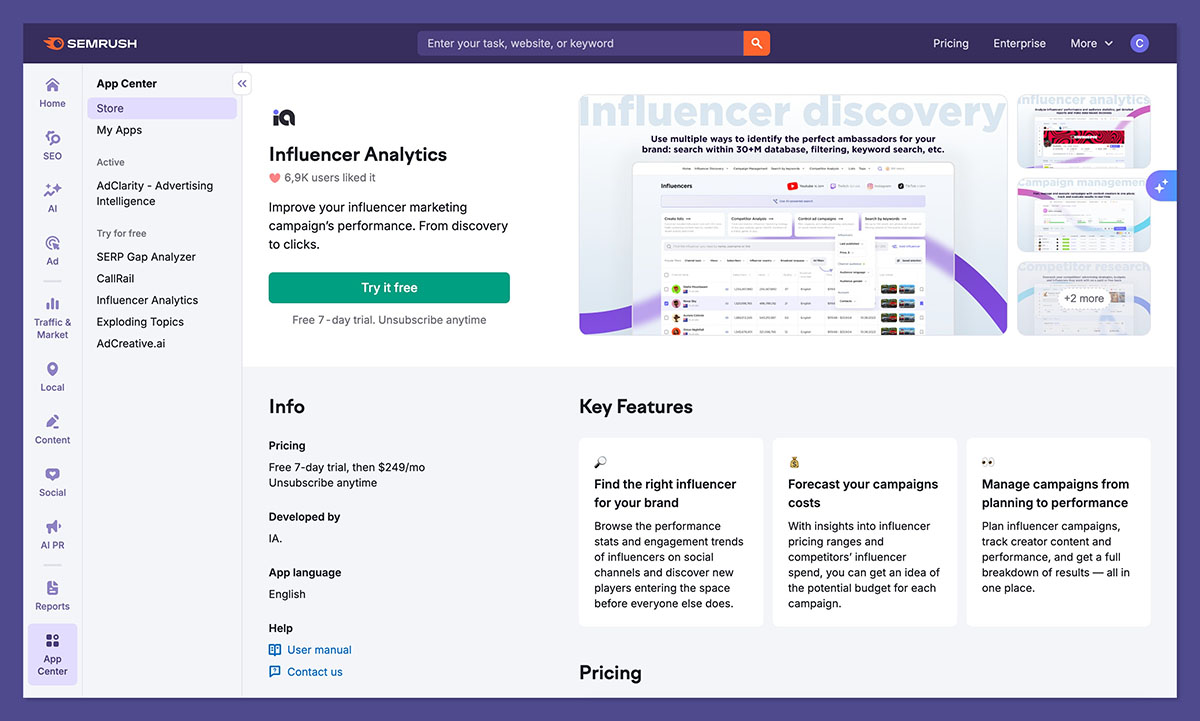
Pricing: From $249/month (7-day free trial)
The version of Influencer Analytics I USE lives inside the Semrush App Center, and if you already use Semrush, it just makes sense. It’s not one of those fluffy influencer marketplaces. It’s built for marketers who care about data.
When I tried it, the keyword search was what hooked me. I typed in a few product terms and instantly found creators already talking about my niche.
Real people, not the usual “influencer-for-hire” crowd. The filters go deep: engagement rate, audience size, location, the works, and the results actually feel relevant.
It’s pricier than some, sure, but you get clean data and proper tracking. I could see who moved the needle, not just who looked good on paper. That alone saves time and wasted spend.
Key features worth noting:
- Keyword-based influencer discovery
- Detailed audience and engagement filters
- Competitor tracking and overlap reports
- Campaign performance tracking
Pros:
- Accurate, actionable data
- Strong search and filtering
- Smooth fit for SEMrush users
Cons:
- Cost adds up
- Interface takes a little getting used to
2. Sprout Social: Best for integrated social + influencer workflows
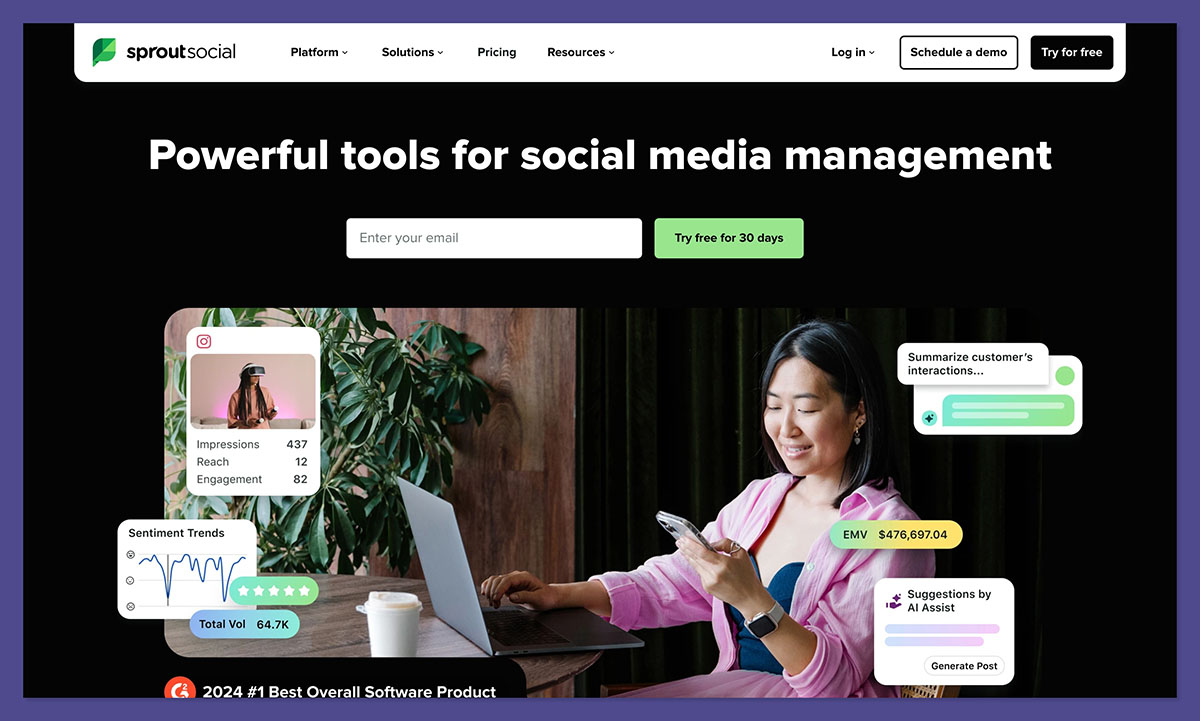
Pricing: Starting at $199 per month.
Sprout Social feels like the “one tool to run it all” route – not just influencer metrics tacked onto a system, but fully woven in. When I poked around, I saw that you can run an entire influencer campaign: outreach, approvals, tracking, inside the platform. That reduces context-switching.
They recently relaunched with a cleaner UI and added AI-driven discovery and natural language filters. One thing I appreciated: you can set brand safety rules (e.g. exclude influencers posting about gambling or alcohol) by workspace.
From my tests, it’s solid for teams already managing social posts; combining that with influencer is a believable time-saver.
That said, some users report that the influencer communication workflows are not fully fleshed, email chaining sometimes happens outside the platform.
Key features worth noting:
- AI-powered influencer discovery & natural language filters
- Brand safety rules / workspace configuration
- Central workflow: campaign briefs, approvals, tracking
- Integrated ROI and paid+organic campaign reporting
Pros:
- Unified social + influencer tool
- Clean data visualization and automation
- Strong brand safety controls
Cons:
- Email/communication tools feel a bit basic
- Pricing opaque; not ideal for solo founders
- Discovery depth might lag pure influencer platforms
3. Upfluence: Best for ecommerce attribution and affiliate + influencer synergy
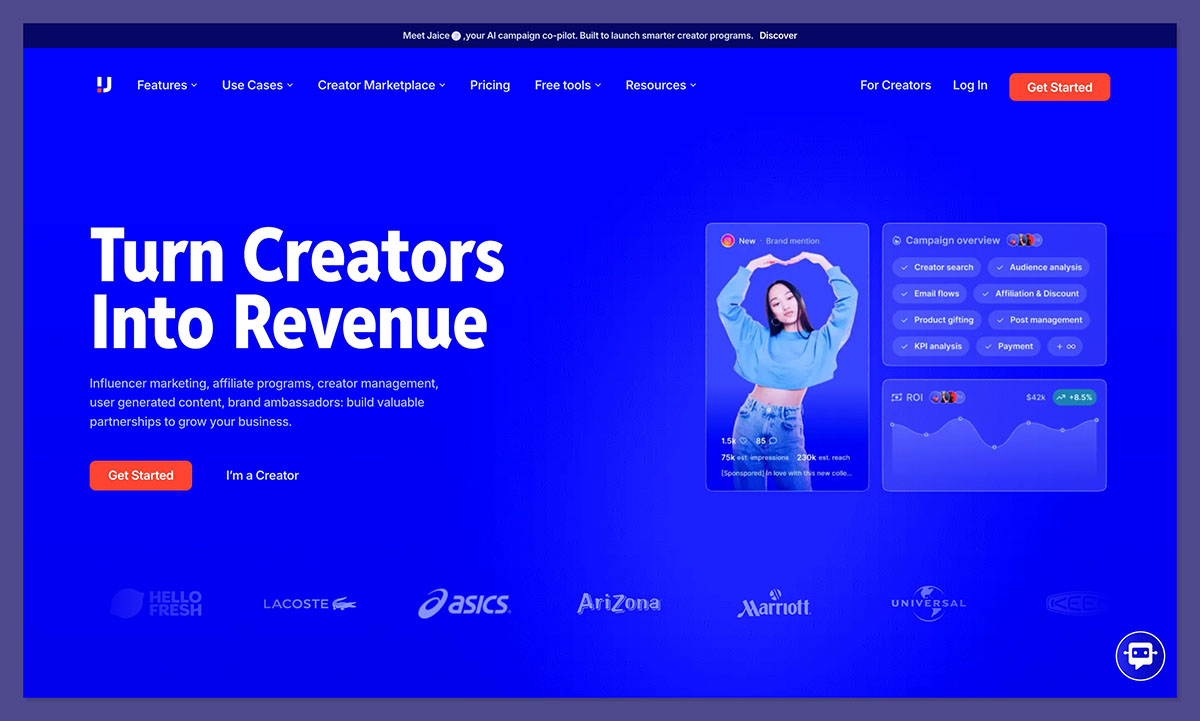
Pricing: Custom / module-based (Growth, Scale, Enterprise) with 12-month minimum contracts
Upfluence shines when you want to link creator activity to actual commerce outcomes. When I experimented with its promo code and link attribution, I could see which creators drove sales, not just engagement.
It also has nice modules: gifting flows, auto-payments (PayPal), influencer recruitment pages, and CRM-style relationship tracking. I tested creating a landing page to collect influencer pitches, and it worked cleanly.
The tradeoff: the pricing and contract model makes it less friendly for small brands. The smallest plans can still stretch budgets, and you’ll want to be confident before signing a 12-month term.
Key features worth noting:
- Sales attribution / ROI dashboards
- Auto-creation of promo codes & affiliate links
- Gifting and product selection flows
- Bulk payments & finance tracking
Pros:
- Strong commerce focus (attribution counts)
- Deep integration with Shopify, WooCommerce, Amazon
- Good CRM & campaign workflow support
Cons:
- Contract commitment (12 months)
- Cost may be high for early-stage brands
- Some features gated by modules
4. Emplifi: best for unified social + influencer operations
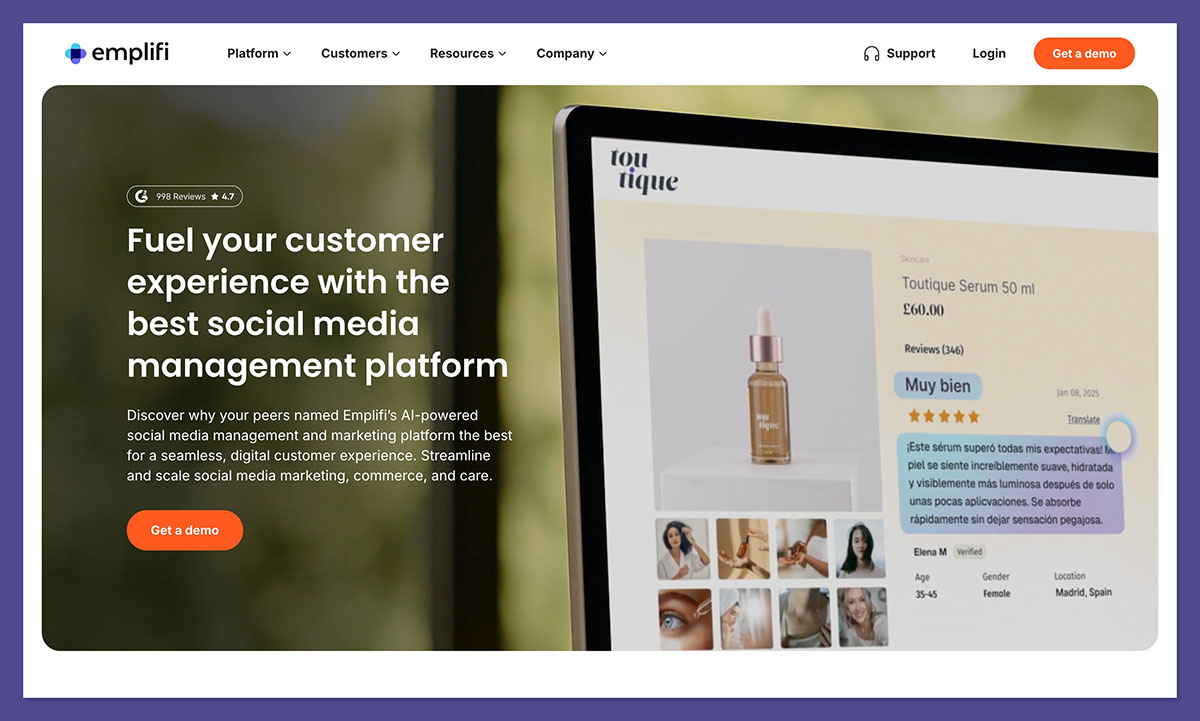
Pricing: Custom / enterprise (demo required)
Emplifi isn’t “just another influencer tool” – it builds from their social analytics, listening, and content stack into influencer management. Their claim: access to 30 million+ influencer profiles with filters, communications, campaign tracking, and gifting all in one place.
What struck me most was their shared insights feature – you can request metrics directly from an influencer’s account (for public Instagram) to help vet them without back-and-forth screenshot chasing. Their ability to embed influencer content into your commerce, emails, or product pages (“Amplify”) is a nice bonus.
Still, for smaller brands its complexity can feel like overkill. The UIs assume you have a team. Also, because many features are modular, you’ll want to test exactly what your plan includes.
Key features worth noting:
- Massive influencer database with advanced filters
- Shared insights (private data requests)
- Campaign, briefing, gifting, and communication workflow
- Embedded influencer content / “amplify” functionality
Pros:
- All-in-one social + influencer ecosystem
- Deep filtering and data access
- Less reliance on off-platform coordination
Cons:
- Not very startup-friendly; cost & scale assumptions
- Some features gated by add-ons or modules
5. GRIN: Best for scaling full influencer / creator programs
Pricing: Custom enterprise / quote basis
GRIN positions itself as a full creator marketing suite – not just analytics. From discovery to payments to content library, it’s built to manage every stage. I tried browsing their reporting demo: the dashboard gives real-time campaign metrics, ROI by creator, and comparisons across campaigns without needing spreadsheets.
I also liked how GRIN handles product seeding and ecommerce integrations. You can sync your store, manage inventory for influencer shipments, and attribute performance more cleanly. Another feature: it automatically collects influencer content into a library organized by creator, date, hashtag, etc. That makes repurposing content much easier.
However, as with many enterprise tools, the cost is high, and you’ll want a clear plan before signing. Some teams mention friction around onboarding and managing smaller partnerships.
Key features worth noting:
- End-to-end influencer campaign management
- Reporting + ROI dashboards by creator & campaign
- Product seeding / inventory / ecommerce integration
- Content library and auto-archival of creator assets
Pros:
- Truly full-featured influencer stack
- Strong ecommerce and product-seeding support
- Deep analytics and reporting
Cons:
- Expensive; often requires enterprise investment
- Implementation/learning curve for smaller teams
- Some pushback in user forums about flexibility for micro campaigns
6. HypeAuditor: Best for deep audience vetting and fraud detection
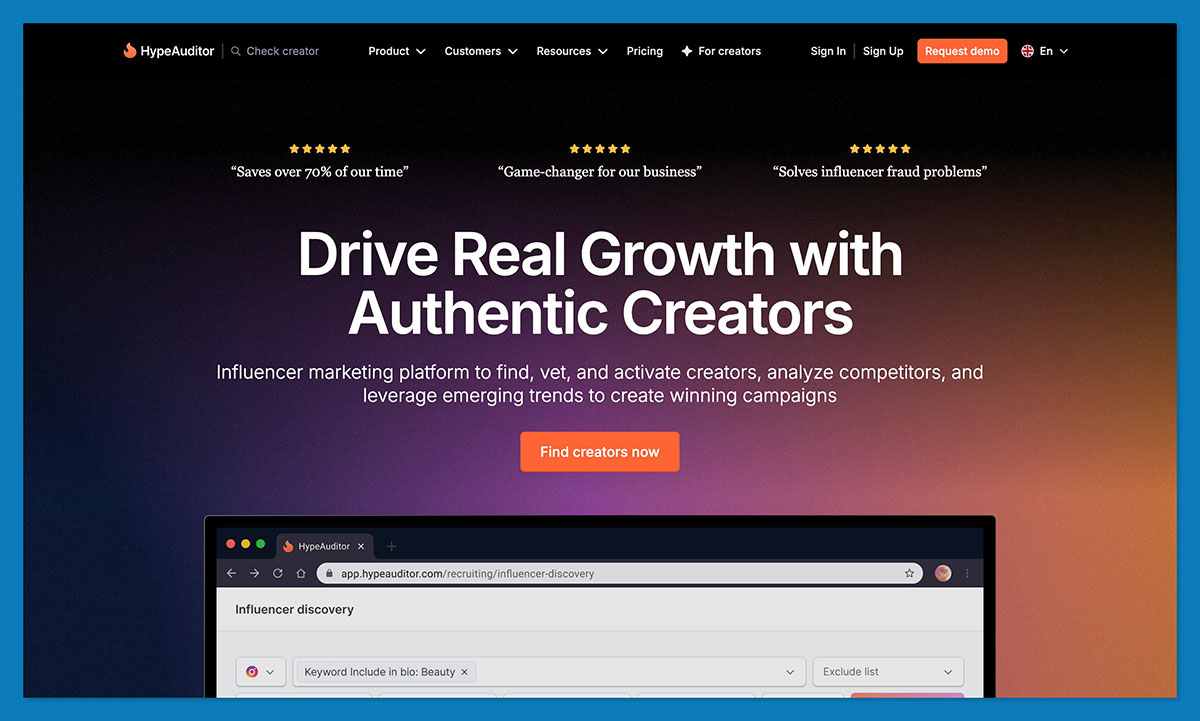
Pricing: Custom / quote basis (not publicly listed)
What drew me to HypeAuditor is its reputation for being one of the most rigorous tools for spotting inauthentic influence. In practice, when I ran audits on creators I already knew, it flagged odd follower spikes, suspicious engagement ratios, and potential bot behavior that slipped past lighter tools. That alone had me lean in harder.
Its influencer discovery is solid too – you can filter by niche, geography, audience quality scores (AQS), and more, across a database that clams over 200 million profiles. The audience breakdowns go into age, location, language, and even interests and “audience quality.”
The Chrome extension is a handy touch – I could see profile metrics without leaving Instagram or TikTok.
It’s not my go-to for full campaign orchestration (there are gaps in outreach or payment workflow), but as a vetting tool, it’s gold.
Key features worth noting:
- Audience Quality Score (AQS) and fraud detection
- Deep demographic & psychographic breakdowns
- Competitor / brand benchmarking
- Chrome extension for on-the-fly profile analysis
Pros:
- Very strong in filtering out low-quality influencers
- Data depth and authenticity metrics
- Broad coverage across platforms
Cons:
- Not a full influencer campaign tool (less workflow support)
- Pricing opaque, can get expensive
- Steeper learning curve for casual users
7. Aspire: Best for managing scalable influencer + affiliate programs
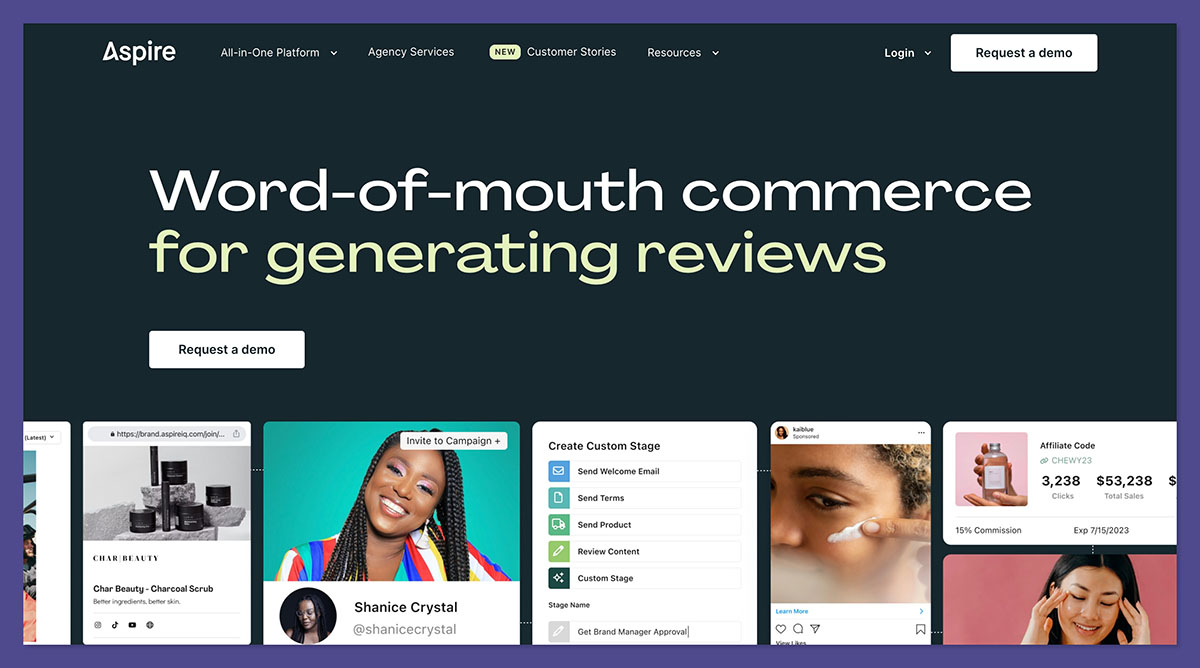
Pricing: From ~$2,499/month (custom quote)
Aspire feels like the “enterprise-ready” solution for influencer programs that want structure, scaling, and governance. When I poked around their public plans and features, what stuck with me was how much they push workflow: inbound/outbound discovery, campaign templates, contract flows, and content syndication.
One feature I liked: you can turn influencer content into paid ads (so the content you pay for becomes part of your paid strategy). Also, their promise to automate “the paperwork that comes with it all” resonated – you don’t want legal/contract chores slowing you down.
That said: the price and commitment are serious. It’s not friendly for small budgets. I saw reports that many brands pay tens of thousands annually.
Key features worth noting:
- Workflow automation (briefing, contracts, content approvals)
- Inbound + outbound influencer discovery
- Content-to-ad repurposing
- Attribution & ROI tracking
Pros:
- Comprehensive tool for scaling influencer programs
- Strong in operational workflows
- Good fit for brands that want control and governance
Cons:
- High cost and long-term commitment
- Overkill if your program is still small
- Some features may be locked behind premium tiers
8. MightyScout: Best for affordable tracking and hands-on campaign management
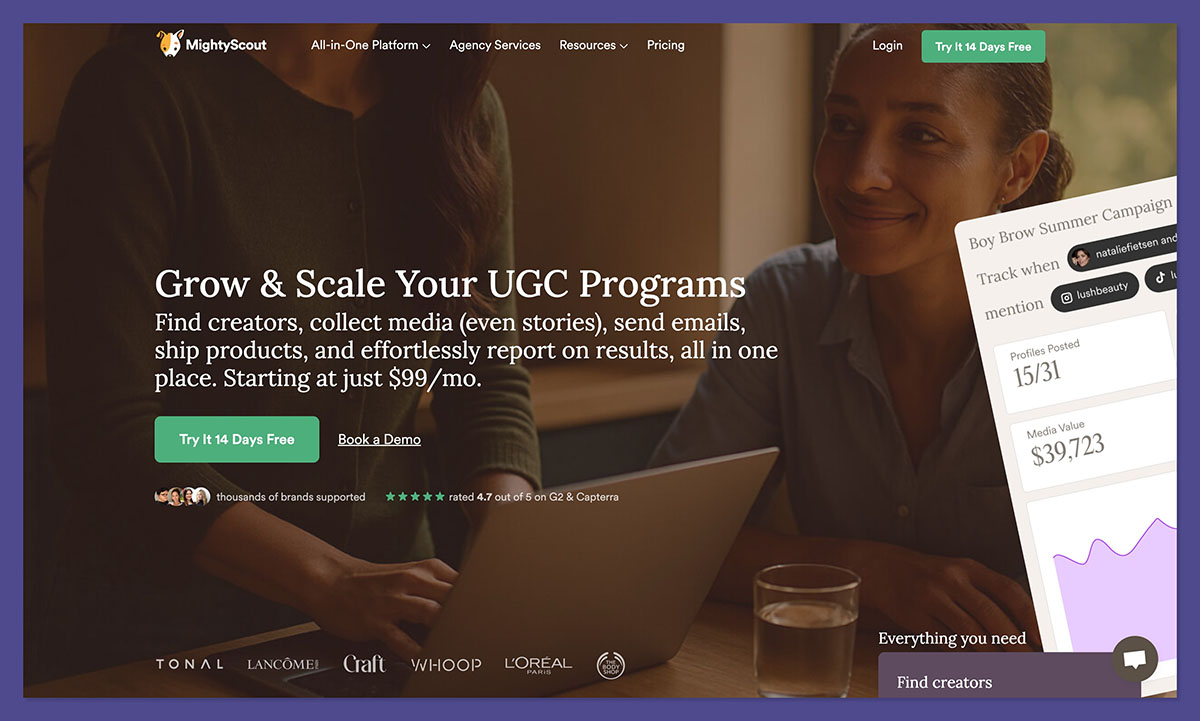
Pricing: Starts at $99/month (monthly plans, no long-term contract)
I ran a small test using MightyScout for a micro-influencer campaign. What caught me immediately was its strength in automating what normally kills you in influencer work: story capture, content archiving, and link attribution. No more chasing influencers for screenshots or scrambling to screenshot stories before they vanish.
Connecting to Shopify / WooCommerce gave me visibility into which creators drove actual orders, not just engagements. The UI is lean and functional, almost scrappy in its simplicity, but delivers exactly the features you need without the mess.
The main catch: it’s not as deep in discovery or advanced vetting compared to tools built for enterprise. But for what it does: tracking + attribution + content capture – it overdelivers given the price.
Key features worth noting:
- Automatic story & post capture (even before expiration)
- Influencer tracking: reach, impressions, engagement
- Shopify / WooCommerce integration for sales attribution
- Gifting & product shipping workflows
- Content management / usage rights & media library
Pros:
- Very affordable relative to full-suite tools
- Excellent at automating content capture & eliminating manual work
- Real sales attribution when integrated with ecommerce
- Flexible month-to-month pricing
Cons:
- Discovery and vetting depth is modest
- Reporting and analytics are functional but not ultra-detailed
- Not ideal as your only tool if you’re scaling into 100s of influencers
What to Look For in an Influencer Analytics Tool
I’ve used a lot of these tools over the years – some brilliant, some useless, and a few that just looked good in a pitch deck. The right one depends on how you run your campaigns, but there are a few things I always look for.
- Influencer discovery: A tool lives or dies on its search filters. I want to be able to type a niche keyword, set a few audience filters, and find people who actually post about what I sell. Not just anyone with a ring light and a discount code. Bonus if it shows smaller, fast-growing creators before the crowd catches on.
- Vetting and brand safety: Fake followers are still a problem. A good platform spots them fast – sudden spikes, lopsided engagement, or bot-heavy comment sections. If a tool can pull verified insights straight from the creator’s account, even better. Saves a lot of awkward DMs asking for screenshots.
- Campaign tracking: I’ve done the spreadsheet route. Never again. You want automatic tracking for reach, clicks, conversions and more in one dashboard. Historical data helps too; seeing how a creator’s numbers trend over time tells you more than a single campaign report.
- Competitor insight: The smartest tools don’t just show your results. They let you see what’s working for other brands in your space. Sometimes that’s how you find the right creators – by noticing who’s quietly delivering wins for your rivals.
- ROI and integrations: If you can’t link campaign performance back to sales, you’re guessing. I need tools that connect to Shopify or Google Analytics so I can see revenue, not just likes. Once you’ve had that clarity, it’s hard to go back.
- Pricing and scale: This one sounds dull but matters. Some tools hide the real costs – extra users, feature gates, per-campaign limits. I like platforms that grow with me, not ones that make me start over when I outgrow a tier.
The point isn’t to find a “perfect” tool. It’s to find one that fits how you actually work: something that saves you time, cuts the noise, and gives you answers you can act on right away.
Choosing an Influencer Analytics Platform
I’ve tested more influencer tools than I can count. Some were game-changers, others were all promise and no follow-through.
What I’ve learned is that it’s not about finding the most expensive or the flashiest option – it’s about finding the one that actually fits how you run your business.
If you’re serious about data and want real clarity, Influencer Analytics (the SEMrush app) is the one I’d start with. It gives you the precision most tools only pretend to have – a proper research engine for influencer marketing.
If you want everything under one roof, scheduling, reporting, influencer management, Sprout Social is hard to beat. It’s made for teams that want clean workflows and integrated reporting.
Running a smaller brand or testing the waters? MightyScout will save you a ton of time without crushing your budget. It’s simple, fast, and gets the job done.
At the end of the day, it comes down to what kind of marketer you are. If you like tinkering, testing, and tracking every dollar, go for the data-heavy tools. If you’d rather move fast and see what works, start lean and upgrade later.
Influencer marketing isn’t a guessing game anymore. With the right analytics setup, you don’t have to cross your fingers and hope, you can see what’s working, what’s not, and double down with confidence. That’s the difference between running campaigns and running a business.