Society6 gives artists a hands-off way to sell prints, home decor, and accessories. You upload your work, and the platform handles everything else: printing, shipping, customer support. It sounds simple, and for years, it was.
But Society6 has changed. In early 2025, the platform moved from an open marketplace to a curated one, meaning new artists need to apply and be approved before they can sell. Pricing was standardized across the board, removing the ability to set your own markups.
For artists who want more control, better margins, or simply a way in without an approval process, it might be time to explore other options.
We looked at the most relevant Society6 alternatives and narrowed the list to 9 platforms. Some are similar marketplaces. Others are POD backends that let you run your own store. A few sit somewhere in between. Here are the best options, depending on what you need.
Why Not Society6?
Society6 still works well for a specific type of artist: someone who wants zero involvement with logistics and is fine with fixed royalties on a curated platform. But the model has some clear drawbacks that push artists to look elsewhere:
- No pricing control
Society6 sets product prices. You cannot adjust markups or set your own margins, which limits earning potential compared to platforms where artists control the final price. - Curated entry since 2025
The open-upload model is gone. Artists now have to be accepted, which adds a gatekeeping step that didn’t exist before. If you’re just starting out, this could be a blocker. - No brand ownership
Your work lives on Society6’s domain, in Society6’s layout, under Society6’s branding. You don’t own the customer relationship, and there’s no way to build a standalone identity through the platform. - Limited audience visibility
Society6 doesn’t share much about how its algorithm surfaces designs. Discoverability depends on the platform’s internal curation and search, which artists can’t directly influence. - One-size-fits-all commission
All accepted artists now operate under the same commission structure. There are no paid tiers or premium options to unlock better terms.
If any of these limitations matter for your goals, the alternatives below offer different tradeoffs worth considering.
9 Best Alternatives to Society6
The best Society6 alternative depends on what’s missing for you. Some artists want to stay in a marketplace. Others want to own their store and just outsource printing. Here are 9 platforms that do things differently.
| Platform | Type | Best For |
|---|---|---|
| Printful | POD backend | Quality-focused artists ready to run their own store |
| Redbubble | POD marketplace | Artists who want a similar marketplace with pricing control |
| Threadless | Marketplace + artist shops | Artists who want both a marketplace and a branded storefront |
| Printify | POD backend | Price-sensitive artists who want supplier flexibility |
| Fine Art America | Art marketplace + POD | Artists selling wall art and photography with custom pricing |
| INPRNT | Curated print marketplace | Artists focused on premium prints and higher price points |
| Fourthwall | Creator storefront + POD | Creators who want merch, memberships, and community in one place |
| Big Cartel | Lightweight storefront | Artists who want a simple branded store paired with a POD service |
| Saatchi Art | Fine art marketplace | Artists selling originals and limited editions to collectors |
1. Best for Brand Ownership and Print Quality: Printful
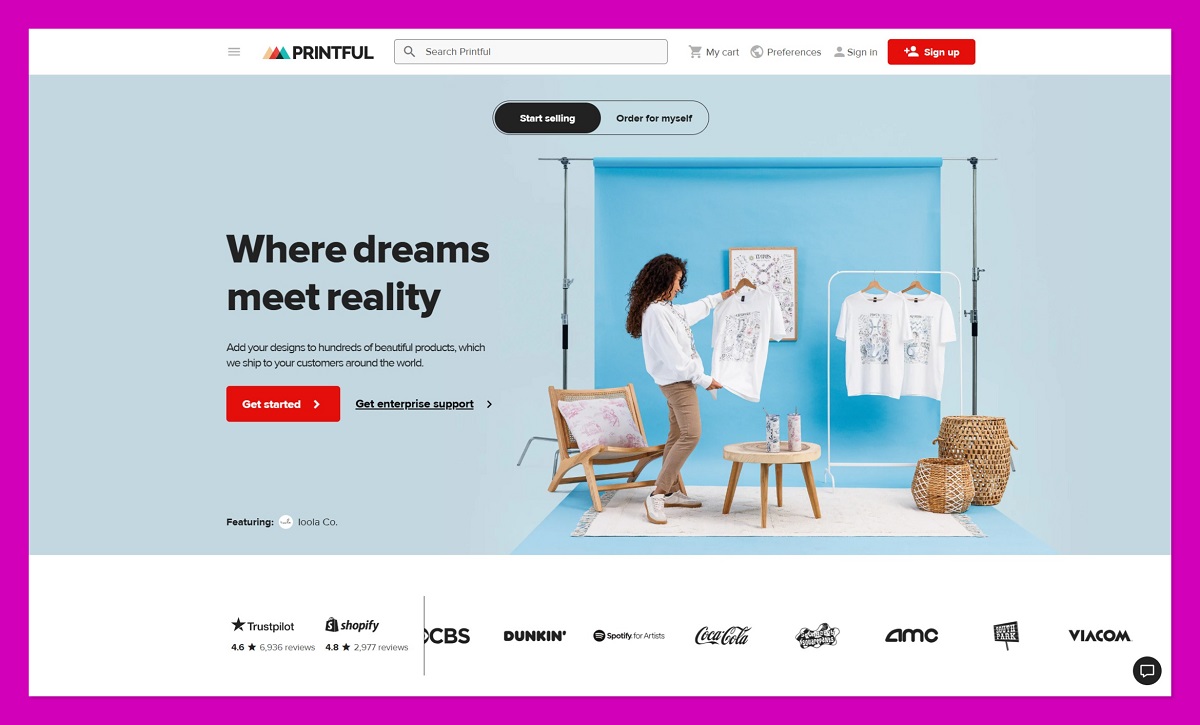
Printful is a print-on-demand backend, not a marketplace. That’s an important distinction. Instead of uploading designs to someone else’s platform and hoping for traffic, you connect Printful to your own store on Shopify, Etsy, WooCommerce, or another ecommerce platform. When a customer places an order, Printful handles the printing, packing, and shipping automatically.
This makes Printful the opposite of Society6 in terms of control. You set the prices. You own the branding. You keep the customer data. And because Printful charges a flat base cost per product rather than taking a revenue share, your margins scale with your pricing decisions rather than being locked into a fixed commission.
Printful is the strongest option for artists who are ready to trade built-in marketplace traffic for higher margins and long-term brand equity.
The product catalog covers canvas prints, posters, framed prints, apparel, home decor, phone cases, and more. Print quality is generally well-regarded, and Printful operates fulfillment centers across the US, Europe, and other regions, which helps with shipping times.
The tradeoff is clear: there’s no built-in audience. You need to bring your own traffic through social media, SEO, email marketing, or paid ads. If you’re comfortable with that, Printful gives you the most room to build a real brand around your art.
What we like about Printful
- Full control over pricing, branding, and customer relationships
- Wide product catalog including wall art, apparel, and home decor
- Integrates with Shopify, Etsy, WooCommerce, and other platforms
- Global fulfillment centers for faster shipping
What we don’t like about Printful
- No built-in marketplace traffic
- Requires running and marketing your own store
- Base product costs can be higher than some POD competitors
Printful demands more effort upfront than Society6, but the payoff is a business you actually own. For artists who are serious about building a brand rather than just listing designs, it’s the strongest foundation on this list.
2. Closest Marketplace Experience: Redbubble
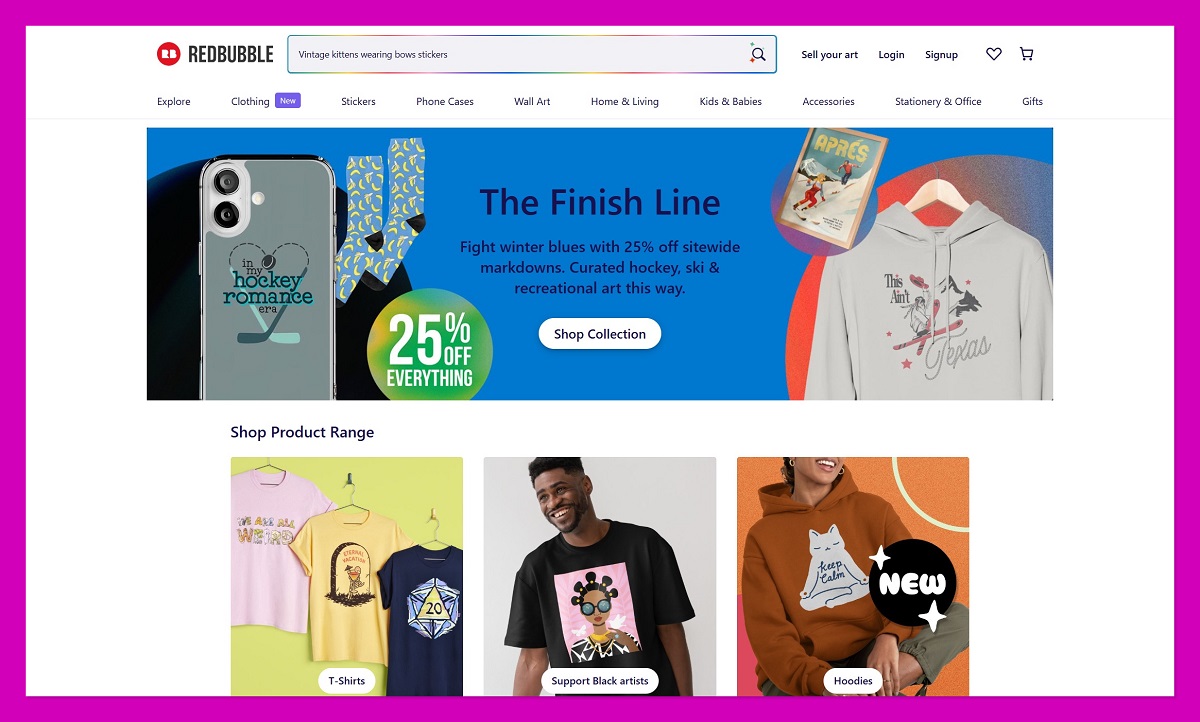
If you want something that works like Society6 but with more flexibility on pricing, Redbubble is the most direct substitute. It’s a large global POD marketplace covering stickers, apparel, wall art, home decor, tech accessories, and stationery. You upload a design once and apply it across dozens of product types.
Like Society6, Redbubble handles production, shipping, and customer service. The operational model is the same passive, hands-off approach. The key difference is that artists can set their own markup on top of Redbubble’s base prices, which means your earnings per sale depend on your pricing decisions rather than a fixed royalty rate.
Redbubble offers the closest experience to Society6, but with control over your markup and a broader product range.
That said, Redbubble’s fee structure has grown more complex over time. There are platform fees that vary by seller tier and sales volume, and “excess markup” fees kick in when royalties go above certain thresholds. The marketplace is also massive, which means more competition for visibility. Standing out requires solid tagging, niche targeting, and often some off-platform marketing.
What we like about Redbubble
- Large global audience with millions of active buyers
- Artists set their own markups above base prices
- Massive product catalog across many categories
- Fully managed printing, shipping, and support
What we don’t like about Redbubble
- High competition makes discoverability difficult
- Complex fee structure with tiered platform fees
- Excess markup fees can cut into higher-margin pricing
Redbubble is the easiest transition from Society6. You get the same passive model with a bit more control over what you earn. Just go in with realistic expectations about standing out in a crowded marketplace.
3. Best Hybrid of Marketplace and Branded Store: Threadless
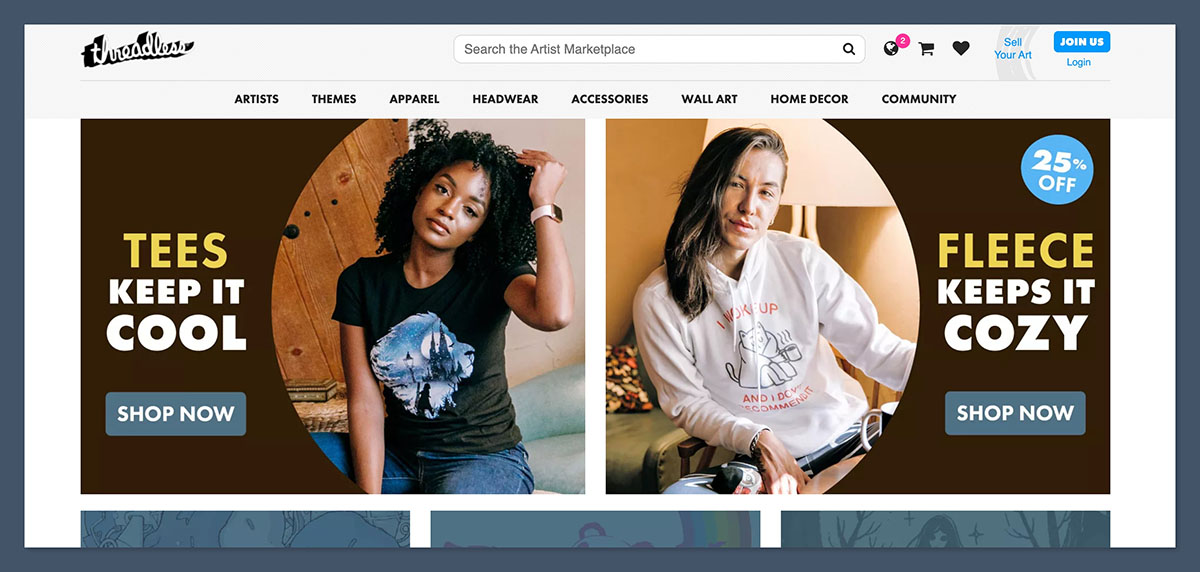
Threadless started as a T-shirt marketplace and evolved into something more interesting for artists. It now offers a dual model: you can sell through the central Threadless marketplace, and you can also set up your own customizable “Artist Shop” with its own URL and branding.
This hybrid approach sits between Society6’s centralized marketplace and running a fully independent ecommerce site. You get some marketplace exposure from Threadless traffic, but you also have a semi-branded storefront that feels more like your own. The product range has expanded beyond tees to include wall art, accessories, and home goods.
Production, shipping, and customer support are still handled by Threadless, so the operational model stays low-touch. For artists who don’t want to manage a full Shopify store but feel limited by a pure marketplace, Threadless offers a middle ground that’s hard to find elsewhere in the POD space.
What we like about Threadless
- Customizable Artist Shops with more branding control
- Marketplace traffic plus your own storefront
- Fully managed production and shipping
- Broader product range than the original T-shirt focus
What we don’t like about Threadless
- Smaller audience than Redbubble or Society6
- Artist Shop customization has limits
- Product catalog still narrower than larger POD platforms
Threadless fills a gap that most POD platforms ignore. It’s the option for artists who want some brand identity without taking on the full responsibility of running an independent store.
4. Best for Supplier Flexibility and Lower Costs: Printify
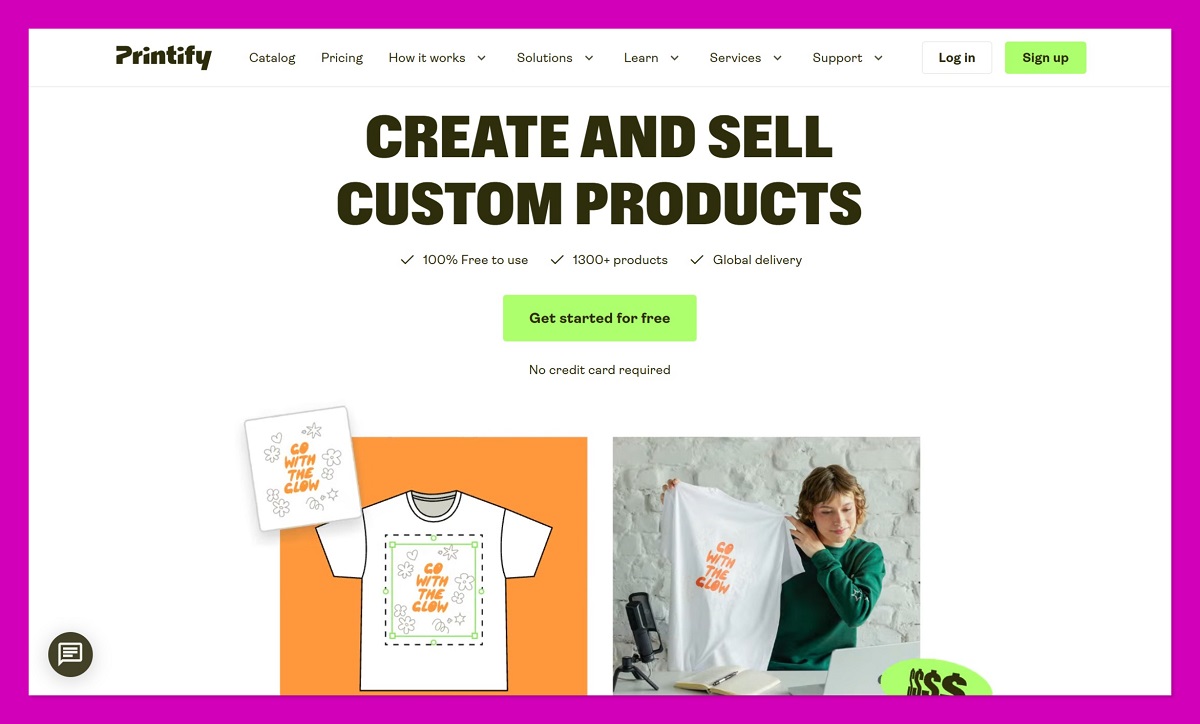
Printify works similarly to Printful as a POD backend, but with a different approach to fulfillment. Instead of running its own print facilities, Printify acts as an aggregator that connects you to a network of global print partners. You choose your supplier based on price, location, product quality, and shipping speed.
This gives artists more flexibility than working with a single-provider service. If you have customers across different regions, you can pick suppliers closer to them to reduce shipping costs and delivery times. You can also compare pricing between providers for the same product, which often results in lower base costs than Printful.
The tradeoff is consistency. Because different suppliers handle production, print quality and packaging can vary. Managing this requires some testing on your end to find reliable partners for each product type. You also need your own storefront, just like with Printful, since Printify doesn’t have a consumer-facing marketplace.
What we like about Printify
- Access to a large network of global print partners
- Often lower base costs than single-provider POD services
- Flexibility to choose suppliers by region, price, or quality
- Integrates with Shopify, Etsy, WooCommerce, and more
What we don’t like about Printify
- Print quality can vary between suppliers
- No built-in marketplace or customer traffic
- Requires more hands-on management to find the right providers
Printify is worth considering if keeping base costs low matters more than having a single, consistent print partner. It takes more testing to find the right suppliers, but the flexibility can pay off once you’ve dialed in your preferences.
5. Best for Wall Art and Photography: Fine Art America
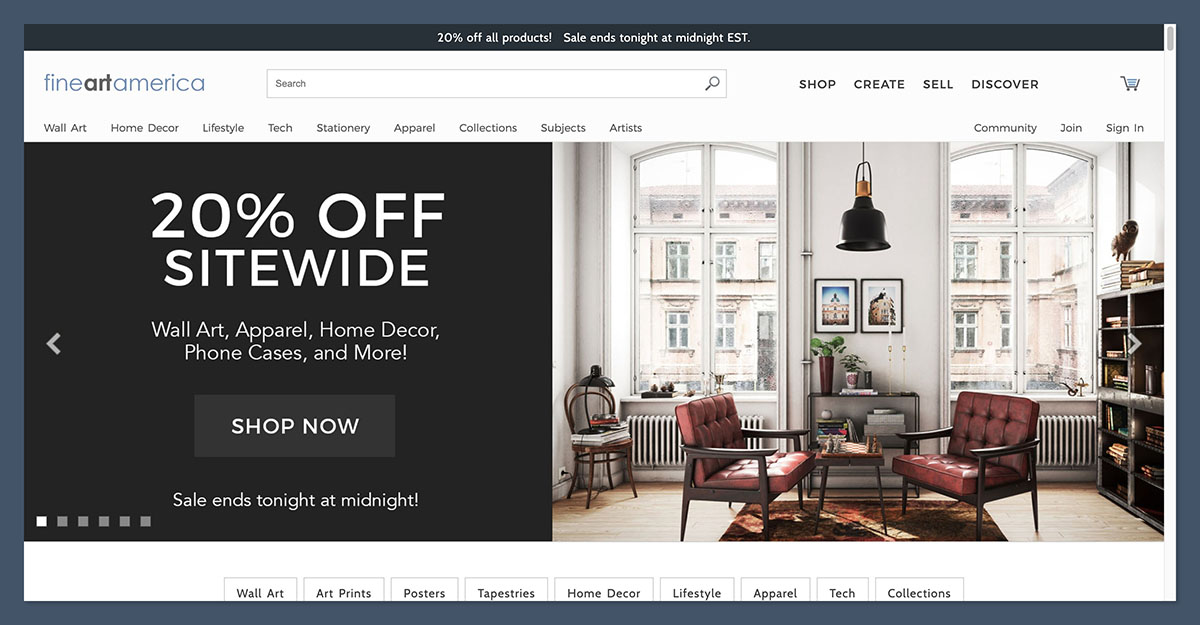
Fine Art America (also known as Pixels) combines an art marketplace with a POD backend. It covers prints, canvases, posters, framed artwork, and a growing range of products like apparel, tote bags, and home decor. The platform attracts buyers specifically looking for art, which gives it a more focused audience than general POD marketplaces.
Artists can set their own prices above the base production costs, which puts margins back in your control. You also get a portfolio page on the platform, which works as a mini storefront within the marketplace. For artists who primarily sell wall art, prints, or photography, this is a more natural fit than a broad POD site where art competes with meme stickers and novelty mugs.
Fine Art America also integrates with Shopify through the Pixels app, so orders from your own standalone store can be fulfilled through the same backend. This makes it a bridge option for artists who want marketplace exposure now but plan to build an independent store later.
What we like about Fine Art America
- Art-focused marketplace with a relevant buyer audience
- Artists control pricing above base costs
- Shopify integration via the Pixels app
- Strong catalog for wall art, prints, and photography
What we don’t like about Fine Art America
- Less suited for artists focused on apparel or novelty merch
- Platform interface feels dated compared to competitors
- Smaller general audience than Redbubble
Fine Art America is a solid middle ground for artists who want marketplace visibility and custom pricing without committing to a fully independent store. The Shopify integration also makes it a natural stepping stone if you decide to go independent later.
6. Best for Premium Prints: INPRNT
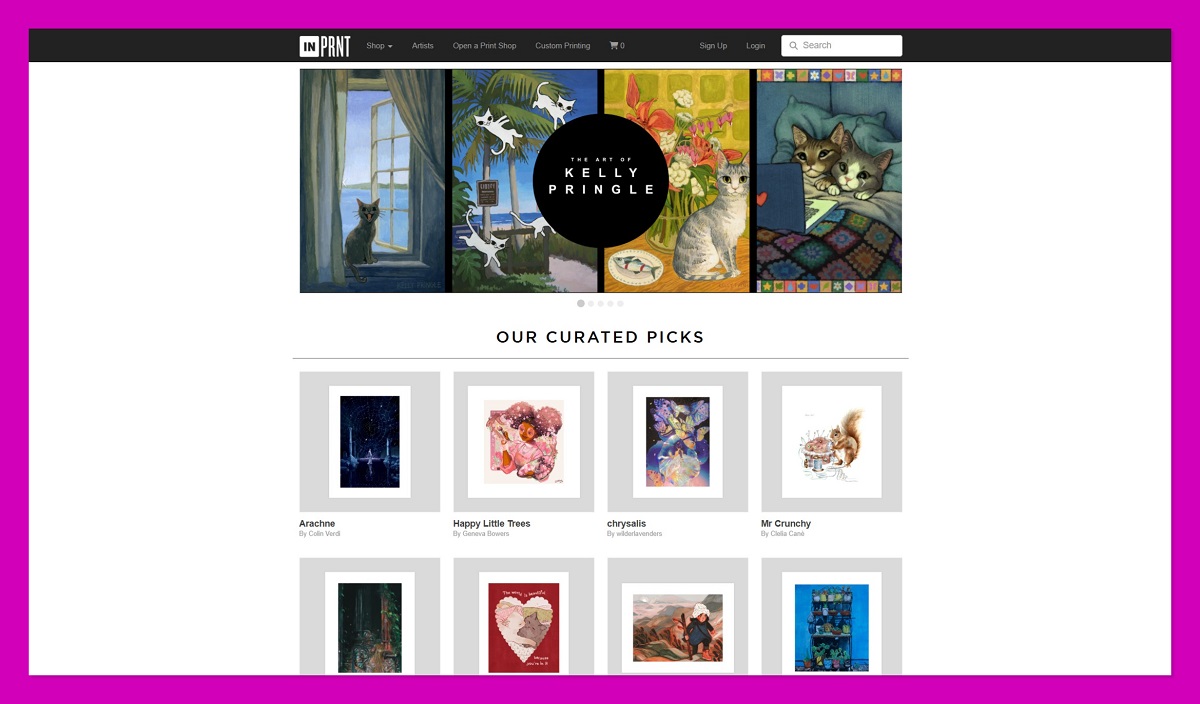
INPRNT takes the opposite approach from marketplaces that accept everyone. It’s a curated platform where artists are accepted through a community voting process. This keeps the catalog smaller and more selective, which supports a higher-end brand perception and generally better earnings per sale.
The product range is narrow by design. INPRNT focuses on fine art prints, framed prints, and canvases rather than trying to cover every POD product category. If your work is the kind that benefits from premium paper, accurate color reproduction, and careful packaging, INPRNT is built for that.
The downside is reach. A smaller, curated marketplace means fewer buyers browsing compared to Redbubble or Society6. INPRNT works best for artists who already have an audience and want to direct fans to a platform that presents their work in a premium context, rather than relying on marketplace discovery alone.
What we like about INPRNT
- Curated catalog with higher-end brand perception
- Stronger earnings per sale than broad POD marketplaces
- Focused on print quality and presentation
- Community-driven acceptance process
What we don’t like about INPRNT
- Smaller audience and fewer buyers
- Limited product range beyond prints
- Approval process means you can’t start selling immediately
INPRNT is a niche pick, but a strong one if your work fits. Artists who already drive their own traffic and want a platform that matches the quality of their prints will find it more rewarding per sale than any of the larger marketplaces.
7. Best for Creators Building a Community: Fourthwall
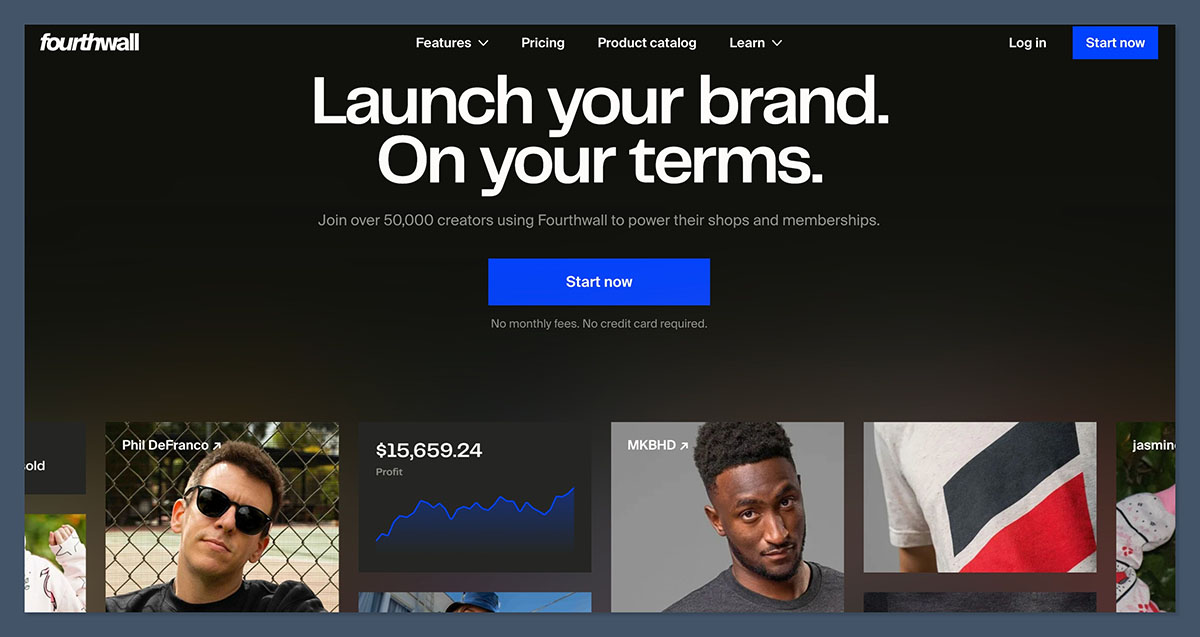
Fourthwall bundles three things into one platform: a storefront, memberships, and POD merch. This makes it a different kind of Society6 alternative, aimed at artists and creators who are building an audience-driven business rather than just listing designs on a marketplace.
You can sell physical products, digital content, and recurring memberships under a single brand. Production and fulfillment for merch are handled by Fourthwall, so the operational model stays hands-off for the physical product side. The storefront itself is customizable, and the membership features allow for community perks, exclusive content, and recurring revenue.
For artists who also have a following on YouTube, Twitch, Instagram, or other social platforms, Fourthwall offers a more complete business model than a pure POD marketplace. The limitation is that you need an existing audience to make it work, since there’s no marketplace traffic built in.
What we like about Fourthwall
- Merch, digital products, and memberships in one platform
- Customizable storefront with creator-focused features
- POD fulfillment handled by Fourthwall
- Built for recurring revenue and community building
What we don’t like about Fourthwall
- Requires an existing audience to generate sales
- Less suited for artists who only want to sell prints
- Smaller product catalog than dedicated POD backends
Fourthwall makes the most sense for artists who think of themselves as creators first. If you’re already building an audience and want to monetize it beyond one-off merch sales, the combined storefront and membership model gives you more levers to pull than any pure POD platform.
8. Best Simple Storefront for Artists: Big Cartel
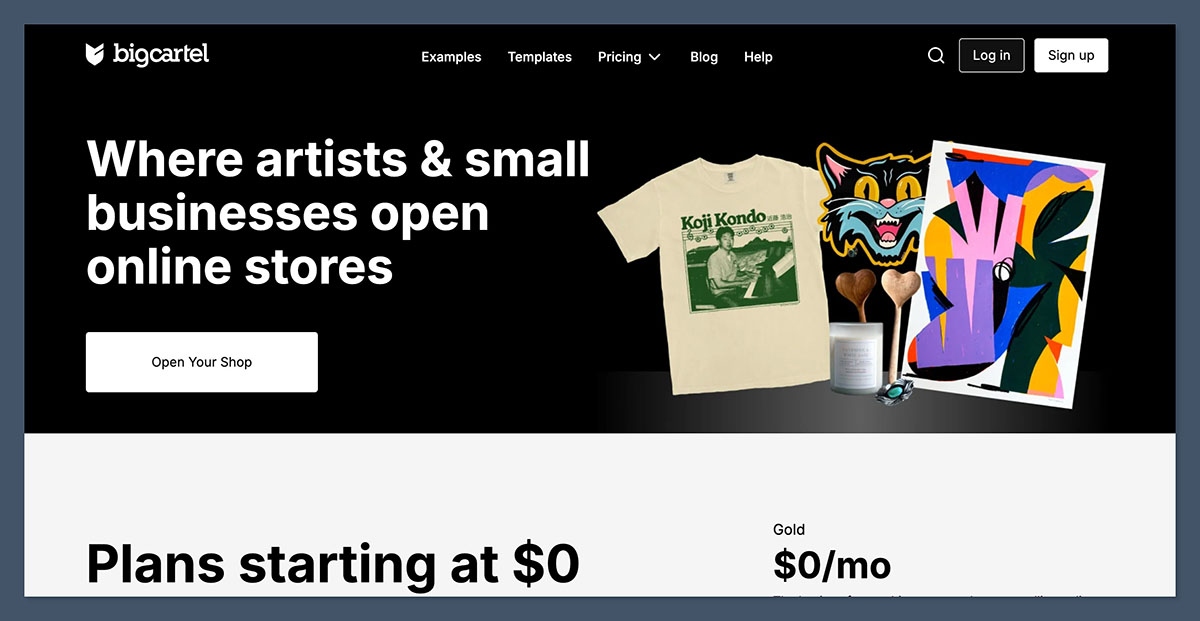
Big Cartel is a lightweight ecommerce platform built specifically for artists and makers. It gives you a simple hosted store where you control the branding, layout, and product presentation without the complexity of a full ecommerce platform like Shopify.
Big Cartel doesn’t include built-in POD. Instead, artists typically pair it with a third-party service like Printful or Printify to handle production and fulfillment. This “build your own stack” approach gives you a branded store with the simplicity of Big Cartel’s interface and the production capabilities of a dedicated POD provider.
The platform is affordable and intentionally minimal. If you don’t need a massive product catalog, complex analytics, or advanced marketing tools, Big Cartel gets out of your way and lets you focus on presenting your work. The cost is low, and the learning curve is almost flat.
What we like about Big Cartel
- Simple, affordable storefront designed for artists
- Full control over branding and customer relationships
- Easy to pair with Printful, Printify, or other POD services
- Minimal learning curve
What we don’t like about Big Cartel
- No built-in POD or fulfillment
- No marketplace traffic
- Limited features compared to Shopify or WooCommerce
Big Cartel is the “build your own mini-Society6” option. Pair it with a POD provider like Printful or Printify, and you get a branded storefront with full ownership at a fraction of the cost and complexity of a full ecommerce platform.
9. Best for Fine Art and Gallery-Level Sales: Saatchi Art
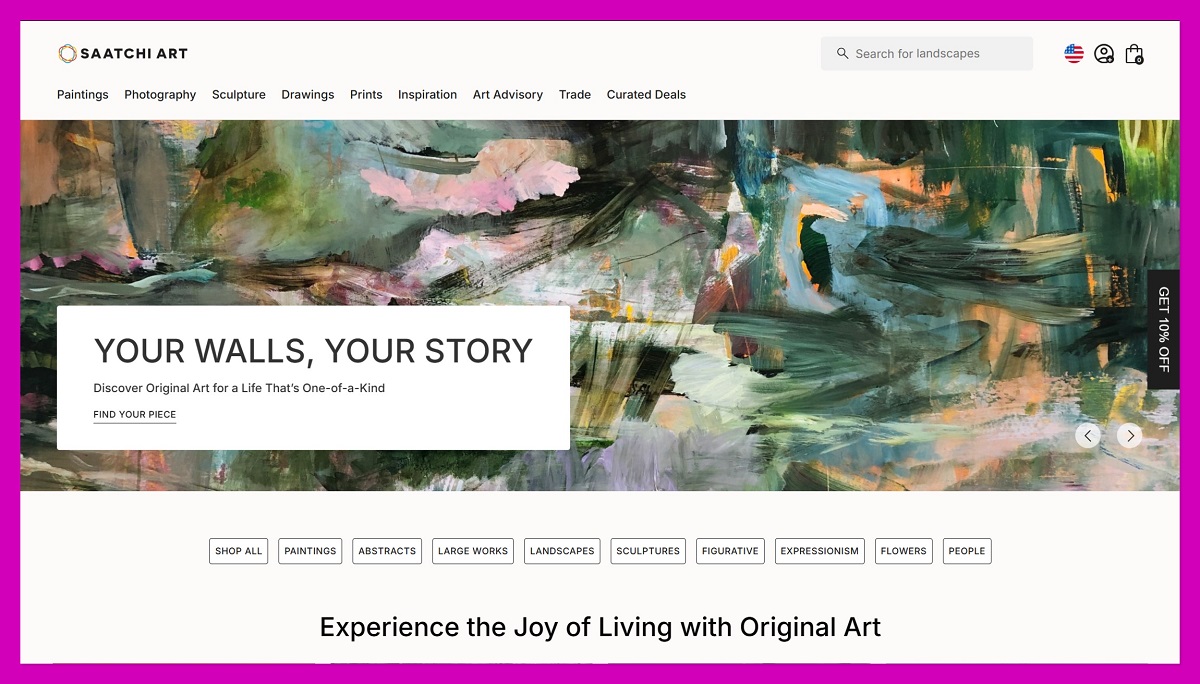
Saatchi Art operates more like an online gallery than a POD marketplace. The focus is on original artworks and limited-edition prints, targeting collectors and buyers in the fine art segment rather than the casual consumer audience that browses Society6 or Redbubble.
Some categories support printed reproductions via POD, but the core value of Saatchi Art is the gallery context. If your work fits the fine art market, being listed on Saatchi Art positions you alongside established artists in a space where higher price points are expected and accepted.
This isn’t a direct replacement for Society6’s mass-market POD model. It’s better understood as an upgrade path for artists whose work commands gallery-level pricing and who want access to a collector audience. If you’re selling phone cases and throw pillows, this isn’t the platform. If you’re selling originals and limited runs, it’s worth a serious look.
What we like about Saatchi Art
- Gallery-oriented platform with a collector audience
- Suited for originals and limited-edition prints
- Higher price points and prestige positioning
- Curated environment that elevates your work
What we don’t like about Saatchi Art
- Not a mass-market POD platform
- Limited product range compared to POD marketplaces
- Better suited for established artists than newcomers
Saatchi Art isn’t a replacement for Society6 in any direct sense. It’s a different tier entirely. But for artists whose work has outgrown the POD marketplace model and belongs in a gallery context, it’s the logical next step.
How to Choose the Right Society6 Alternative
The right platform depends on where you are as an artist and what you’re trying to build. Here’s a simple way to think about it:
If you want a marketplace where you upload and earn passively: Redbubble is the closest match to Society6, with the added benefit of setting your own markups. Fine Art America is a better fit if your work leans toward wall art and photography. INPRNT makes sense if you’re focused on premium prints and don’t mind a smaller audience.
If you want to own your brand and control your margins: Printful and Printify are the core POD backends to consider. Pair them with Shopify, Etsy, WooCommerce, or even Big Cartel for the storefront side. Printful offers the best balance of quality and integrations. Printify gives you more supplier options and often lower costs.
If you want a hybrid approach: Threadless gives you marketplace traffic plus a customizable Artist Shop. Fourthwall bundles merch with memberships and community tools for creator-driven businesses.
If you’re moving into the fine art market: Saatchi Art is the step up for artists selling originals and limited editions to a collector audience.
Society6 still works for artists who value zero-effort logistics and are comfortable with fixed royalties on a curated platform.
But if you’ve outgrown that model, or never got accepted in the first place, the alternatives above cover every direction you might want to go.