Etsy has always been a difficult platform to compare to something like Fourthwall, because the solutions, and the business models they’re directed towards are obviously very different. Etsy gives you a room to occupy on one of the world’s largest marketplaces. Fourthwall gives you a full ecommerce store that you can scale however you choose.
I won’t deny that Etsy still has a brilliant advantage in terms of reach. The marketplace generated about $2.5 billion in just the first quarter of 2026. Also, it’s fair to say that the features are maturing, with things like better search and AI-assisted discovery.
Still, I naturally gravitate towards Fourthwall first if anyone asks me for a platform that’s easier than Shopify, that still lets them own their brand, and sell a wider range of digital and physical products.
Fourthwall or Etsy? My Quick Verdict
For new creators, Etsy is still the best place to set up a storefront and start listing products you can be pretty sure will get attention relatively quickly. The audience is huge, and Etsy keeps spending money on recommendations and discovery tools that smooth out the buying process.
Fourthwall is the better option by far if you already have people paying attention to your company or brand, and want to scale. You get a full store of your own, and you can sell everything from retail-grade print on demand products, to custom sourced items, digital downloads, and memberships.
Fourthwall vs Etsy: The Quick Comparison
Etsy probably doesn’t need a lot of explaining to most “would-be” sellers, it’s the creative marketplace where you can sell all kinds of unique items, provided that they were made, designed, handpicked or sourced by you, the seller. It supports physical products and digital downloads, and you can explore print on demand, provided your partner follows Etsy’s rules.
Fourthwall is a brand building toolkit. It gives you a hosted ecommerce platform, with a fully customizable website, social commerce opportunities, included print on demand with lots of luxury goods to customize, plus the freedom to source and sell products you track down yourself.

| Comparison Point | Fourthwall | Etsy |
|---|---|---|
| What it is | Complete brand-building platform and ecommerce system | Marketplace for creative goods |
| Meant for | Sellers building revenue from an existing audience | Sellers who need to find an audience quickly |
| Built-in shoppers | No | Yes |
| Branded website and domain | Full customizable storefront and custom domain | Etsy shop with limited layout control, custom domain available through Pattern |
| Print on demand | Yes, through Fourthwall’s catalog | Yes with your own production partner |
| Products you can sell | Custom print-on-demand products, physical products, digital downloads and memberships | Digital downloads and physical products that adhere to Etsy’s rules |
| Support | Merchant of record support and customer support for print-on-demand | Merchant of record support, but you handle customer service |
| Starting price | Free | Free |
Fourthwall vs Etsy Pricing: Which Has the Lower Total Cost?
You won’t really need a massive budget to get started with either Etsy, or Fourthwall, since both let you sign up for free. Technically though, there are still fees.
If you’re using a standard Etsy account, every listing will cost you $0.20 and that purchase automatically renews every month. A sale comes with a 6.5% transaction fee, too, plus there’s a processing charge that varies depending on where you’re based.

Then there are other possible expenses. For instance, if Etsy attributes a sale to one of its offsite ads, you need to pay them 15% of the total order value. If you want to experiment with more branding control (something closer to a real website), Pattern starts at $15 per month. There’s also Etsy Plus, which gives you 15 listing or renewal credits and $5 in advertising credits every month for $10.
Fourthwall’s free plan comes with fewer fees upfront. You don’t pay any fees when you sell physical products (aside from payment processing costs), but there is a 5% fee for digital products or memberships. If you upgrade to the Pro plan for $15, the digital product fees disappear.
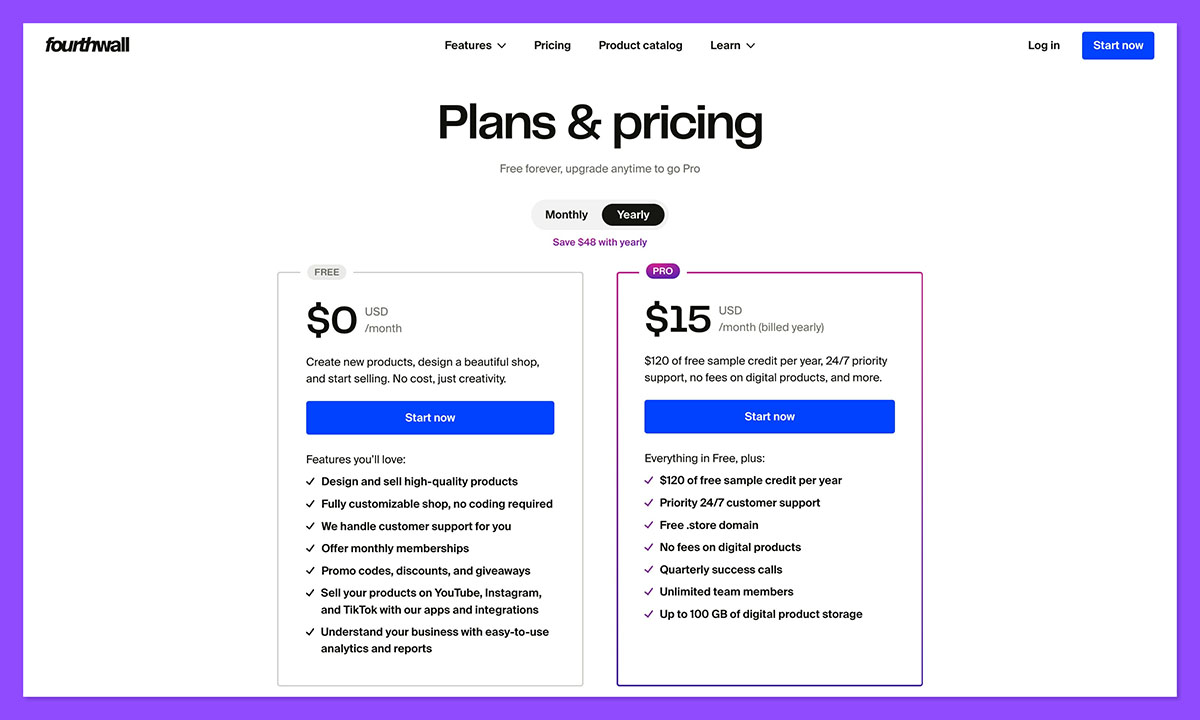
Either way, with Fourthwall, you still get a free .store domain, a complete website, and the option to sell any kind of products you like. The premium plan just adds things like unlimited team members, sample credits, more digital product storage, and priority support.
Etsy is still a good deal, particularly if it helps you earn the initial traffic you need, but Fourthwall is better value for money when you already have an audience.
Fourthwall vs Etsy: Which Is Better for Building a Website?
This is probably going to be the easiest part of this comparison. Etsy doesn’t really give you a full website builder. Every store on the marketplace looks pretty much the same, all you really get to add is your logo and banner. You can also make a few tweaks to shop sections and descriptions, obviously, but that won’t necessarily distinguish you from anyone else.
There is Pattern, which technically lets you build a separate store with its own domain, the trouble is that once again, you’re getting a very basic store, not something that you could compare with a platform like Shopify.

Plus, with Pattern, you’re creating a separate store (even if it features all of your Etsy products), so you lose the main benefit you would get from choosing Etsy in the first place. Etsy stops delivering traffic, and you start sourcing it yourself.
Fourthwall is a complete website builder and hosted ecommerce system. You get a store with a fully editable layout (no-code is supported). You can add your own domain (free for the first year), plus you can add content feeds and custom pages, experiment with color palettes, typography, and themes, design collections, and even introduce your own custom code.
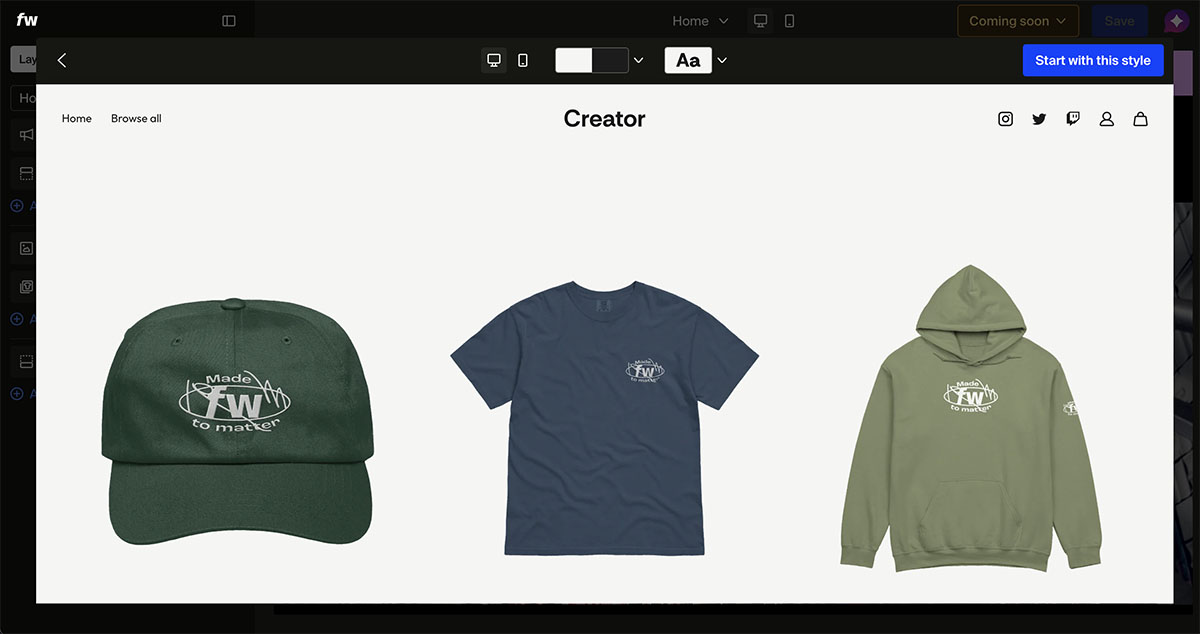
From the integrations side, Fourthwall lets you link to things like YouTube Shopping or Twitch for social selling, and there’s Klaviyo and similar tools for email marketing. Etsy has its own app marketplace that can help you out with listing management, finding product partners, or managing sales in-person through tools like Square.
Fourthwall vs Etsy: Discovery and Marketing
If you’re launching a store with no existing audience whatsoever, Etsy is probably the better place to start. You’ve got direct access to around 87 million active buyers here, and Etsy continuously pushes products beyond its own search bar too. For instance, eligible listings can now appear in shopping experiences customers have with AI tools like ChatGPT.
The problem is that there’s a lot of competition on the marketplace already, so visibility isn’t guaranteed, nor is the ability to outshine other sellers. You also don’t really have that many ways to market yourself beyond writing great descriptions and adding attractive photos unless you have a separate site for content marketing, or a social media presence.
Fourthwall doesn’t serve up an audience in the same way that Etsy does, but it helps you build relationships with the people who do care about your brand more effectively. You can link your store to your social media channels, create blogs to attract attention, or run email marketing campaigns with Kit, Klaviyo, or Mailchimp.
Fourthwall vs Etsy: What Can You Sell?
Both platforms give you a decent number of options, but you definitely have more freedom with Fourthwall. With Etsy, you’re allowed to sell physical and digital products, as well as print-on-demand items, as long as everything you offer follows a strict set of rules.
Every product needs to have a creative element to it, so you’re usually safe with things like handmade goods, original designs, and certain vintage items. If you’re sourcing products from someone else, you need to make sure the design is your own, or provided by the customer, and that the production partner is approved by Etsy.
Fourthwall lets you explore as many avenues as you like. You could start by selling a range of products from their incredible print-on-demand collection, then jump into digital product downloads or memberships. There’s even the option to accept donations, and you can mix-and-match product types in bundles too, so you could sell a physical book alongside an eBook.
Fourthwall can also help you with sourcing products, or sourcing designs for print on demand with its marketplace. It also lets you find manufacturers and add your own custom items to your catalog, too. So, basically, anything you can think of to sell is probably approved by Fourthwall.
Fourthwall vs Etsy: How Much Support Do You Get?
The good news for sellers worried about tax headaches is that both companies can act as your merchant of record. Still, Fourthwall offers help in other places that Etsy overlooks. For instance, if you want to explore print on demand, Fourthwall’s partners deal with creating and shipping orders for you, whereas Etsy forces you to find your own partner.
Fourthwall can help you find suppliers for custom products too, as mentioned above, and give you access to a marketplace of designers. It also has its own AI assistant (Eli), which can help with editing your site, or managing products. Etsy has an AI assistant too, but it mostly helps with simple things like optimizing listings and writing messages.
The best part is the help you get with customer service if you’re using Fourthwall as a print on demand partner. They can handle responding to queries and dealing with returns on your behalf for any item that comes from their catalog. You’re still responsible for customer support with anything you source yourself, but still, at least some of the work is off your plate.
Etsy expects you to handle all customer service personally, although the Purchase Protection program can help cover up to $250 on eligible orders when you need it.
Both companies have great self-help resources and customer support teams if you need them for day-to-day help, too, although Fourthwall’s support is better on the paid plan, and Etsy’s service teams can be a little slow at times.
Fourthwall vs Etsy: Which Has the Better Extra Features in 2026?
Fourthwall has probably had the more exciting year for feature updates, introducing the AI assistant Eli to help with analyzing sales and store data, changing pricing, or developing promotions. It also now supports MCP to help compatible AI tools interact with your store information.
This year, Fourthwall also launched the designer marketplace for companies that need artwork to add to print on demand products. Plus, the company has started investing in partnerships with companies like Throne for wishlist creation and crowdfunding.
Etsy is still focusing on making things simpler for sellers. There are shop stats that now come with AI summaries, plus a Stats assistant that’s being tested to help further. Etsy also introduced listing forms to help you spot missing attributes, and the marketplace is starting to use AI for delivery estimates and shopping discovery through intelligent assistants, too.
Fourthwall or Etsy: Which Should You Choose?
I’d say it’s a pretty easy decision really. Etsy is still the platform worth using if you’re brand-new to selling and need a marketplace that can actually help you find your audience. You’ll need to make sure you’re selling the right kind of products, but with Etsy you can grab the attention of potential buyers faster, and keep initial costs pretty low.
Fourthwall is the far better choice if you already have somewhere that you’re getting audience attention, and you need a comprehensive branded homebase that can scale with you. It gives you more product options to sell, more support with growing your business, more control over your image and brand identity, and more room to experiment.
Of course, there’s always the third option: use both. Fourthwall supports Etsy product listings as of July 2026, so you can always use Etsy to handle the initial marketplace discovery work, while Fourthwall becomes the central space for your bigger brand.