If you’ve read one of my reviews before, you’ll know I spend a lot of time testing out POD vendors, dropshipping companies, and basically any solution that claims to make selling custom products online easier.
I’ve tried everything from Redbubble, to Printful, and felt the headaches along the way.
PODpartner is a name I honestly don’t see as often as I’d expect in this market. Sure, it has fewer product options than some alternatives, since it focuses exclusively on apparel, but it also does a lot of important things incredibly well, like quality, fast shipping, and customization freedom.
I won’t claim it’s going to be perfect for everyone, but I will say if you’re starting a luxury fashion brand soon, PODpartner is worth a look. Here’s why.
Why You Can Trust This Review
This review is coming to you from someone who hasn’t just tested PODpartner directly (designing products, managing integrations, and ordering samples), but has also tried dozens of other platforms.
I’ve been working with platforms like these for over a decade, and I’ve advised countless ecommerce companies on the kinds of tools that would work best for them.
I don’t make recommendations to get a commission or a benefit. This review is entirely based on my own insights and experiences.
PODpartner Pros and Cons: The Quick Rundown
Here’s the quick version. PODpartner isn’t trying to compete with the giant “everything-you-could-ever-print” marketplaces. They ignore the usual novelty items and focus exclusively on apparel, but that’s kind of a good thing.
The quality of the garments is better than what I’ve seen from most POD suppliers in the same price range. The embroidery is the standout feature by far, and the design freedom (especially the size of the print areas) puts them ahead of many well-known competitors.
They’re not perfect. The product catalog isn’t huge, and you don’t get a dozen integrations or built-in AI design toys.
But if your goal is to sell clothing that feels like it comes from a genuine fashion brand, it’s hard to go wrong here.
Pros
- Beautiful, eco-friendly, and durable garments
- Excellent embroidery
- Large print and stitch areas
- Modern apparel styles (oversized, heavyweight, faded, etc.)
- No monthly subscription
- Faster production than many POD vendors
Cons
- Exclusively focused on apparel
- Not many integration options
- Simplistic design tools
Getting Started with PODpartner
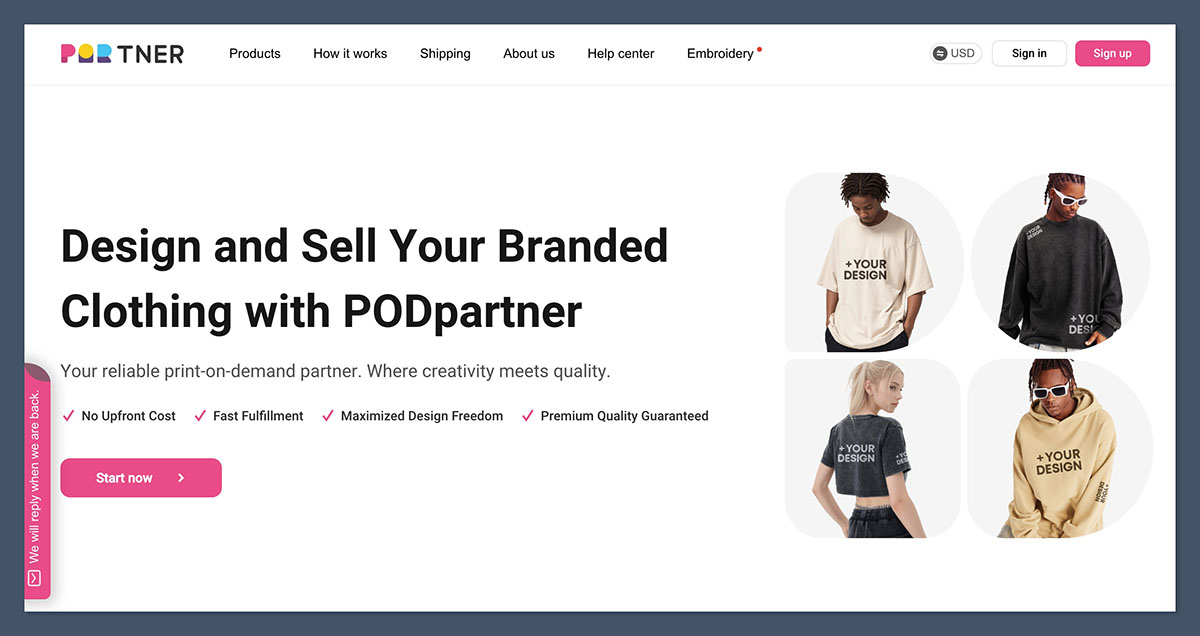
One of the things that usually kills my excitement with new POD suppliers is a complicated setup process. I don’t have time for endless welcome tours or navigating screens that make no sense. PODpartner doesn’t create problems like that.
Setting up an account takes less than a minute. Add your email, choose a password, and you’re ready to dive into the creation process.
That part is fast too. The catalog isn’t massive, so you don’t get stuck scrolling for 20 minutes trying to figure out what’s “good.” Everything they offer falls into the apparel category, and you can filter through what you like in no time.
Once you hit the design tool, you’ll just get a simple system that makes it easy to upload your artwork, pick between print or embroidery, move designs around and resize as needed.
There’s no “AI image generator” or other fancy tools like that, which is a shame, but I doubt it’ll put too many creators off. You can always use an AI tool elsewhere and upload the image.
Getting Designs Ready to Sell
PODpartner makes everything suspiciously simple, even creating quality mock-ups. The only really challenging part is getting used to the split between embroidery and print. This is a provider that treats the two different design options as separate processes, so you’ll need to switch modes depending on what you’re working on.
Once you get your head around that though, it starts feeling much simpler.
When the time comes to connect your store, that’s a breeze too. You can integrate with Shopify, Etsy, WooCommerce, Wix, and Squarespace in a couple of minutes. Every time you create a design, you can send it straight to your store, add a price and description, and hit publish.
PODpartner deals with the part of processing orders really well, so you can really just sit back, relax, and wait for the profits to roll in.
PODpartner Product and Design Options
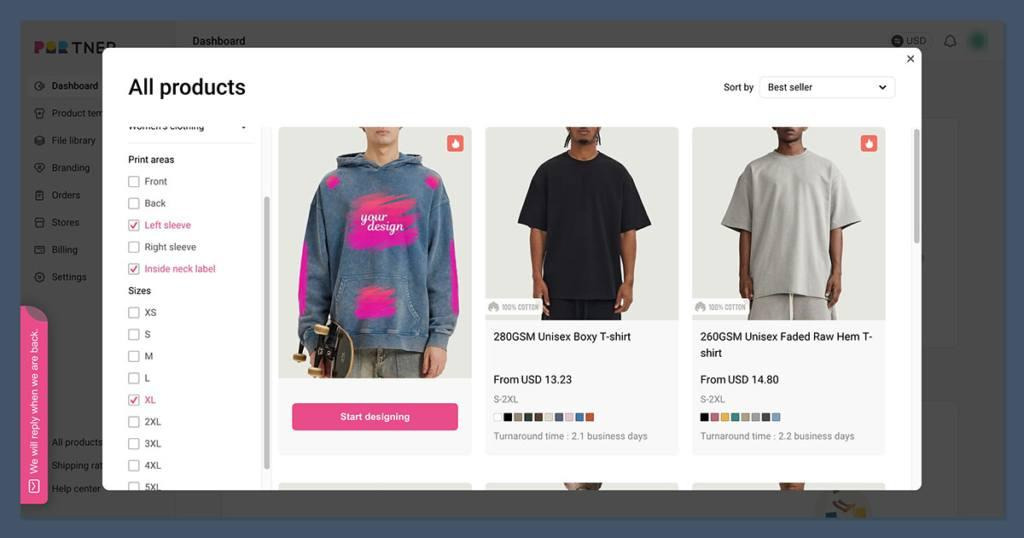
If you’re coming from a platform like Printify or Gelato, you’re probably used to scrolling past 30 pages of random items like mugs, puzzles and wall art. There’s none of that here. PODpartner sticks exclusively to clothing, and that does feel like a good thing.
Even though it’s apparel-only, the lineup doesn’t feel thin. It feels intentional. Here’s what you get:
- Classic tees in both lightweight and heavier cuts
- Proper heavyweight and oversized tees
- Oversized tees and hoodies
- Faded and pigment-dyed styles
- Tanks and similar tops
- Fleece-lined hoodies
- Tanks, shorts, joggers, and a few seasonal pieces
What’s really impressive is how current the styles are. A lot of POD suppliers still cling to the same “unisex basic tee” from 2012. PODpartner clearly pays attention to what people actually buy today, things like oversized silhouettes, thicker fabrics, and washed colorways.
DTG and Embroidery without the Creative Limits
Even if the catalog is apparel-only, the customization side gives you more freedom than most big-name POD suppliers. You get the two methods most apparel sellers rely on: DTG, and embroidery.
The DTG option is great, with beautiful, high-quality prints and endless placement options, there’s even a new set of Jumbo DTG prints, with sizes ranging up to 24×24”. But honestly, it’s the embroidery that really stands out. You get up to 15 thread colors, large 12×12 embroidery areas, and multiple placement zones.
You can even blend DTG and embroidery for a totally unique item. This isn’t the same kind of “blending” you get from a company like Printful. You can add DTG and embroidery to the same side of the garment, not just two different sides.
For example, on a single hoodie or tee, you can:
- Run a full-width graphic across the back
- Add a stitched chest logo
- Throw a print on the sleeve
- Add something subtle on the lower front panel
Not many POD platforms let you go that far without hitting restrictions or weird “not available on this product” warnings.
The Customization Feature (for Your Customers)
This is the one thing PODpartner offers that most POD platforms completely ignore.
If you’re on Shopify, you can activate a feature that lets customers customize your products directly on your storefront. It’s absolutely free, and it doesn’t require anyone to install an extra app. Once you enable it, your customers can:
- Add their name
- Add a date
- Adjust text
- Personalize a quote
- Or tweak whatever you choose to let them change
Personally, I think this is a big selling point for this brand. It’s an easy way to turn any of your products into a personalized version with almost no extra work on your end. Gelato offers something similar, but beyond that, this feature is rare in the POD world.
If you’re selling gifts, wedding items, sports team apparel, or any kind of “made just for you” product, this can bump your average order value and conversions without needing a separate customization app.
Product Quality, Branding, and Fulfillment
If you’ve explored print on demand before, you’ll know that just about every vendor tells you they create “luxury” products, but few actually do. PODpartner is one of the few companies that impressed me when I received my samples.
Most of PODpartner’s tees are 100% cotton, and the difference is obvious as soon as you pick them up. Even the lightweight shirts don’t feel flimsy or cheap. The heavier options actually feel like something you’d trust wearing in winter.
The prints are phenomenal, with clean edges, no odd ink spots and very little fading after multiple washes. If you choose embroidery, expect to be extra impressed.
The stitching is neat, raised, and consistent, no loose threads, no patchy fills, and none of that stiff, shiny embroidery some POD suppliers get wrong.
If you’re trying to sell hoodies or crewnecks that feel premium, embroidery is where the perceived value jumps, and PODpartner handles it well.
There’s another factor that adds to the quality of PODpartner’s products too: sustainability. This is a company that actually controls most of its own production process, so you know you’re not getting anything that’s not “eco-friendly” thrown in.
Branding Options: Not Extensive, but Enough
Branding is one of the biggest pain points in POD. Customers want to open a package and feel like they bought from your brand, not a random fulfillment center. PODpartner covers the essentials:
- Custom labels
- Neck tags
- Packaging inserts
They don’t offer the massive “custom unboxing experience” you’ll see from high-end fulfillment companies, but what they do offer is clean, well done, and honestly more than enough for most small business owners looking for a chance to stand out.
Also, it’s worth noting that the branded materials PODpartner offers are produced on-demand. That means you can adjust material designs based on market feedback without headaches.
Other companies, like Printful and Printify, still force you to purchase a batch of materials and store them in warehouses.
Fulfillment and Shipping
Design tools are nice, but fulfillment is where POD companies prove whether they can actually be trusted. Slow production, sloppy packaging, and confusing shipping timelines can tank even the best store.
PODpartner estimates that most orders get processed within about 48 hours. My test orders lined up with that timeline, but do remember that processing time and shipping time aren’t the same thing.
Shipping times (and prices) with PODpartner can vary.
You can ship worldwide, thanks to partnerships with established logistics partners like FedEx and UPS, and the price is about average (starting at $4.96 for your first t-shirt).
What really makes PODpartner impressive is that you and your customers can choose different fulfillment speeds, based on their urgency or budget. There’s Standard, Fast and Express shipping in most major regions. That’s a big thing.
If you’ve ever had a customer order a product that had to arrive before a major event, giving them option to “expedite” the delivery could be the key to earning their loyalty.
PODpartner Pricing: What You’ll Pay
PODpartner keeps things simple. There are no paid plans, no “unlock better pricing” membership tiers, and no upsells hiding behind a subscription wall. You create an account, list your products, and you only pay when a customer buys something.
Honestly, I’d quite like to see an option for a premium service one day in the future. I personally think Gelato’s premium plan, for instance, is great value.
Still, if you want a “free setup” PODpartner works. The base cost of products is decent too.
As an example, a simple lightweight t-shirt costs around $5.59. Something similar on Printful can cost you around $9 before you add customization.
Of course, extras stack up depending on how ambitious your design is:
- More print placements = higher cost
- Jumbo DTG = bigger print, higher cost
- Embroidery = more expensive than DTG
- Multiple embroidery locations = additional fees
- Digitization = required if your file isn’t already in DST format
Processing Fees and Shipping Costs
If you combine DTG and embroidery on the same garment, PODpartner adds a small multi-process fee (around $2.99). Honestly, that’s reasonable. Two different production workflows means more labor.
But here’s the upside: combining embroidery with print is one of the easiest ways to make your apparel feel premium.
Most POD stores don’t bother doing it because their suppliers make it expensive or limit where you can place the designs. PODpartner actually makes mixed-media pieces achievable without killing your margins.
Shipping costs, as mentioned above, can vary, but the prices are predictable. Standard shipping for a T-shirt starts at $4.96 for the first item and $2.44 for each additional piece in the same order. That’s right in line with what I see across most POD suppliers right now.
Margin Potential
When you stack everything together, base price, decoration cost, shipping, the margins look surprisingly healthy, especially if you’re positioning your store as a boutique apparel brand rather than a “funny T-shirt” shop.
People expect to pay more for:
- Heavyweight tees
- Embroidered crewnecks
- Oversized streetwear silhouettes
- Pigment-dyed or specialty pieces
That means you should be able to charge enough to make a decent profit.
Who Should Use PODpartner, and Who Shouldn’t?
PODpartner isn’t a one-size-fits-all POD platform, and that’s actually what makes it appealing. After testing enough suppliers to fill a closet, I can say pretty confidently that this one works best for a specific type of seller.
PODpartner Is a Great Fit If You’re…
- Building a clothing-first brand, they really do excel at apparel
- Creating your own clothing brand
- Focused on streetwear, lifestyle apparel, or anything “premium”
- Obsessed with embroidery quality or just gorgeous materials
- Someone who wants more control over design placement
- A Shopify seller looking to offer personalization
PODpartner Probably Isn’t for You If You’re…
- Selling a wide mix of product types
- Looking for a massive list of integrations
- Someone who wants built-in AI design tools
- A seller who needs hand-holding or instant support (support is decent, but it’s not 24/7 or instant all the time)
My Final Verdict on PODpartner
PODpartner isn’t trying to compete with every POD platform out there, it’s intentionally focused on fashion-first companies that prioritize quality.
If you want to sell clothing that feels real, pieces with weight, structure, good stitching, and thoughtful design placements, this is one of the better POD suppliers available right now.
The embroidery alone puts it ahead of most competitors, and the ability to offer full customization through Shopify is a genuinely useful feature.
It’s not perfect. The catalog stays in the apparel lane, and shoppers with more complex integration needs may feel limited.
But for creators building a fashion-forward brand, especially anything in the streetwear or lifestyle space, PODpartner is easy to recommend.