Best Overall
Shopify
See pricing Try Shopify →$39/month, or $29/month billed yearly
3 days free, then $1/month for 3 months
- Full store with your own domain
- Checkout, discounts and email built in
- 24/7 live chat on every plan
Best for Free Testing
Printful
See pricing Try Printful →Free plan: $0/month, pay per order
Growth: $24.99/month, optional
- 600+ products, printed in-house
- Free Quick Stores storefront (US only)
- Works with 20+ platforms and marketplaces
When I compared the best ecommerce platforms for print on demand, one question kept coming up: do you need Shopify, or can Printful handle the selling too? After comparing both companies, Shopify, with Printful plugged in as your supplier, is the better way to sell print on demand. Printful alone wins for US sellers testing a design at zero cost.
Shopify and Printful aren’t true rivals. Shopify runs your store and checkout; Printful prints, packs and ships, and most sellers end up using Printful inside Shopify.
This Shopify vs Printful comparison scores a Shopify store against selling through Printful alone: its free Printful Quick Stores storefront or a marketplace integration, across six rounds.
Key Takeaways
- Printful is free to start: its Free plan and Quick Stores have no monthly fee; Shopify Basic costs $39 monthly, or $29 billed yearly.
- A $25 tee leaves $13.08 with Quick Stores and $11.91 with Shopify, before sales tax and Shopify’s monthly plan.
- Shopify wins on selling and branding, with your own domain, themes, checkout, discount codes, Shopify Email and ad tracking.
- Quick Stores is US-only: US tax-resident sellers and US shipping addresses, no custom domain, Google Analytics or Meta Pixel.
- Shopify offers 24/7 live chat on every plan; Printful’s chat starts with an AI assistant, with no phone line.
A Quick Comparison of Shopify vs Printful
Choose Shopify for a branded store or Printful Quick Stores for a free US-only start.
| Shopify | Printful | |
|---|---|---|
| Overall rating | 4.9/5 | 4.5/5 |
| Starting price | $39/mo • $29/mo billed yearly | $0 • you pay per order |
| Free plan or free trial | Free trial | Free plan • free Quick Stores (US only) |
| Pros | • Your own domain and 24 free themes • Full checkout with Shopify Payments • Discount codes and Shopify Email • Google Analytics and Meta Pixel • 24/7 live chat on every plan | • $0 to start, no monthly fee • More than 600 products • Seven in-house fulfillment centers • Free Quick Stores storefront • Works with 20+ platforms and marketplaces |
| Cons | • $39/mo on Basic • 2.9% + $0.30 card fee per sale on Basic • Extra 2% fee with outside gateways on Basic • Makes no products, so you need a POD app • Paid themes cost $100-$500 | • Quick Stores is US-only • No custom domain or tracking pixels on Quick Stores • One flat shipping rate, no free shipping on Quick Stores • Monthly payouts, $25 minimum • No phone support |
| Products and themes | No products of its own • 24 free and about 1,350 paid themes | More than 600 products • no custom themes on Quick Stores |
What Kinds of Business Is Shopify or Printful Best For?
Have a specific business need in mind? Here’s a summary of what kinds of businesses Shopify and Printful are best for:
Shopify Is Best for…
- Sellers building a long-term brand who want their own domain, an email list and ad tracking, with Printful making products in the background
- Sellers outside the US, who can’t open a Quick Store
Printful Is Best for…
- US sellers testing a design at zero cost with a free Quick Store and a link to share
- Sellers who’d rather list on Etsy, Amazon, eBay or TikTok Shop than run their own store
1. Best for Pricing: Printful
The Winner
Printful is free to start, and you keep more in our tee example
Printful’s Free plan and Quick Stores have no monthly fee, so a $25 tee leaves you $13.08 in our example. Shopify adds a $39 monthly plan and a card fee on every order.
Printful’s Free plan costs nothing each month, while Shopify starts at $39 a month. If you’re testing ideas on a tight budget, Printful is the cheaper way to start selling print on demand.
How Much Do Shopify and Printful Cost?
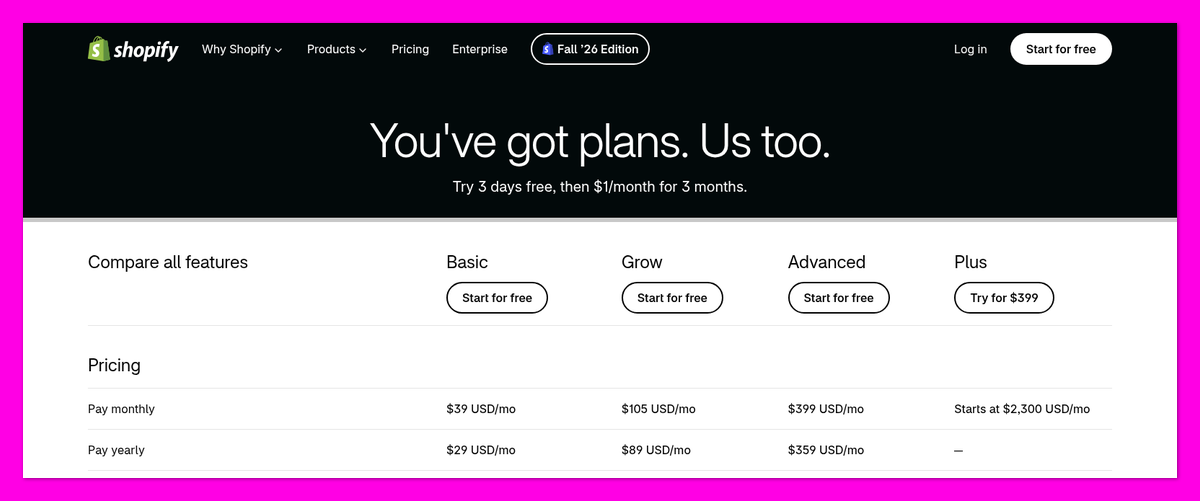
Shopify’s pricing runs from $39 to $399 a month on monthly billing, and Basic drops to $29 a month when you pay yearly. Plus starts from $2,300 a month.
Printful’s Free plan costs $0, and its optional Growth plan is $24.99 a month. All prices here are in USD, as of November 2026.
| Shopify Plan (monthly billing) | Key Shopify Features | Printful Plan | Key Printful Features |
|---|---|---|---|
| Basic: $39/mo ($29/mo billed yearly) | • 2.9% + $0.30 online card rate • 2% fee on outside payment gateways • 24/7 live chat | Free: $0/mo | • More than 600 products • Unlimited connected stores plus 10 Quick Stores • Design Maker and mockups |
| Grow: $105/mo | • 2.7% + $0.30 card rate • 1% fee on outside gateways • 5 staff accounts | Growth: $24.99/mo | • Up to 33% off products • 9% off branding • 25% off samples • Free once you reach $12,000 in yearly sales |
| Advanced: $399/mo | • 2.5% + $0.30 card rate • 0.6% fee on outside gateways • 15 staff accounts | Enterprise: custom pricing | • Custom pricing |
Shopify’s plan pays for the store, not the products: you still pay Printful for every item you sell. The third-party gateway fee isn’t charged if you use Shopify Payments, but the card-processing fee still applies.
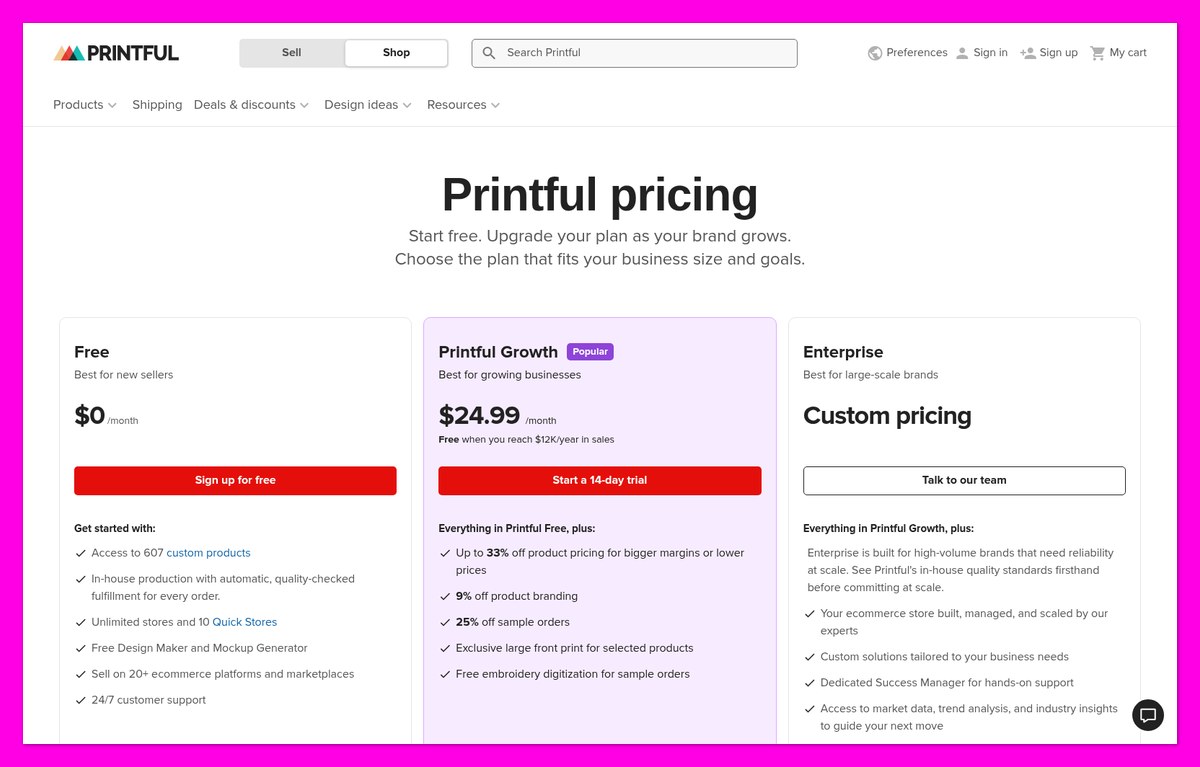
I recommend starting with Printful’s Free plan rather than paying for Growth before you have orders. Its design tools and integrations are already included; Growth buys discounts, not permission to start selling.
Before paying for Growth, compare the discount on your actual products with its $24.99 monthly fee. “Up to 33%” isn’t a promise that every tee gets that discount.
How Much Do You Keep on a $25 T-Shirt?
I ran the numbers on one Bella+Canvas 3001 tee, costing $11.92 on Printful’s Free plan, sold for $25 to a US customer who also pays $4.95 shipping, before sales tax.
- Printful Quick Stores: $13.08 profit per tee. That’s $25.00 minus $11.92. The $4.95 your customer pays for shipping goes to Printful. Printful’s pages list no monthly, setup or listing fee and no separate payment-processing fee for you.
- Shopify Basic with Printful Free: $11.91 profit per tee, before the $39 plan. Your customer pays $29.95, Shopify Payments takes 2.9% + $0.30 ($1.17), and Printful charges you $11.92 + $4.95 = $16.87.
| Tees sold per month | Printful Quick Stores | Shopify Basic + Printful | Extra cost of Shopify |
|---|---|---|---|
| 10 | $130.80 | $80.10 | About $51 |
| 50 | $654.00 | $556.50 | About $98 |
| 200 | $2,616.00 | $2,343.00 | About $273 |
Shopify figures are after the $39 Basic plan; all figures are before sales tax. Quick Stores figures assume a signed W-9 is on file.
Shopify costs about $1.17 more per tee plus $39 a month, so the gap grows as you sell more. Shopify never pays for itself on fees alone in this example: its selling and marketing tools, covered in rounds 2 and 4, need to help you sell more tees or charge more for them.
Billed yearly, Basic is $29 a month, which narrows each monthly gap by $10. These figures don’t include optional branding or marketing spending, so treat them as a starting margin rather than your final take-home earnings.
If you’re not sure $25 is the right price for your design, our guide on how to price print-on-demand products shows how to set a margin.
Do Shopify and Printful Offer Free Trials?
- Shopify gives you 3 days free with no card needed, then $1 a month for your first 3 months if you’re an eligible new merchant, before standard pricing starts.
- Printful doesn’t need a trial, because its Free plan costs $0 for as long as you use it. The optional Growth plan has a 14-day trial and becomes free once you reach $12,000 in yearly sales. Our Printful pricing breakdown covers each plan.
2. Best for Selling Online: Shopify
The Winner
Shopify gives you a full store you control
Shopify runs your checkout, payments, discounts and orders, and isn’t limited to US buyers. A Quick Store is free, but Printful runs the sale; marketplaces charge fees on orders.
Based on what each option lets you control, Shopify is the better place to sell once print on demand is a business and not a test.
Sales Features
Shopify gives you the selling tools, while Printful’s free app sends orders to Printful in the background:
- Shopify Payments charges 2.9% + $0.30 per online card sale on Basic. Another gateway adds Shopify’s extra 2% fee on Basic.
- Discount codes are yours to create and run.
- Your own shipping rates can include free shipping if you build the cost into your prices.
- Orders, payments and customer details stay in your Shopify account, while Printful automatically prints and ships.
A YouTube creator building a merch brand describes the same flow: design, upload to Printful, sync to Shopify, then let Printful ship straight to the customer.
Shopify Store vs Printful Quick Stores
Quick Stores is Printful’s own free storefront. It’s quick to open, but Printful is the seller on every Quick Stores order: your customer pays Printful, which passes your profit on.
| Shopify + Printful | Printful Quick Stores | |
|---|---|---|
| Monthly cost | $39 on Basic ($29 billed yearly) | $0 |
| Who can sell and buy | Not limited to the US | US sellers with US tax residence • US shipping addresses only |
| Who takes the payment | You, through Shopify Payments or another gateway | Printful, through Stripe |
| When you get paid | Through your payment provider | Monthly, for delivered orders only • $25 minimum |
| Sales tax | Your job as the seller | Printful collects and remits US sales tax |
| Shipping options | You set the rates | One flat Printful rate • no free shipping |
| Order changes | You can edit orders in Shopify | Usually can’t edit or cancel once placed |
Quick Stores only sells catalog products Printful can fulfill in the US.
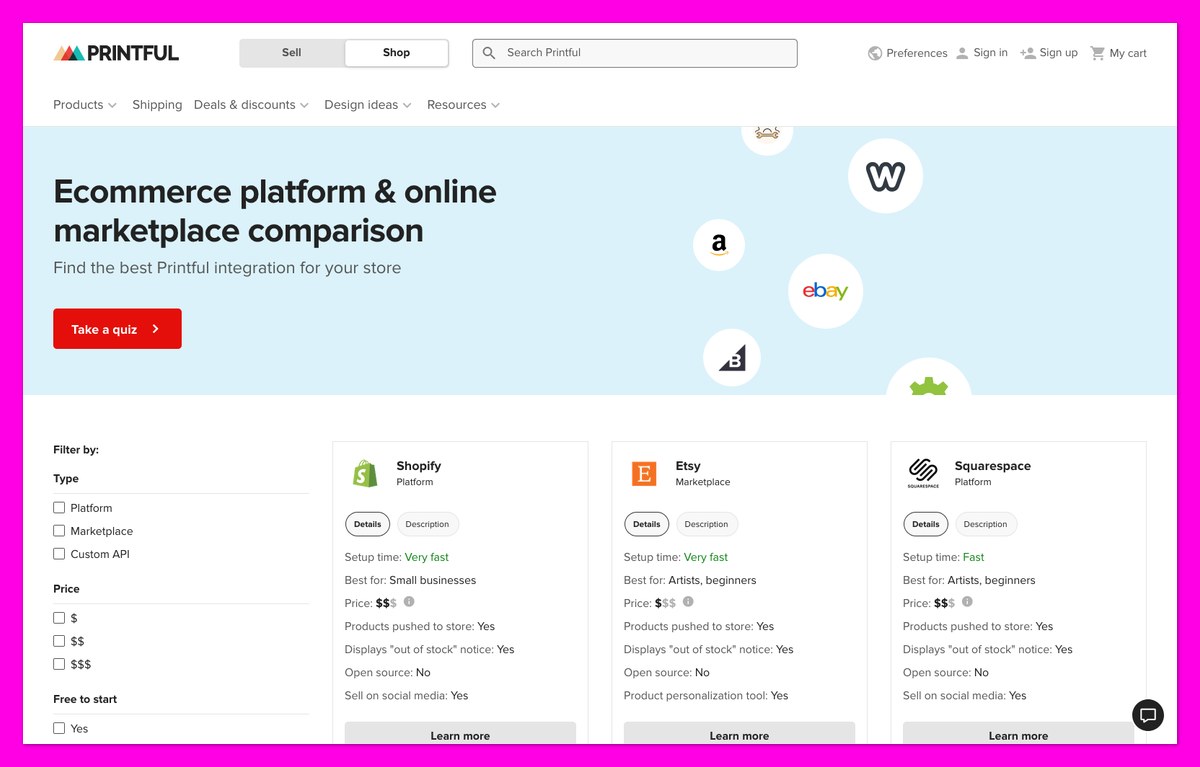
Selling on Etsy, eBay, Amazon and TikTok Shop
Connect Printful to a marketplace to reach its existing shoppers without running your own store. Unlike marketplaces, Quick Stores relies on traffic you bring yourself.
- Etsy: $0.20 per listing and a 6.5% transaction fee, plus payment processing; our breakdown of how much commission Etsy takes covers the rest. On round 1’s $29.95 order, the 6.5% fee alone is $1.95, already more than Shopify’s $1.17 card fee.
- eBay: 250 free listings a month, with a selling fee of 13.25% plus $0.40 per order.
- Amazon: Printful’s integration requires a Professional seller plan at $39.99 a month, before per-sale fees.
- TikTok Shop: Printful’s integration works in the US and UK only; here’s how to set up TikTok Shop with Printful.
Printful works with 20+ platforms and marketplaces, so you can start on one and add Shopify later.
Our take
A Quick Store is a link you share, not a marketplace with waiting shoppers. If you already have followers or an email list, it’s enough to test a design. Otherwise, consider a marketplace’s built-in traffic or Shopify’s marketing tools, without assuming either guarantees sales.
3. Best for Products and Fulfillment: Printful
The Winner
Printful makes and ships your products, and Shopify makes none
Printful prints more than 600 products in seven in-house fulfillment centers. Shopify needs a print-on-demand app, like Printful’s, to sell custom products.
Printful wins this round outright: Shopify doesn’t print, pack or ship anything, so a Shopify print-on-demand store needs a supplier.
What Printful Makes and What It Costs
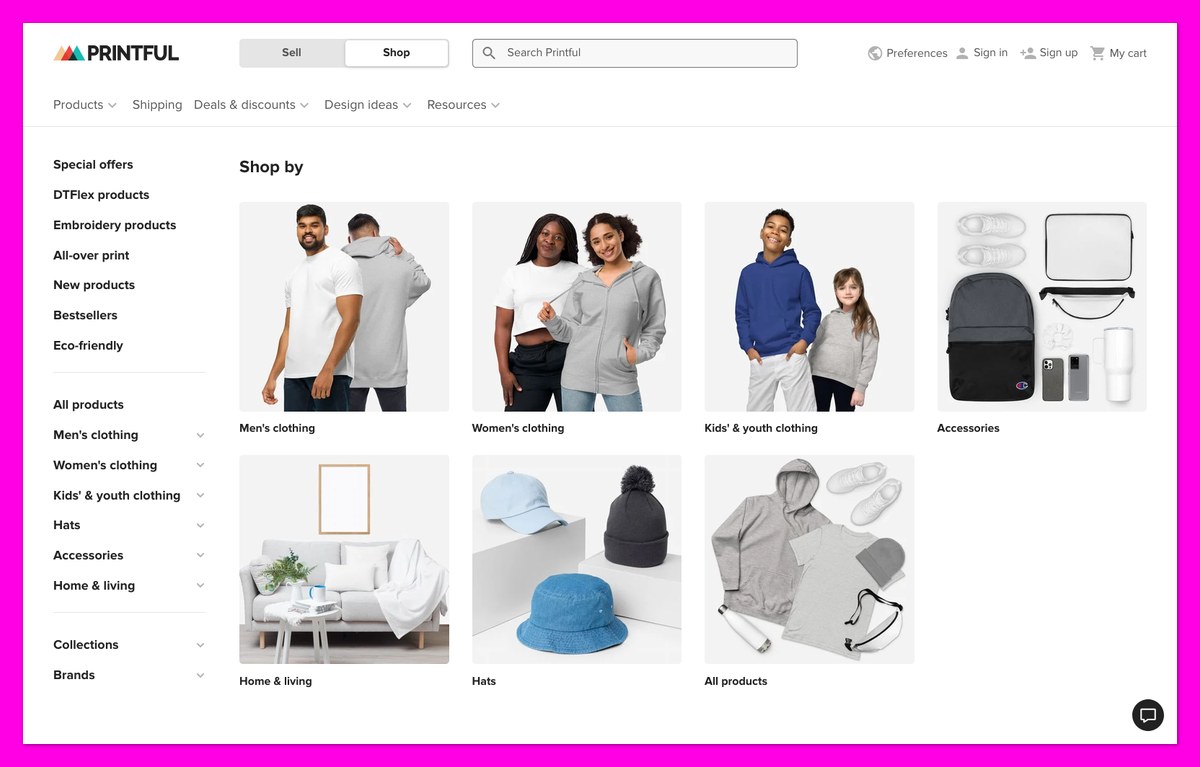
Printful has more than 600 products. These examples show Free plan base prices and US standard shipping:
| Product | Base price (Free plan) | US shipping (first item / each extra) |
|---|---|---|
| Bella+Canvas 3001 tee (S-XL) | $11.92 | $4.95 / $2.20 |
| Gildan 64000 Softstyle tee | $7.25 | $4.95 / $2.20 |
| Gildan 18500 hoodie | $21.95 | $8.79 / $2.50 |
| Embroidered Classic Dad Hat | $14.94 | $4.69 / $2.00 |
| White Glossy Mug, 11 oz | $6.50 | $6.69 / $3.50 |
| Enhanced Matte Poster, 12×16 in | $11.50 | From $4.99 / $0.40 |
The Gildan 5000 tee also costs $7.25, and the Growth plan takes up to 33% off product prices. Rates for other products and destinations are in our guide to Printful shipping rates.
How Printful Fulfills Orders
Printful uses seven in-house fulfillment centers: Riga, Barcelona, the UK, Charlotte, Dallas, Tijuana and Toronto. Printful picks the center for each order, not you.
Production takes 2-5 business days, with US standard shipping taking another 3-4 business days. Printful says over 97% of orders ship within 5 business days; that isn’t a delivery promise.
Printful stopped storing sellers’ own stock on March 1, 2026, so don’t choose it for warehousing non-POD goods.
A YouTube creator comparing Gelato, Printify and Printful described Printful’s own centers as offering more predictable lead times and consistent quality, but at higher prices.
What Shopify Brings to Fulfillment
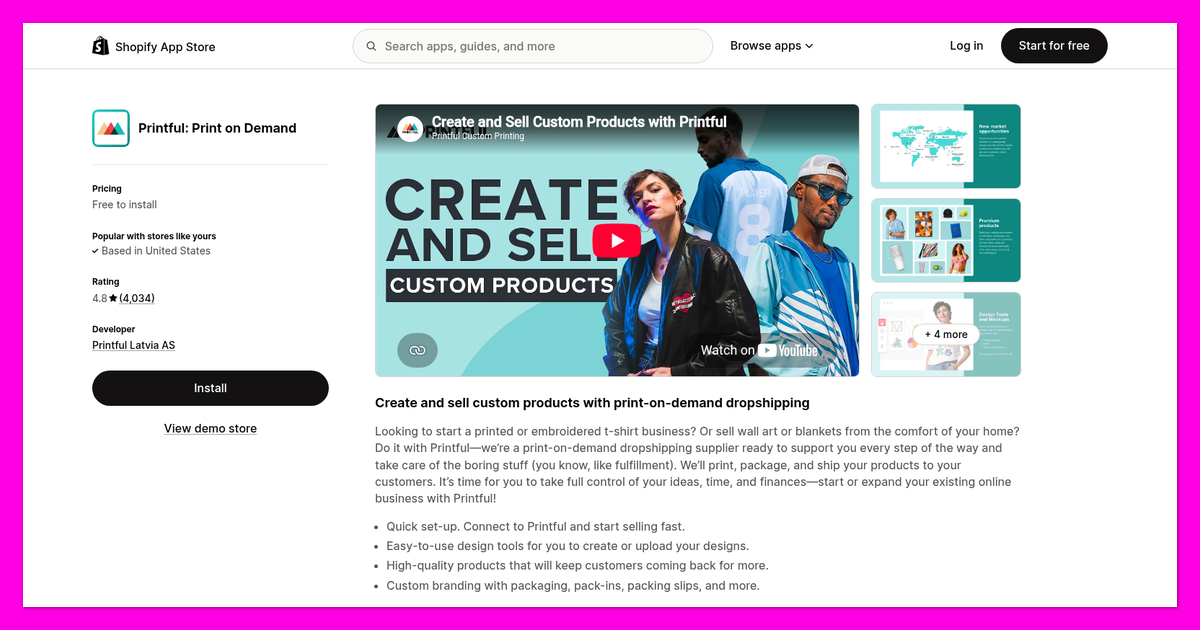
Shopify’s print-on-demand category lists 379 apps, including Printful, rated 4.8 from about 4,000 reviews, and Printify, rated 4.7. Both are free to install, so you aren’t locked into one supplier.
If you want to look beyond Printful, we’ve compared the best Shopify print-on-demand apps.
Printful and Printify announced a merger in November 2024 but still run as separate brands with their own apps. Our Printful vs Printify comparison covers the differences.
Our take
Shopify’s summary of Printful seller reviews highlights praise for order sync, product range and print quality, alongside higher base costs. One Canadian seller wrote in November 2026 that prices plus shipping leave “almost no profit on a basic Gildan.” I recommend Printful for its integrated fulfillment setup, not as the cheapest supplier. Check your margins first.
4. Best for Branding and Marketing: Shopify
The Winner
Shopify lets you build a brand around your products
Shopify gives you your own domain, themes, email marketing and ad tracking. Printful brands the product and parcel, but a Quick Store’s storefront branding is limited to your name and logo.
For a branded storefront with your own domain and email marketing, Shopify gives you far more tools to build one.
Store Design and Domain
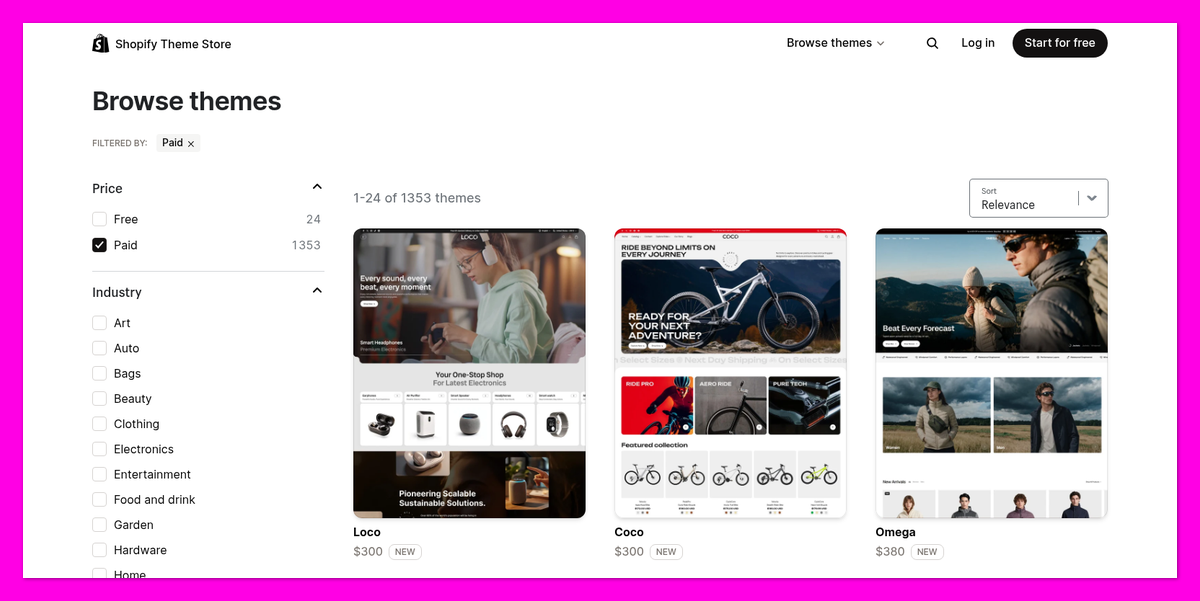
Shopify’s Theme Store has 24 free themes and about 1,350 paid themes at $100 to $500, paid once. A .com domain costs about $16 a year.
Quick Stores lets you set your store name, upload a logo and edit product names and descriptions. There are no layout changes, menus or custom themes, and you can’t connect a custom domain.
Your store isn’t fully white-label: Printful appears in places such as the URL, which you can’t change after you create the store. For more on these limits, see our guide to selling directly from Printful.
Marketing Tools
Shopify gives you ways to bring customers back and measure your campaigns:
- Shopify Email includes 10,000 free emails a month.
- Abandoned checkout emails are free on every plan.
- You can add Google Analytics and Meta Pixel for tracking.
Quick Stores doesn’t support those tracking tools. Printful points sellers who need them toward Shopify or WooCommerce, so if you plan to run ads, a Quick Store can’t measure them through those integrations.
A YouTube creator comparing POD storefronts also describes Quick Stores as harder to rank in Google than a full website, recommending it for sellers who already have a social following or email list.
Printful’s Product Branding
Printful’s branding lives on the product and parcel, rather than the storefront:
- Custom packing slip: free, with your logo and a message.
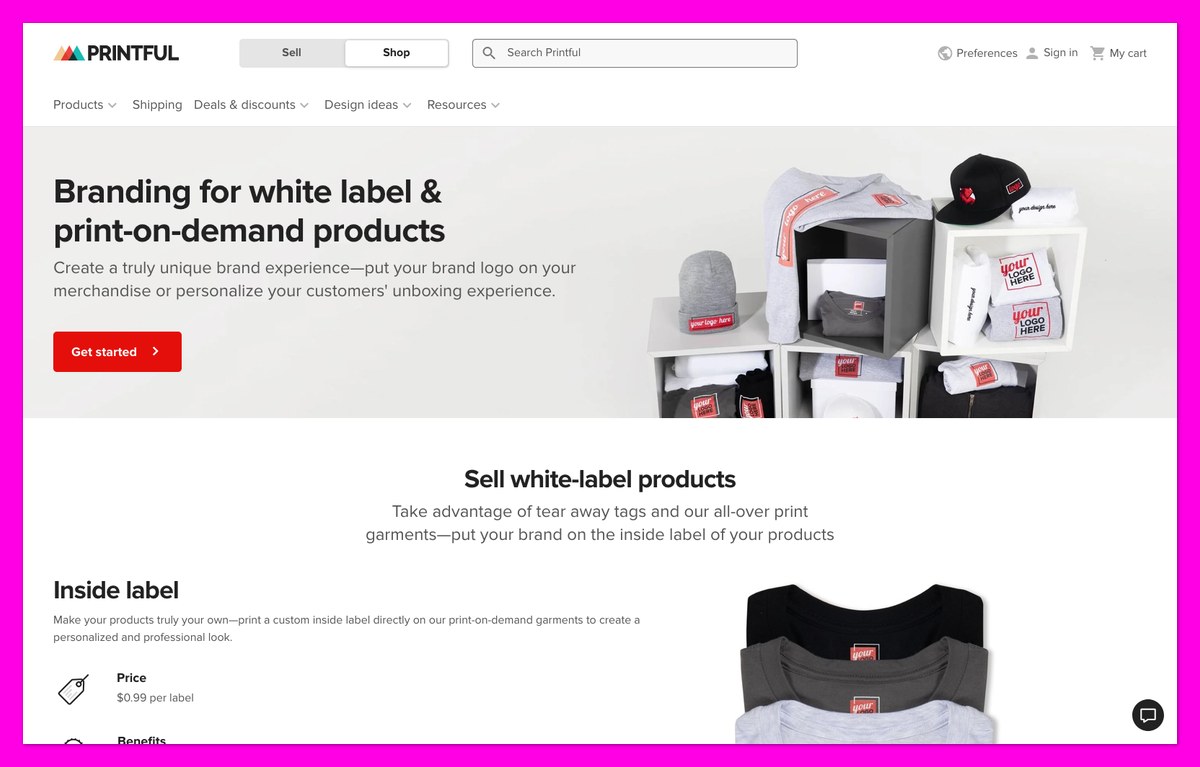
- Inside labels: $0.99 each, or $2.49 for an outside label.
- Pack-ins and custom packaging: $0.50 per order, plus a $25 monthly storage minimum.
- Embroidery digitization: $2.95-$6.50, once per design.
The Growth plan takes 9% off branding. You can combine Shopify’s storefront branding with Printful’s product branding rather than choosing between them.
Top Tip
Start with Printful’s free custom packing slip and add your logo and a thank-you note, so orders carry your brand without another fee. Add $0.99 inside labels once a design starts selling, rather than paying for every branding extra upfront.
5. Easiest to Use: Printful
The Winner
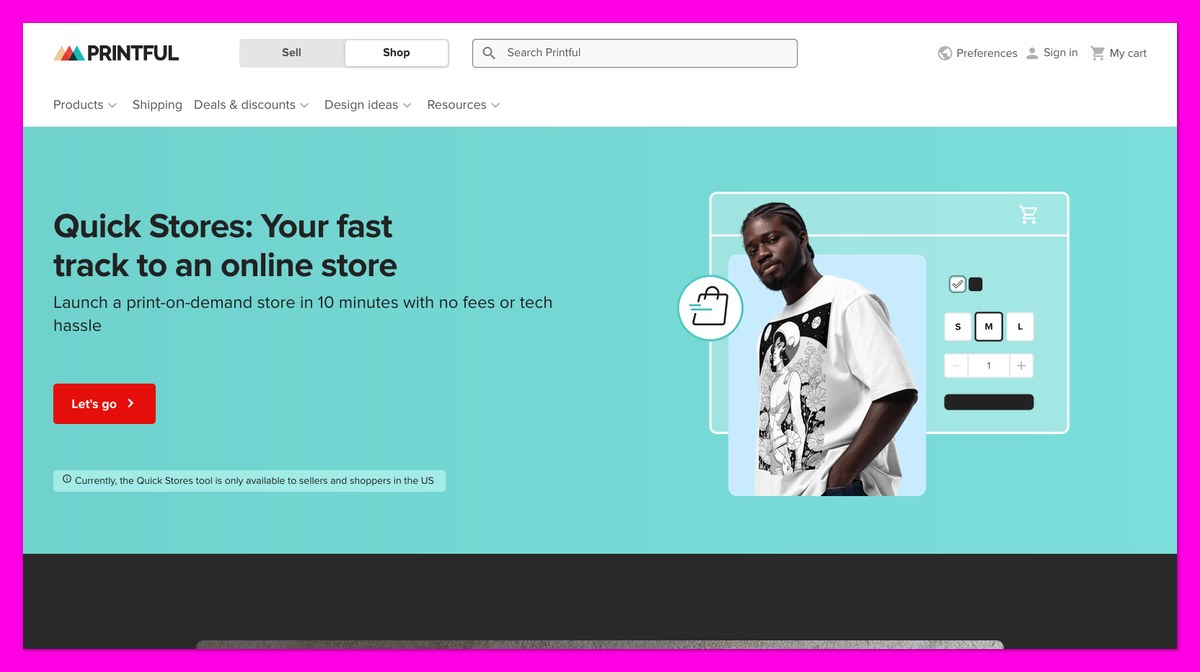
A Printful Quick Store can be live in about 10 minutes
Printful gives that setup estimate without requiring a billing method. Shopify adds a plan, payment setup and a Printful app connection.
A Quick Store is the faster route from idea to a live store, with fewer setup decisions than Shopify.
Getting Started With Printful Quick Stores
Printful says setup takes about 10 minutes, with no billing method needed. A YouTube creator who filmed their setup shows the form asks for:
- A store name and web address, using lowercase letters, numbers and hyphens.
- Your country of tax residence and a logo.
- A default markup: 30% to start, adjustable per product.
Getting paid requires more work. Before your first payout, add tax and legal details, upload a signed W-9 and pass Stripe’s identity check.
Without the W-9, Printful withholds 24% of your earnings. Finish that step before relying on the profit figures in round 1.
Getting Started With Shopify and Printful
Shopify’s trial store starts in private mode with checkout switched off. To take orders, set up a payment provider and pick a paid plan; your work carries over.
Then connect Printful:
- Create a free Printful account and design your first product.
- Install the free Printful app from the Shopify App Store and connect your store.
- Push your products to Shopify; new orders sync to Printful automatically.
You also choose a theme, add a domain and set shipping rates, which makes Shopify’s launch more involved. Our guide on how to connect Printful to Shopify walks through the setup.
What’s the Next Step After Setup?
Order a sample before you sell. A creator building a merch brand with Shopify and Printful orders samples and wear-tests them before listing products. The Growth plan takes 25% off samples.
Then bring traffic: Quick Stores gives you a link to share, and Shopify needs marketing too. Our Shopify print-on-demand startup guide covers the rest of the launch checklist.
What About Designing Products?
Printful’s Design Maker and mockup generator are free on every plan, whichever way you sell. Shopify has no product designer of its own, so with this setup, you design in Printful and push the finished product listing to Shopify.
6. Best for Support: Shopify
The Winner
Shopify offers 24/7 live chat on every plan
Basic, Grow and Advanced include round-the-clock chat. Printful’s chat starts with an AI assistant and hands you to a human agent when one is online, with no phone line.
Shopify takes the lead for support, though Printful still handles product problems in a Shopify store.
Printful’s app holds 4.8 stars from about 4,000 reviews, versus 4.1 from about 8,000 reviews on Trustpilot.
Shopify Support
✔️ 24/7 live chat on Basic, Grow and Advanced
✔️ A free Help Center and community forum
❌ Priority phone support only on Shopify Plus, from $2,300 a month
❌ Shopify can’t fix a misprint: product problems go to Printful
Printful Support
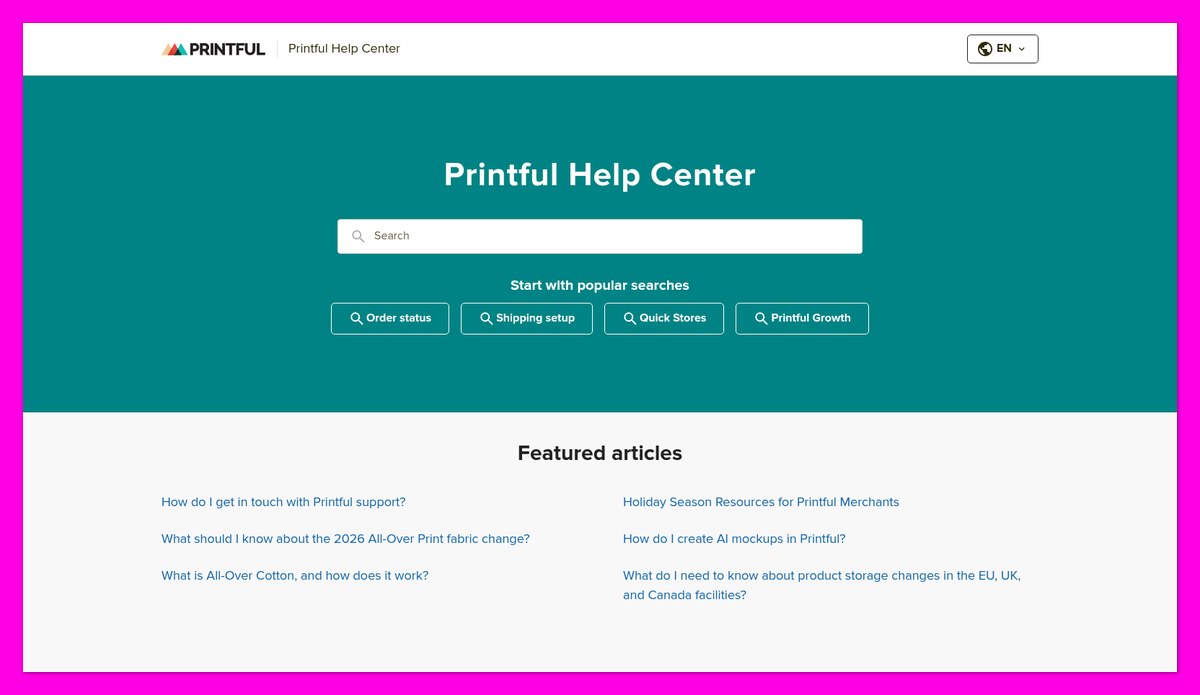
✔️ Chat that starts with an AI assistant and hands you to a human agent when one is online, plus a contact form and “Report a problem” in your dashboard
✔️ Free reprint or refund for manufacturing errors reported within 30 days of delivery, with photos
✔️ On Quick Stores, Printful handles customer issues and refunds buyers directly
❌ No phone support
❌ No returns or exchanges for wrong size, color or a change of mind, because products are made to order
❌ A seller of more than 10 years wrote in a 2026 Shopify App Store review that quality control “has gone super downhill.” Another said garment sizes can vary by up to an inch, a detail they felt was buried in product documentation
Who Handles a Misprinted Order?
In a Shopify store, your customer contacts you, not Printful, which changes who does the work:
| What happens | Shopify + Printful | Printful Quick Stores |
|---|---|---|
| Your customer contacts | You | Printful Support, through the link in your store’s footer |
| Who reports it to Printful | You, with “Report a problem” in the Printful dashboard, within 30 days of delivery | Printful reviews it directly |
| Where the refund goes | Your Printful Wallet, then you refund the customer in Shopify | Back to the customer’s original payment method |
| Size or change-of-mind returns | Your call, at your own cost | Not offered |
Lost packages must be reported within 30 days of the estimated delivery date.
How We Test Print-on-Demand Platforms
I weighted selling features most heavily because this comparison asks where you should sell. For this comparison, I used seven areas:
- Selling Features: 25%. We compare checkout, payments, fees, payouts and selling locations.
- Pricing and Value: 20%. We calculate per-sale and monthly profits.
- Products and Fulfillment: 15%. We compare products, prices, shipping and fulfillment times.
- Branding and Marketing: 15%. We assess design, domains, email, tracking and product branding.
- Help and Support: 10%. We check channels and responsibility for order problems.
- Ease of Use: 10%. We compare documented setup steps.
- Reputation: 5%. We review Shopify App Store and Trustpilot seller ratings.
Each side wins three rounds, but Shopify wins the most heavily weighted round: selling features.
I compared both companies’ pricing, product, help and policy pages, Printful’s Shopify App Store listing and seller reviews in November 2026. I didn’t use an account or place test orders. This comparison doesn’t judge print quality; order a sample before launch.
Shopify vs Printful: Our Winner
For most print-on-demand sellers, Shopify with Printful plugged in as your supplier is the best way to sell. Shopify won the selling, branding and support rounds, while Printful still makes and ships orders behind the scenes. Choose it for control over your business, not because it saves you money on fees.
Printful alone wins for US sellers testing a design at zero cost: a Quick Store keeps $13.08 on our $25 tee with no monthly fee. Outside the US, or if you don’t want a store, consider Printful’s marketplace integrations, subject to availability; our full Printful review goes deeper on the service. If its base prices squeeze your margins, our list of Printful alternatives covers other suppliers that work with Shopify.
While Shopify is our top choice overall, I recommend opening a free Printful account first, then trying Shopify’s free trial once you’re ready to build a brand.