Choosing the right print-on-demand platform can make or break your online store, and Tapstitch and Printify represent two very different approaches to the same problem.
One is built for fashion brands that want premium garments, consistent quality, and a fully branded customer experience. The other is built for scale, flexibility, and the lowest possible base costs across thousands of products.
In this comparison, we break down everything you need to know, product quality, pricing, integrations, fulfillment, and branding, so you can pick the platform that fits the business you’re actually building.
Tapstitch vs Printify: Quick Verdict
Tapstitch is a fashion-focused, premium apparel print-on-demand solution built for clothing brands that care about garment quality, multi-zone prints, and cohesive branding.
Printify is a broad, marketplace-style POD network optimized for low base costs, a massive product catalog, and multi-channel scale.
Reasons to use Tapstitch instead of Printify
Tapstitch is the better option if you’re building a real clothing brand rather than selling generic merch. It offers fashion-first blanks, in-house production with standardized quality, and fully branded packaging, all with no monthly subscription fee. It’s designed for sellers who want a vertically integrated partner and can price their products accordingly.
Reasons to use Printify instead of Tapstitch
Printify wins on catalog breadth, pricing flexibility, and multi-channel reach. With 1,300+ products, 90+ print providers, and integrations across every major ecommerce platform and marketplace, it’s purpose-built for sellers who want to test lots of niches, scale volume, and keep base costs as low as possible.
I’ll start this full comparison with a quick overview of both platforms before diving into the details.
| Feature | Tapstitch | Printify |
|---|---|---|
| Primary niche | Fashion / apparel brands | General POD (all categories) |
| Product catalog size | Curated apparel only | 1,300+ products across all categories |
| Fulfillment model | In-house production | Network of 90+ third-party print providers |
| Print quality consistency | ✅ Standardized (in-house) | ⚠️ Varies by provider |
| Monthly subscription | None (pay per order) | Free / $24.99–$39/month (Premium) / Enterprise |
| Product discounts | None | Up to 20–33% (Premium plan) |
| Base costs | Higher per item | Lower, especially with Premium |
| Production time | 2–4 business days | 2–7 business days (varies by provider) |
| Shopify integration | ✅ | ✅ |
| Etsy integration | ✅ | ✅ |
| Wix integration | ✅ | ✅ |
| WooCommerce integration | ❌ | ✅ |
| Squarespace integration | ❌ | ✅ |
| eBay integration | ❌ | ✅ |
| Amazon integration | ❌ | ✅ |
| TikTok Shop integration | Indirect (via Shopify) | ✅ Native (US) |
| Custom API access | ❌ | ✅ (Enterprise) |
| Multi-store support | Limited | Up to 10 stores (Premium) |
| Neck labels | ✅ Full catalog | ⚠️ Select providers only |
| Branded packaging | ✅ Fully branded | ⚠️ White-label only (varies by provider) |
| Multi-zone printing | ✅ | ⚠️ Depends on provider |
| Order tracking | ✅ (some delays reported) | ✅ |
| US fulfillment | ✅ | ✅ |
| International fulfillment | ✅ | ✅ (varies by provider) |
| Supplier selection control | ❌ (single partner) | ✅ Full control |
| Eco-friendly products | ✅ Premium blanks | ✅ Select products |
| Built-in storefront | ❌ | ✅ Pop-Up Store |
| Customer support outsourcing | ❌ | ✅ Printify Connect (Premium) |
| Trustpilot rating | ~4.3 | ~4.6 |
| Best for | Fashion brands, curated drops, brand-led positioning | Multi-channel scale, wide niches, price-driven markets |
Tapstitch and Printify: An Overview
Both Tapstitch and Printify are print-on-demand services that let you design, sell, and ship custom products through your own online store or marketplace. Like all POD platforms, they operate on a made-to-order model, products are only printed when a customer places an order, which means no upfront inventory costs.
The process with both platforms follows the same basic steps:
- Pick a product from their catalog
- Customize it with your design
- Set your retail price and list it in your store
Where they diverge significantly is in their underlying approach to production and their target audience.
Two Different Philosophies
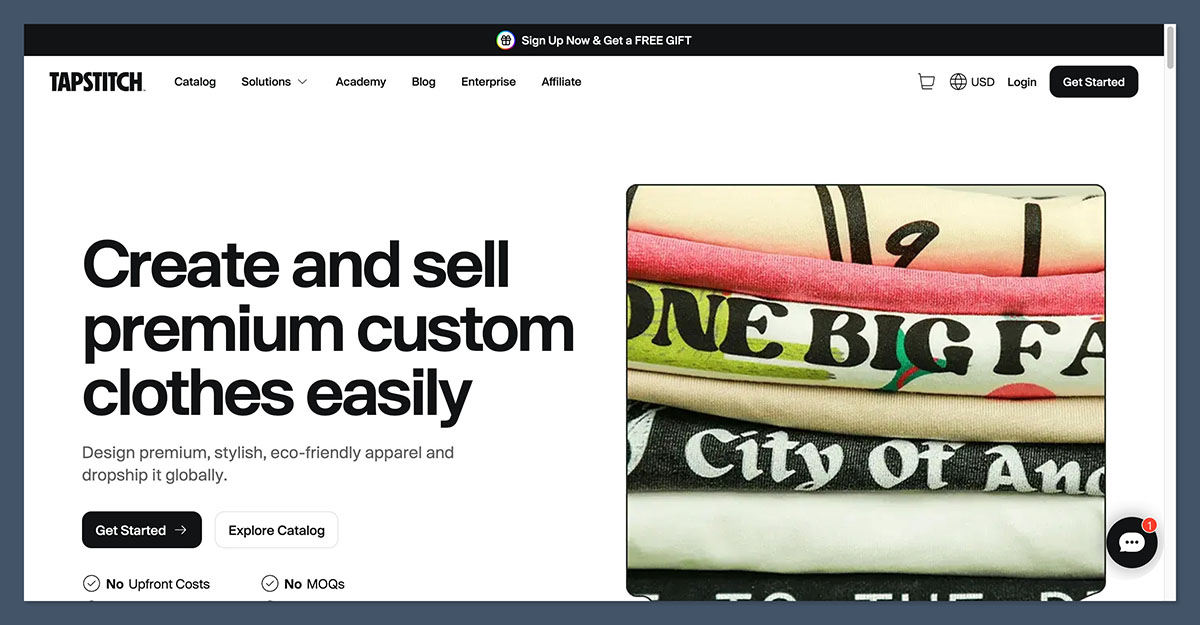
Tapstitch operates as a vertically integrated production partner. It handles printing in-house using its own “advanced printing technology,” which means quality is standardized and tuned to its specific garment blanks. Its pitch is squarely aimed at fashion-conscious creators: “build a real clothing brand, not just merch.”
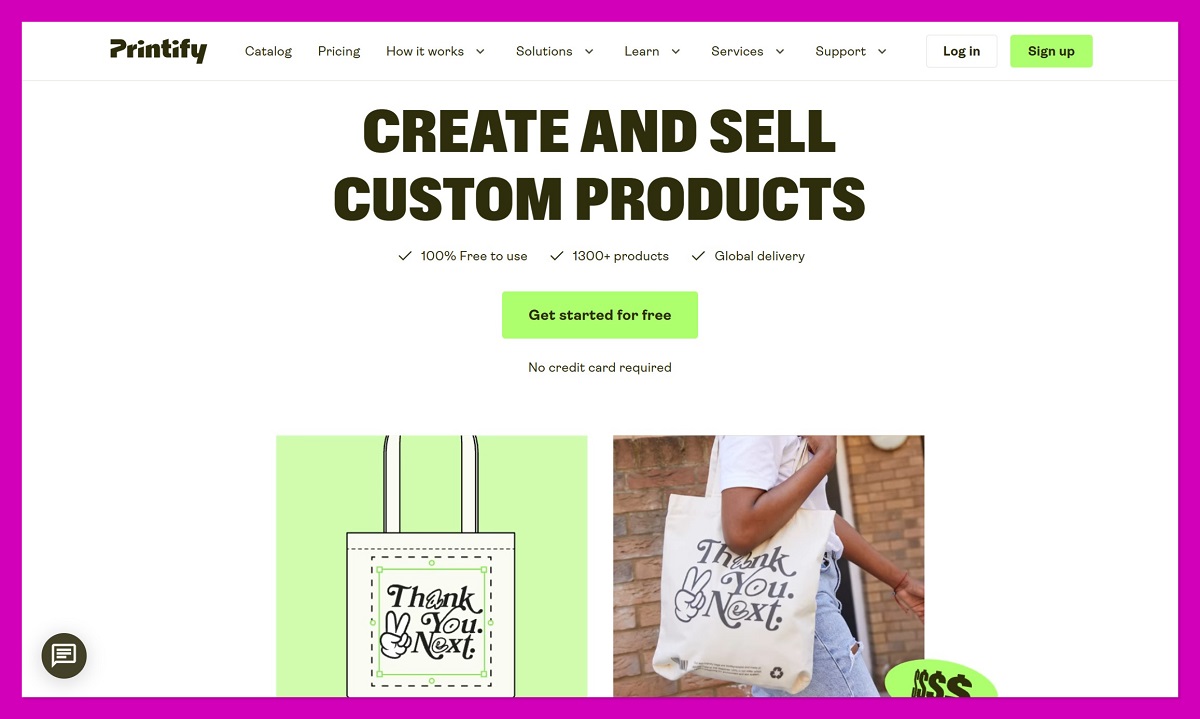
Printify operates as a classic broker or marketplace. Rather than printing anything itself, it connects you to a network of 90+ independent print providers globally.
You choose which supplier to use on a product-by-product basis, with each provider offering its own pricing, shipping rates, production times, and quality profile.
As we’ll see throughout this comparison, each approach has distinct trade-offs across product quality, pricing, branding, and scalability.
Platform Focus and Core Positioning
| Aspect | Tapstitch | Printify |
|---|---|---|
| Primary niche | Fashion / streetwear / apparel brands | General POD: apparel, mugs, wall art, home & living, and more |
| Catalog strategy | Curated, fashion-first garments (hoodies, tees, sweats, joggers, etc.) | Very large catalog across many categories and providers |
| Brand positioning | “Build a real clothing brand, not just merch” | “Scale POD with flexibility, low base prices, many suppliers and channels” |
| Fulfillment model | In-house production with US and international routing | Network of 90+ independent print providers globally |
Product Range and Quality
Catalog Breadth
This is one of the biggest differences between the two platforms.
Tapstitch concentrates entirely on apparel, tees, hoodies, sweatshirts, joggers, and similar fashion garments.
The catalog is intentionally curated rather than expansive, with an emphasis on premium, eco-leaning blanks and multi-location print options. If you’re building a clothing brand, this focus is a feature. If you want to sell mugs, wall art, or phone cases, Tapstitch isn’t the right fit.
Printify offers thousands of SKUs across virtually every POD category, from basics to niche products across apparel, accessories, homeware, and more. T
his makes it far more suitable for sellers who want to test many product types or operate outside the fashion vertical entirely.
Quality Control
Quality is where the two platforms’ production models produce meaningfully different outcomes.
Tapstitch uses in-house production, which means quality is standardized and consistent across its product range.
It specifically targets creators who are frustrated with the inconsistency of typical merch-grade POD, positioning itself around “fashion-first blanks, no MOQ, fast global shipping, fully branded.”
Printify quality varies by print provider. The platform addresses this by providing provider rankings and performance scores, as well as encouraging sellers to order samples before scaling.
This works, but it places the quality management burden firmly on the seller, you need to research providers, compare metrics, and test samples before committing.
What Users Say
On Trustpilot, Printify holds a rating of around 4.6, while Tapstitch sits at approximately 4.3, indicating solid but slightly lower average feedback for the newer platform.
Community feedback on Reddit is mixed for Tapstitch. Some users report good quality and decent turnaround times, while others note opaque tracking and warn against relying solely on marketing claims. The consistent advice: order samples before you scale.
Bottom line, if print quality consistency is your top priority, Tapstitch’s in-house model has a structural advantage over Printify’s distributed network. But if you’re willing to invest time in provider selection, Printify can deliver comparable results at lower cost.
Pricing, Plans, and Margins
Subscription and Platform Fees
Tapstitch has no paid subscription tier. You simply pay production and shipping costs per order, with no monthly fee regardless of your volume.
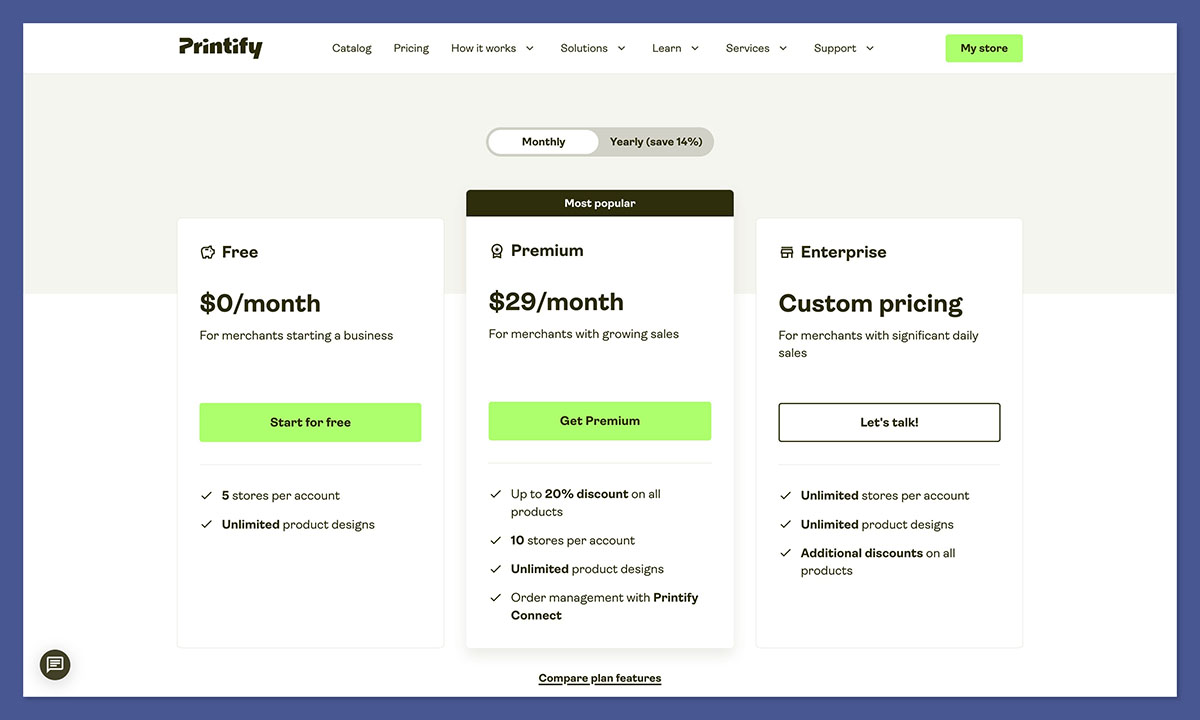
- Free: $0/month, up to 5 stores, unlimited products
- Premium: $39/month (or $24.99/month on an annual plan at $299/year), up to 10 stores, plus up to 20–33% discounts on products depending on the item
- Enterprise: Custom pricing for high-volume sellers with additional discounts and a dedicated account manager
Profitability Comparison
Printify’s own comparisons claim that, using matched products and January 2026 shipping data, Printify generates over 60% higher monthly profit than Tapstitch at both low and high sales volumes.
This is primarily attributed to lower base costs, lower shipping rates, and Premium plan discounts. Worth noting: this is vendor-authored data, so treat it as directionally useful rather than gospel.
The honest framing for your decision:
- Tapstitch: No subscription, but higher per-item and shipping costs. Best suited to higher retail price points and brand-led positioning where margins come from premium pricing rather than cost minimization.
- Printify: A monthly subscription at scale (Premium), but lower base costs and better margins once volume justifies the subscription. More competitive in price-driven niches.
Integrations and Scalability
Store and Channel Integrations
This is a clear win for Printify.
Tapstitch offers native integrations for Shopify, Etsy, and Wix, plus a Shopify app. It can reach channels like TikTok Shop indirectly via Shopify or WooCommerce, but doesn’t offer the same breadth of native multi-platform integration that Printify does.
Printify provides native integrations with Shopify, Etsy, WooCommerce, Wix, Squarespace, BigCommerce, Prestashop, eBay, Amazon, TikTok Shop (US), and more, plus custom API access for larger operations.
| Platform / Marketplace | Tapstitch | Printify |
|---|---|---|
| Shopify | ✅ Native | ✅ Native |
| Etsy | ✅ Native | ✅ Native |
| Wix | ✅ Native | ✅ Native |
| WooCommerce | ❌ | ✅ Native |
| Squarespace | ❌ | ✅ Native |
| eBay | ❌ | ✅ Native |
| Amazon | ❌ | ✅ Native |
| TikTok Shop | Indirect (via Shopify) | ✅ Native (US) |
| Custom API | ❌ | ✅ (Enterprise) |
If you’re running or planning a multi-store, multi-marketplace operation, Printify is the significantly stronger choice here.
Scaling Your Operation
Tapstitch is well suited to small-to-mid-sized brands running curated drops or collections. Its focused catalog and in-house production make it easier to maintain quality at that scale, but it’s not designed for massive SKU libraries or high-volume multi-channel operations.
Printify is explicitly built for horizontal scale, testing many products across several marketplaces and stores. Its Premium and Enterprise tiers specifically target high-volume merchants with meaningful discounts that improve margins as order volume grows.
Fulfillment, Shipping, and Branding
Fulfillment and Shipping
Tapstitch handles production in-house with a typical production time of 2–4 business days. It offers US and international fulfillment with tracking on all orders. User reviews generally describe shipping speed as solid, though not exceptional, and some note that tracking updates can be opaque.
Printify‘s network of 90+ print providers across multiple regions means orders can often be routed closer to the end customer, which can reduce both shipping time and cost.
All orders include tracking, and some providers offer localized shipping options, for example, EU-only or US-only production, which is useful for international sellers managing shipping costs.
The key caveat with Printify’s routing is that it works best for single-product orders. If an international customer orders multiple items from your store at once, you can’t always reroute different items to their nearest print location.
Branding Options
Tapstitch makes branding a central part of its pitch. It markets “every detail branded for you”, with fashion-centric options including neck labels, multiple print zones, and fully branded packaging for clothing brands. For sellers building a real clothing brand identity, this is a genuine differentiator.
Printify offers branding options, but availability depends heavily on which print provider you’re using and which product you’re selling.
You can typically add branded inserts, custom packaging, or neck labels on select SKUs, but this is not uniform across the network. You’ll need to check provider-by-provider to confirm what branding is available for your specific products.
If consistent, fully branded presentation across your entire product range is important to you, Tapstitch has a clear structural advantage here.
Tapstitch vs Printify: Which Should You Choose?
Tapstitch is the better choice if you:
- Run or plan a fashion-first brand, streetwear, minimalist apparel, curated clothing lines, and want to prioritize garment quality and consistent brand presentation over catalog size
- Prefer dealing with one vertically integrated production partner and can charge higher retail prices to offset higher base costs
- Primarily sell via Shopify, Etsy, or Wix and don’t need deep multi-channel integrations right away
- Want fully branded packaging and neck labels available across your entire range without having to check provider-by-provider
Printify is the better choice if you:
- Want to test many product types and niches with a very wide catalog and are comfortable managing variable quality through provider selection and sampling
- Aim to build a multi-channel POD operation across marketplaces and store platforms, and expect to scale volume enough that Premium or Enterprise discounts materially boost margins
- Are highly price-sensitive and need the lowest possible base and shipping costs to compete in crowded, price-driven niches
- Need integrations with platforms beyond Shopify, Etsy, and Wix, particularly WooCommerce, Amazon, eBay, or TikTok Shop
Tapstitch vs Printify: Conclusion
These are two platforms with genuinely different purposes, and the right choice depends almost entirely on what kind of POD business you’re building.
If you’re building a clothing brand, one where the garment quality, the branding, and the overall brand presentation matter as much as the design itself, Tapstitch deserves serious consideration.
It removes the complexity of supplier management, delivers consistent quality, and makes fully branded presentation straightforward from day one. The trade-off is higher per-item costs and a narrower catalog, which means it works best when paired with strong retail pricing.
If you want scale, catalog breadth, and the lowest possible base costs, and you’re willing to invest time in provider selection and sampling, Printify is the more powerful and flexible platform.
Its Premium plan unlocks meaningful discounts, its integration list is the most comprehensive in the POD space, and its network of global print providers gives you real flexibility in managing shipping costs across markets.
The best way to find out which is right for you? Try both. Both platforms offer free accounts with no upfront commitment.
Tapstitch vs Printify – Pros and Cons Summary
Reasons to choose Tapstitch over Printify
- In-house production means standardized, consistent print quality across your entire catalog
- No monthly subscription — you only pay per order
- Fashion-first garment blanks specifically chosen for clothing brands, not generic merch
- Fully branded packaging, neck labels, and multi-zone prints available without provider-by-provider checking
- Simpler supplier relationship — one production partner, one set of quality standards
- Ideal for curated drops and collections where brand cohesion matters more than catalog size
Reasons to choose Printify over Tapstitch
- Access to 1,300+ products across virtually every POD category — more than 10x Tapstitch’s range
- 90+ print providers globally, with the ability to choose suppliers based on price, location, production time, and reviews
- Native integrations with 10+ platforms and marketplaces including WooCommerce, Amazon, eBay, and TikTok Shop
- Premium plan ($24.99–$39/month) unlocks up to 20–33% product discounts, improving margins significantly at volume
- Better suited to multi-channel and multi-store operations
- More competitive base costs in price-driven niches where retail pricing power is limited
- Pop-Up Store feature lets you sell without a separate ecommerce platform