
Photography prints sit somewhere between art and home decor, and the way you sell them should reflect that.
The photographer who builds a brand around cohesive, room-ready collections will almost always outsell the one who dumps a portfolio onto a marketplace and hopes for the best.
This guide covers how to sell photography prints online in a way that actually works: choosing the right business model, picking platforms and print-on-demand providers, preparing files that won’t disappoint buyers, pricing for real margins, and driving traffic without burning through an ad budget.
The short version. You have three paths:
- Marketplaces (Etsy, Fine Art America, Redbubble) give you built-in traffic but low control.
- Your own store (Shopify, Squarespace) paired with a POD lab (Printful, Gelato, Printify) gives you higher margins and brand ownership but requires you to drive traffic.
- Client galleries (SmugMug, PhotoShelter) work best if you already shoot events and want to upsell prints to existing clients. Most successful photographers eventually combine two or three of these.
1. Choose Your Business Model
Before you pick a platform or upload a single file, you need to decide how you want to reach buyers. There are three main models, and each involves different tradeoffs between effort, control, and income potential.
Direct-to-consumer via your own store
This means building a standalone website (Shopify, Squarespace, WooCommerce) and connecting it to a print-on-demand fulfillment service. You control your brand, your pricing, your customer data, and the entire shopping experience.
The tradeoff is that nobody shows up unless you bring them there yourself through marketing, SEO, and social media.
This model works best for photographers building a recognizable brand around a specific style or niche, whether that’s landscape work, travel photography, fine art, or architectural minimalism. Margins are higher because you’re not paying marketplace commissions, but it takes longer to get your first sale.
Marketplaces and art platforms
Platforms like Etsy, Society6, Redbubble, and Fine Art America have millions of active buyers browsing for wall art. You upload your images, set your markup, and the platform handles discovery, production, and often shipping. The downside is heavy competition, limited brand control, and fees that eat into your margins.
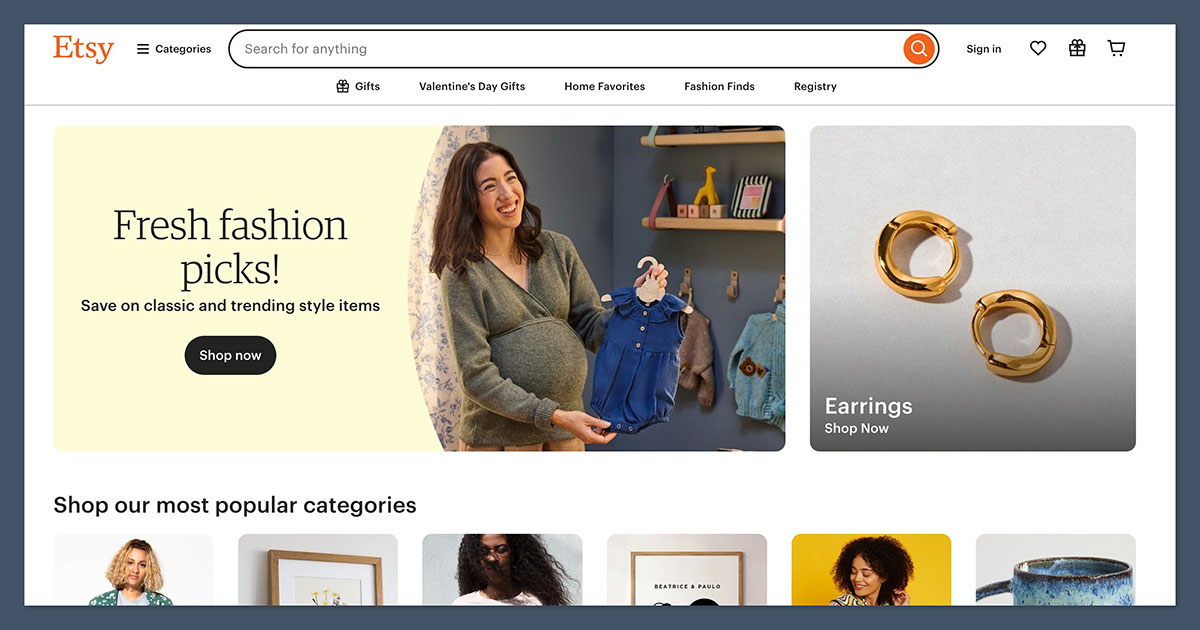
Marketplaces are a good starting point if you want to test which images actually sell before investing in your own storefront.
They’re also useful as a long-term secondary channel even after you have your own site.
Client galleries and private sales
Tools like SmugMug Pro and PhotoShelter focus on private galleries where event and portrait clients can browse, proof, and order prints.
These platforms integrate with professional print labs and handle the entire transaction. If you already shoot weddings, portraits, or commercial work, this is the fastest path to print revenue because you’re selling to people who already want your specific images.
Think of these models as a spectrum. Marketplaces sit at the “fast and easy but low control” end. Your own branded store sits at the “slow to build but high margins and full ownership” end. Client galleries fall somewhere in between. The smart move is to start where you can get traction fastest, then expand toward more control over time.
2. Pick Your Platform and Print-on-Demand Stack
The platform you sell on and the lab that prints your work are two separate decisions, though some services bundle both. Here’s how the landscape breaks down.
Platform layer: where buyers find and buy your prints
| Use case | Best platforms | What to know |
|---|---|---|
| Build a branded print store | Shopify + POD app, Squarespace, WooCommerce | Full design and SEO control; higher setup effort; you drive all traffic |
| Sell to art and decor buyers | Etsy, Society6, Fine Art America, Redbubble, Zazzle | Built-in search traffic; platform fees and competition; limited branding |
| Serve event and portrait clients | SmugMug Pro, Pixpa, PhotoShelter | Private galleries; integrated labs; proofing and upsell tools |
| License digital files | Adobe Stock, Shutterstock, Alamy | Licensing revenue, not physical prints; can complement a print business |
Production layer: who prints and ships your work
If you’re running your own store, you’ll connect to a POD fulfillment service. If you’re on a marketplace like Society6 or Fine Art America, the platform handles production internally. Here are the main POD options for photographers.
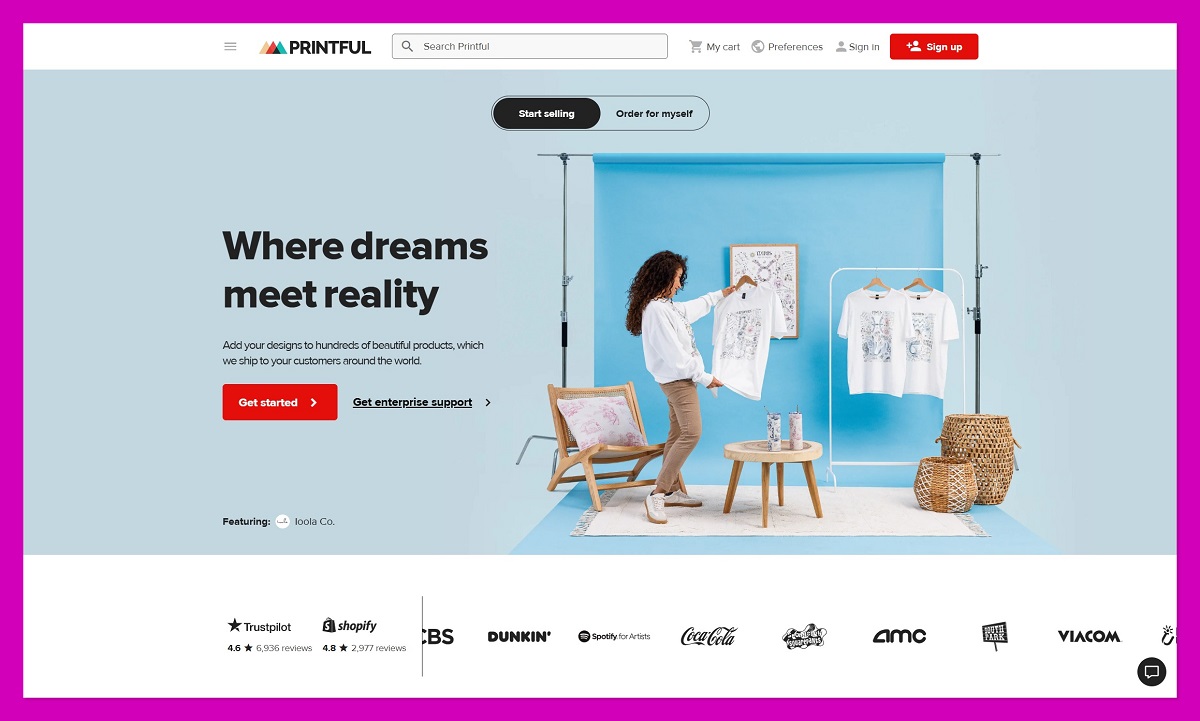
Printful offers a wide product range including posters, framed prints, canvas wraps, and metal prints. Its mockup generator is strong, and branding options (custom labels, pack-ins, branded packaging) are more developed than most competitors. Base prices tend to run higher than Printify, but print quality and customer support are consistently good.
Printify connects you to a network of third-party print providers, which often results in the lowest base prices. The tradeoff is that quality can vary between providers, so you’ll need to test samples from each one you plan to use. It’s a good fit for budget-conscious sellers focused on posters and standard wall art.
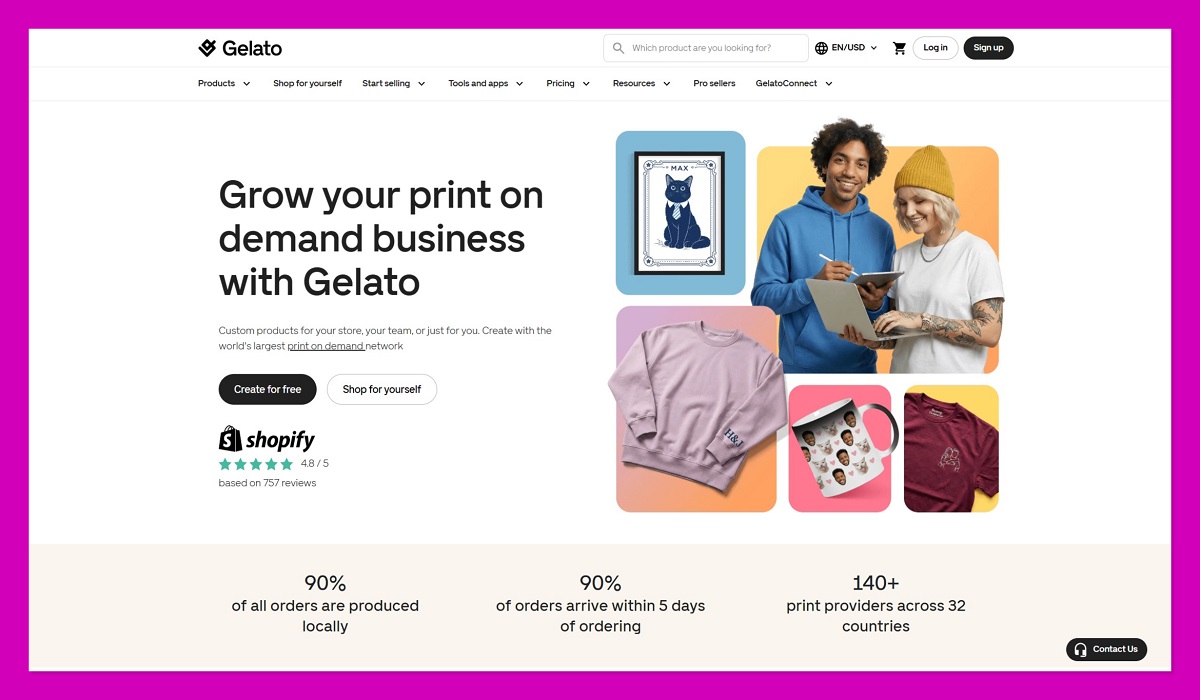
Gelato operates a global network of print partners, which means orders ship from a facility close to the buyer. This translates to faster delivery and lower shipping costs, especially for international customers. It integrates with Shopify, WooCommerce, and Etsy, and offers white-label packaging so buyers see your brand, not the lab’s.
Fine Art America, Society6, and Redbubble function as both marketplaces and fulfillment services. You upload your images, set your margin, and they handle everything from printing to shipping. The convenience is hard to beat, but you sacrifice control over quality, packaging, and the customer experience.
SmugMug Pro, Bay Photo, and CanvasPop lean toward professional-grade output with color-managed workflows, ICC profiles, and premium substrates like cotton rag and metallic papers. These are better suited for fine art and high-end portrait work where color accuracy is non-negotiable.
Stack recommendation: Think of your setup as “platform + lab.” For example: Shopify + Gelato for a branded global store, Etsy + Printify for budget-friendly marketplace exposure, or SmugMug + Bay Photo for professional client galleries. You can run more than one stack simultaneously.
3. What Actually Sells (And What Doesn’t)
Not every great photograph makes a great print product. The images that sell well as wall art tend to be the ones that fit into someone’s living space, not just someone’s Instagram feed.
Subjects that perform well
Nature, landscapes, and coastal scenes consistently rank among the best sellers, especially when they feature recognizable or emotionally resonant locations.
Minimalist architecture, cityscapes, and calm interior-friendly compositions also do well because they complement modern home decor without clashing.
“Personal connection” themes tend to outperform generic beauty shots. A print of a specific coastal town, a local skyline, or a recognizable hiking trail will often outsell a technically superior but anonymous landscape. Buyers want something that triggers a memory or says something about who they are.
On the trendier end, high-flash retro aesthetics, intentional film grain, and warm analog color palettes are performing well in the mid-2020s, especially with younger buyers decorating first apartments.
Formats and products that move
Standard sizes (20×30, 16×24, A2/A3) in framed prints and canvas wraps account for the bulk of home-decor purchases.
These are the “safe” products that appeal to the widest audience. Large statement pieces and curated sets (triptychs, gallery walls of three to five complementary prints) are popular for living rooms and offices where buyers want a finished look.
Metal and acrylic prints sit in a premium segment. They work especially well for vivid landscapes, cityscapes, and high-contrast images where the material adds visual impact. They also justify higher price points.
How buyers find and buy prints
Most print buyers discover work on social media (Instagram, Pinterest, TikTok) and then complete purchases on a separate storefront. This means your social presence drives awareness, but your product pages close the sale. Clear mockup images showing prints in real room settings significantly boost conversion rates because buyers can see the scale and how a piece fits their space.
Key mindset shift: Think “decor fit” over “photography portfolio.” Build cohesive collections organized by room, color palette, or mood rather than by date shot or camera used. Buyers are decorating, not browsing a portfolio.
4. File Preparation and Print Quality
Getting the technical side right is what separates prints that delight buyers from prints that get returned. This isn’t the most exciting part of the process, but skipping it is expensive.
Resolution and file setup
Export your files at the final print dimensions with 300 DPI whenever possible. For large wall art, most POD providers publish specific minimum pixel dimensions per size, so check those before uploading. Work in sRGB unless your lab explicitly requests a different color space, and calibrate your monitor or use the soft-proofing ICC profiles that professional labs provide.
Keep your master files as TIFFs or high-quality PSDs. Most POD services accept flattened JPEGs for upload, so export a production-ready JPEG from your master rather than uploading the editable file directly.
Paper, finishes, and materials
The three most common options are matte/lustre photo paper (affordable, versatile), cotton rag or fine art paper (textured, premium feel, best for fine art), and canvas (gallery-wrap ready, popular for large pieces).
Each has a different look, texture, and price point.
Rather than offering every available option, curate a small set, maybe three to four choices, that match your work and price positioning. “Premium Lustre,” “Fine Art Rag,” and “Canvas Gallery Wrap” is a clean lineup that covers most buyer preferences without creating decision fatigue.
Proofing and test orders
Order samples from every POD provider you plan to use. Check color accuracy against your calibrated monitor, inspect sharpness at the actual print size, and evaluate the packaging quality. This step is non-negotiable: it protects you from returns and bad reviews.
Those test prints also double as content. Photograph them in real settings (on a wall, leaning against furniture, being unwrapped) and use those images in your product listings and social posts. Real product photography builds trust far more effectively than digital mockups alone.
File preparation checklist:
- Export at final print dimensions, 300 DPI
- Work in sRGB (unless your lab says otherwise)
- Calibrate your monitor or use lab-supplied soft-proofing profiles
- Keep master TIFFs/PSDs; upload flattened high-quality JPEGs
- Order test prints from every provider before listing products
- Photograph test prints in real room settings for product imagery
5. Pricing for Real Margins
Pricing photography prints is where many sellers leave money on the table. Underpricing signals low value and kills margins. Overpricing without brand support kills sales. The goal is a price structure that covers all costs, leaves healthy profit, and positions your work appropriately.
Know your cost stack
Your retail price needs to cover three things: the POD base price (production), shipping costs, and platform or payment processing fees. On marketplaces like Society6, the platform sets a base and lets you add a percentage markup.
Fine Art America lets you set a fixed dollar markup. On your own store, you control the entire price but need to factor in payment processing (typically 2.9% + $0.30 per transaction) and any Shopify or hosting fees.
Typical markups that work
A good starting target is 2x to 3x your total cost (production plus average shipping) for standard prints. Framed prints, large formats, and premium materials can support higher markups because buyers already expect to pay more for those products.
Limited editions, signed prints, and certificate-of-authenticity pieces push even further into premium pricing territory if your brand and audience support it.
Build a product ladder
Offer at least three tiers. An accessible entry product (small open-edition print, maybe $25 to $45) brings first-time buyers in. Core products (mid-size framed prints, $75 to $150) generate most of your revenue.
A premium tier (large limited editions, metal or acrylic prints, $200+) maximizes revenue from your most engaged customers and creates aspirational value that makes the mid-tier look reasonable by comparison.
Pricing example: 30×40 cm framed print. If the POD base price is $22, shipping averages $8, and payment processing is roughly $4 at retail, your total cost is about $34. At a 2.5x markup, your retail price would be $85. At 3x, it’s $102. Pick a price point that reflects your brand positioning and test buyer response.
On marketplaces, resist the urge to race to the bottom on price. You’ll never be the cheapest, and trying to be signals that your work isn’t worth much. Compete on niche appeal, presentation quality, and perceived value instead.
6. Build a Store That Converts
Whether you’re on Shopify, Etsy, or SmugMug, the fundamentals of a high-converting print store are the same.
Buyers need to quickly understand what you sell, trust the quality, visualize the product in their space, and check out without friction.
Curate a cohesive catalog
A focused niche or theme almost always outperforms a random mix of images. “Andalusian coastal minimalism” is a store. “Photos I like” is a portfolio. Group your products into collections organized by room, color palette, or mood so buyers can visualize how pieces work together. Curated sets and gallery wall bundles also increase average order value.
Product pages that close the sale
Use multiple images on every product page: a hero shot of the print, a close-up showing texture or frame detail, and at least one real-room mockup showing the print on a wall with furniture for scale. Include clear size guides, framing options with visuals, paper or material descriptions, shipping timelines, and simple care or hanging instructions. Every unanswered question is a reason not to buy.
Trust signals
Reviews and testimonials (even a handful) matter more than most sellers realize, especially for higher-priced pieces. Display a clear return and refund policy, visible contact information, and transparent shipping details including estimated delivery times. For wall art, buyers want to know exactly what’s arriving, when, and what happens if something goes wrong.
Quick win: If you’re just starting and don’t have reviews yet, photograph your test prints being unwrapped, hung on a wall, and displayed in a real room. An “unboxing” gallery on your product page builds confidence and shows buyers exactly what they’ll receive.
7. Drive Traffic and Market Your Prints
Having a great store with beautiful prints means nothing if nobody sees it. Marketing photography prints is a long game built on consistent visibility, not viral moments.
Social media and content
Instagram, TikTok, Pinterest, and YouTube Shorts are the primary discovery channels for wall art. Post consistently around your niche with a mix of finished work, behind-the-scenes process content, and lifestyle shots showing prints in real spaces.
Pinterest deserves special attention for photography prints because pins drive traffic for months after posting, and the platform skews heavily toward home decor and interior inspiration.
Email marketing
Build an email list from day one, even if it’s small. Offer a simple lead magnet like a free phone wallpaper download, a print size guide, or a room decor checklist in exchange for an email address.
Then set up a basic automated sequence: introduce yourself and your story, showcase best sellers, and announce new releases or limited drops. Email consistently outperforms social media for converting interested browsers into buyers.
SEO and search visibility
Optimize your product titles, descriptions, and collection pages around decor-oriented search terms. “Large coastal wall art” and “minimalist bedroom photography print” will attract buyers with purchase intent. Generic terms like “landscape photo” won’t.
Add concise Q&A sections to product and category pages (covering questions like “Is this print framed?” or “How long does shipping take?”) to improve visibility in both traditional search and AI-driven answer engines.
Paid ads and partnerships
Retargeting ads on Meta and Pinterest are cost-effective once you have warm traffic from organic content. Cold ads tend to be expensive for print sales, so build your organic foundation first.
Collaborations with interior designers, local hotels, cafes, or home decor influencers can place your prints in real spaces and create both authority and exposure that paid ads can’t replicate.
Two marketing modes to plan around. “Always-on” channels (Pinterest, SEO, email sequences) generate steady baseline traffic. “Launch” campaigns (limited edition drops, seasonal collections, holiday promotions) create urgency and spikes. You need both.
8. Legal, Operations, and Risk Management
The unglamorous side of selling prints trips up a lot of photographers. Getting these basics right protects your income and your reputation.
Image rights and licensing
Make sure you own full rights to every image you sell as a print. If your photos include recognizable people, you need model releases. If they feature private property or certain landmarks, check whether property releases are required. Be explicit in your terms of sale about what the buyer is purchasing: a physical print for personal display, not a license to reproduce the image commercially.
Returns, damage, and customer service
With POD fulfillment, the provider typically handles reprints for damaged or defective orders, but you need to understand their specific policies on color variance, shipping damage, and lost packages.
Communicate your return policy clearly on your store, and set up standardized responses for common support scenarios. In niche art markets, slow or unhelpful customer service destroys word of mouth faster than almost anything else.
Avoid platform dependency
If Etsy changes its algorithm or fee structure tomorrow, and that’s your only sales channel, your business takes a hit overnight. Build an email list and an independent website alongside any marketplace presence.
The email list is the asset you actually own. Over time, shift your primary revenue toward channels you control while keeping marketplaces as a discovery and secondary income source.
Final Thoughts
Selling photography prints online is not a passive income hack. It’s a real product business that happens to use your creative work as the raw material.
The photographers who succeed at it treat it that way: they pick a niche, build a cohesive catalog, choose the right platform and fulfillment stack, and put as much effort into marketing and customer experience as they do into the images themselves.
The barrier to entry has never been lower. Print-on-demand removes the need for inventory, upfront investment, and shipping logistics. Platforms like Shopify, Etsy, and Fine Art America make it possible to go from idea to live store in a weekend. But low barriers also mean more competition, which is why positioning, presentation, and consistency matter more than ever.
Start with one channel and a small, focused collection. Test what sells. Order your own prints and make sure the quality holds up. Build an email list from day one.
Then expand: add a second sales channel, introduce new formats or sizes, experiment with limited editions or seasonal drops. Growth in this space is incremental, not overnight, but the margins on a well-positioned print business are genuinely good once the flywheel starts turning.
Your camera already did the hard part. Now build the business around it.
Frequently Asked Questions
Do I need my own website to sell photography prints?
Not to start. Marketplaces like Etsy, Fine Art America, and Society6 let you begin selling without building a site. But long-term, your own store (on Shopify, Squarespace, or similar) gives you higher margins, full brand control, and ownership of your customer data. Most successful print sellers eventually run both.
Which print-on-demand service is best for photographers?
It depends on your priorities. Gelato is strong for international shipping and white-label branding. Printful offers the best mockup tools and widest product range. Printify tends to have the lowest base prices. For fine art and professional-grade output, SmugMug Pro or Bay Photo with color-managed workflows are better choices. Order test prints from any service before listing products.
How should I price my photography prints?
Start by calculating your total cost: POD base price plus average shipping plus payment processing fees. Then mark up at least 2x to 3x that cost for standard prints, and more for framed, large-format, or limited edition pieces. Build a product ladder with an entry-level, mid-range, and premium tier to capture different buyer budgets.
What types of photography prints sell best?
Nature and landscape prints, especially those featuring recognizable or emotionally resonant locations, are consistently strong sellers. Minimalist architecture, cityscapes, and calm interior-ready compositions also do well. The key factor is “decor fit”: images that look good on a wall and complement modern interior styles tend to outperform technically impressive but visually busy work.
How do I drive traffic to my print store?
Pinterest and Instagram are the strongest organic channels for wall art discovery. SEO around decor-focused keywords (like “large coastal wall art” rather than “landscape photography”) attracts buyers with purchase intent. Email marketing converts browsers into buyers more reliably than social media. Retargeting ads work well once you have organic traffic flowing, but cold ads are usually too expensive to start with.
Do I need to hold inventory?
No. Print-on-demand means each order is printed and shipped only after a customer buys it. You never hold physical inventory, which eliminates upfront investment in stock and reduces risk. The tradeoff is slightly higher per-unit costs compared to bulk printing, and longer fulfillment times.
How important is print quality for selling online?
Critical. Wall art is a considered purchase, and buyers expect the product to match what they saw on screen. Always order test prints to verify color accuracy, sharpness, and packaging quality before listing. Poor print quality leads to returns, negative reviews, and destroyed trust that’s hard to rebuild.