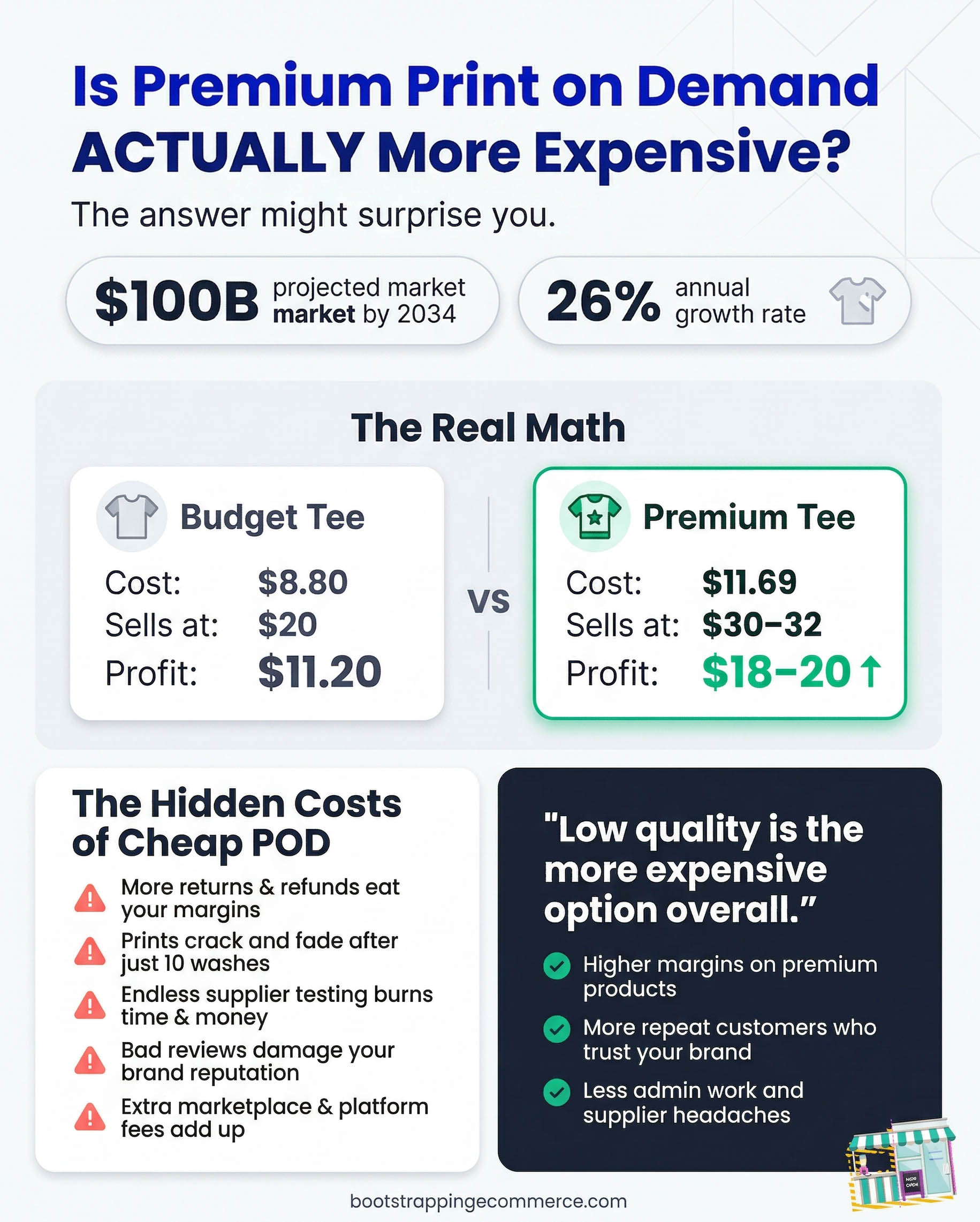
First, I want to clarify that the print-on-demand era is not over. It’s actually still growing at a rate of 26% per year, and could be worth over $100 billion by 2034. The market, however, is definitely saturated. People have woken up to the appeal of a business model that lets them sell with virtually no upfront costs and no admin work.
That means you need to do a lot more to stand out. Generic “good enough” products aren’t really good enough anymore. That’s why I think people are starting to look at premium products instead, and then panicking at the threat of “higher base costs”.
But is higher-quality print-on-demand always more expensive? I’m probably going to surprise you here, because most people say “Yes, but”. I’d say, “not always.”
What “High-Quality” Print on Demand Actually Means
First, let’s clarify this: high-quality print on demand isn’t the same as “expensive” products. Redbubble’s products can be pretty expensive (more on that in a minute), and we all know they don’t have the best reputation for quality.
What actually makes a product high-quality is:
- The blank you’re printing on: A cheaper shirt like a Gildan 5000 isn’t unusable, but it feels basic. Slightly stiff, not something you’d pick up again. A Bella+Canvas or similar shirt feels like something you’d wear anyway, even without the design.
- What happens after the first wash: I’ve had prints that looked fine out of the package and then started fading or softening almost immediately. If your customers wouldn’t recommend your product to someone else, it’s not high quality.
- Consistency: People don’t forgive inconsistency because you’ve decided to use different suppliers. They expect the same quality, sizing, delivery speed, and print perfection every time they order.
High-quality POD companies, like Fourthwall, Gelato, or Printful, you know you’re getting more than just a good selection of printing techniques and products; you’re getting stringent quality control. That’s what you’re paying more for, not just “better materials”.
Is High-Quality Print on Demand Always More Expensive?
My ultimate answer is “No.”
Sometimes, if you line suppliers up side-by-side and look at the base cost, the “lower-quality” options will be cheaper. Some Printify t-shirts cost less than $8, depending on the supplier you choose, whereas Printful and Fourthwall tend to start above $9.
What you don’t always realize straight away is how saving a couple of dollars on a “cheap” product narrows your pricing. You can’t really expect to charge $30 for a t-shirt you bought for $8. You can charge higher prices for truly premium shirts, with all-over prints, or vibrant colors.
Think of it this way:
- Budget tee: cost around $8.80, sold at $20
- Premium tee: cost around $11.69, sold at $30 or $32
Obviously, your exact margin depends on a few things, but a premium product generally absorbs a higher retail price much easier than a budget one.
Pricing Snapshot: How Platforms Compare
To give this a bit more depth, I had a closer look at how prices tend to look for base products across some of the more popular “premium” and “mid-to-low” quality platforms. To keep it easy, let’s focus on t-shirts for now:
| Platform | Starting t-shirt cost | Typical premium range | What you’re really getting |
|---|---|---|---|
| Fourthwall | from $9.25 | up to ~$37 | Tighter catalog with negotiated quality control & premium materials |
| Printful | from $9.25 | $30–$35+ | Consistent output, fewer variables |
| Printify | from $7.95 | $20–$23+ | Cheapest entry point, depends heavily on supplier |
| Gelato | from $9.42 | $20–$22+ | Local production, more predictable shipping |
| Redbubble | ~$20 base | $25–$35+ retail | Marketplace pricing, less margin control |
Again, pricing is dynamic across most platforms, which means what you’ll actually pay depends on things like your printing method and designs, but that’s a basic idea.
What’s surprising, really, is that the difference between the “cheapest” Printify and something guaranteed to be premium from a platform like Fourthwall (they make sure their suppliers use the best settings) is usually a couple of dollars.
Also, platforms like Redbubble, which people often assume is the “easy” or “cheap” option, can actually end up costing a lot more, and giving you a much smaller margin.
Why the Higher-Cost Option Can Produce Better ROI
I’ve already touched on this, but even if the base cost of a “premium” product is higher than what you’d get from a cheaper supplier, the ROI is often bigger too. If you’re selling a cheaper t-shirt, there’s a ceiling on how much you can reasonably charge and get away with. Customers are going to notice if you charge higher prices for basic products.
But higher quality protects your margins in other ways too:
- Fewer returns: If someone pays for a low-quality product and doesn’t like it, especially if they’ve paid more than they expected, they’re going to return it. Most POD platforms force you to deal with that, so you absorb the loss.
- More repeat customers: Stores built around cheaper blanks can still sell, especially with good designs or a strong niche. But every sale feels isolated. You’re constantly pulling in new buyers rather than building any real momentum. People come back naturally for quality.
- Less work: When you know you’re getting consistent quality, there’s less work to do. You don’t have to buy samples from countless new suppliers, test alternatives, watch for differences between batches, or rebuild your reputation when something goes wrong.
So yes, you might pay more initially, but you earn more too. You might spend $2,000 a month on cheap products and earn $4,000 back ($2,000 profit). Or you could spend $5,000 per month on high-quality products and get $12,000 back ($7,000 profit).
The question isn’t what’s cheaper, really; it’s what makes you more money long-term.
The Hidden Costs of Cheap POD
Print companies can optimize their margins but using less ink on their prints. That makes them a few extra cents per order. Your customers may not notice right away, but they’ll see it as prints crack after 10+ washes. By contrast, companies like Fourthwall have specific contracts with vendors to use the max ink settings in their signature line, so the quality holds up over 20+ washes.
People see the math and still say, “Well I can’t afford higher-quality now, so it’s best to stick cheap, even if I earn less.” That makes sense for a lot of early sellers, but you might be missing the extra costs that come with cheaper platforms.
For instance:
Admin and Store Management Work
Most print-on-demand companies like Printful and Printify come with other costs to consider. Even if you’re selling on a “cheaper” platform like Etsy, the cost of running your storefront adds up. Let’s say, for example, you sell a Gildan 5000 t-shirt on Etsy for $20. The production cost is $9.25, US shipping is $4.49, Etsy fees come to $2.35, and the final net profit is $3.91.
If you choose a higher quality product, like the Bella + Canvas 3001 at $11.69 (on Printful) and sell it on Etsy for $25, with $4.49 shipping and Etsy fees of $2.83, that leaves $5.99 in net profit.
Still, once you start moving to platforms like Shopify, the “running your business” costs do get higher. Something like Fourthwall can really reduce the overall fees here. You get the storefront and POD in the same place (no extra fees), so you’re spending less to build your brand.
Also, it’s worth remembering that you still have to pay for the extra stuff, like managing taxes, and handling customer support. Customer support costs alone can quickly add up if people are constantly complaining about quality. Fourthwall handles some of that for you, and your taxes as a merchant of record, which takes a bit more off your plate.
The Price of Testing and Quality Assurance
If you’re using something like Printify, you’re not just choosing a product, you’re choosing a supplier behind that product. That means you have to be diligent. You can look for suppliers with higher reviews (but the products tend to cost more). If you stick to cheaper suppliers, it’s really up to you to test the quality.
So you order samples. Then more samples. You try a different provider. Maybe a different blank. You’re not just building a store; you’re running expensive experiments in the background. That time and money doesn’t show up in the product price, but it’s still part of the cost.
Then you’ve got the inconsistency factor. Even if you find a good provider, availability and production routes can change. You tend to end up starting from scratch multiple times through the year, which adds up to more expense.
The Cost of Protecting Your Reputation
Customers don’t think in terms of suppliers or print methods. They just remember the product. If they think they’ve paid more than necessary for a product that feels and looks cheap, they’re going to remember that.
They’ll leave negative reviews on your site, talk badly about you on social media and Reddit, and warn other people not to buy your merch. You’ve saved a few dollars in production, but suddenly you’re spending a lot more trying to rebuild your brand, convince customers that you do have value to offer, and offset the original damage.
Does Cheaper Print on Demand Ever Make Sense?
I’m not saying you have to invest in the highest quality products from day one. A lot of creators start off with cheaper vendors. I just think if you really want to build a community and make money long-term these days, you can’t assume cheaper is automatically better.
Feel free to use a cheaper supplier if you’re just testing out ideas, seeing what shirts might look like, or figuring out what people in your community actually want.
You could even consider sticking to cheaper options for high-volume, price-sensitive products (basic stickers and mugs, for instance). Just keep in mind that you’re going to need to be comfortable with managing suppliers and running your own quality checks.
When you shouldn’t take the “cheap” route is when you’re actually trying to build a brand. Remember, people aren’t just comparing you to other creators; they’re comparing you to every fashion or clothing company they buy from. If your products are cheap where it counts, you’ll fall out of their good graces pretty quickly.
So, Is Higher-Quality Print on Demand Actually More Expensive?
Ultimately, for me, the answer is “No.”
Yes, sometimes the base cost is cheaper, but overall, low quality is the more expensive option overall. It limits your pricing range, eats into your margins, harms your reputation, and makes it a lot harder to convince people to keep coming back to your store.
Cheap options will give you an easy entry point. But more expensive, premium options, like Fourthwall, will give you the tools you need to actually make a consistent profit. That’s what matters really. Not how much something costs to produce. How much can you earn from it?