There’s an approach to comparing dropshipping platforms today that I think is getting a little outdated, and that’s reviewing every partner by the number of products it offers, or the base price of those goods.
Those things are still important, but having a huge catalog and low outgoing costs won’t necessarily make you profitable, particularly when there are dozens of retailers offering the same thing. With that in mind, I looked at dropXL from a slightly different angle.
It might not have a huge multi-million product catalog, but it could offer retailers something more important: a combination of quality and help with the logistics issues that certain companies really need.
Quick Verdict: Is dropXL Worth It?
I like dropXL as an option for companies that want to sell high-quality furniture, sporting goods, and pet supplies. The range, from vidaXL is excellent, the logistics are mostly handled for you too, which definitely helps if you’re shipping large items to various regions. Also, the fixed cost of €30 per month is pretty reasonable.
I don’t think it’ll be a good choice if you’re trying to sell low-cost, everyday items in bulk, and it’s worth saying that there’s some mystery around the base cost of products (you need to sign up to see the list). Still, neither of those things would put me off entirely.
Pros:
- Over 90,000 high-quality products from vidaXL
- Flat subscription fee and zero commission fee
- Integrates through API or plugins to popular ecommerce stores
- Various logistics issues are handled for you
- Relatively easy to use, even for bulk ordering
- Very fast delivery across various regions including EU, AU, USA
Cons:
- You need one seller account for every delivery country
- You can’t see product prices before you sign up
- Custom-branded packaging isn’t available
What Is dropXL? The Basics
dropXL is the B2B dropshipping solution that lets retailers source products from VidaXL’s catalog. You sign up for an account, choose the country you’ll be selling in, then wait for approval.
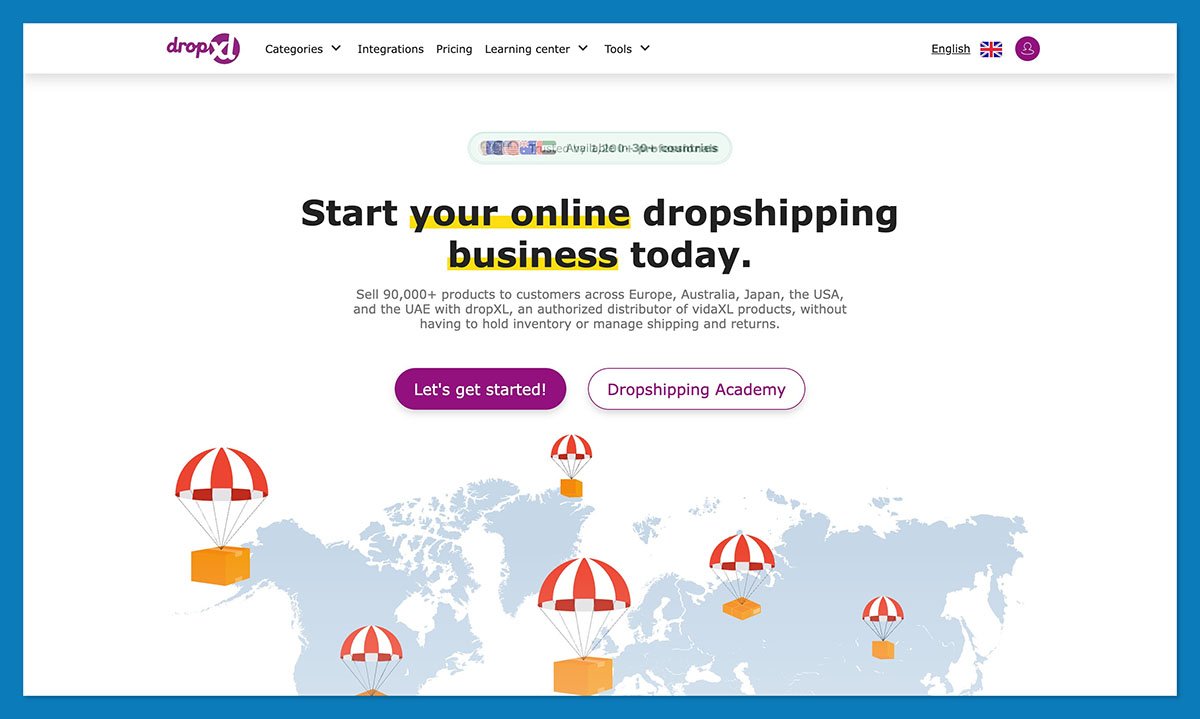
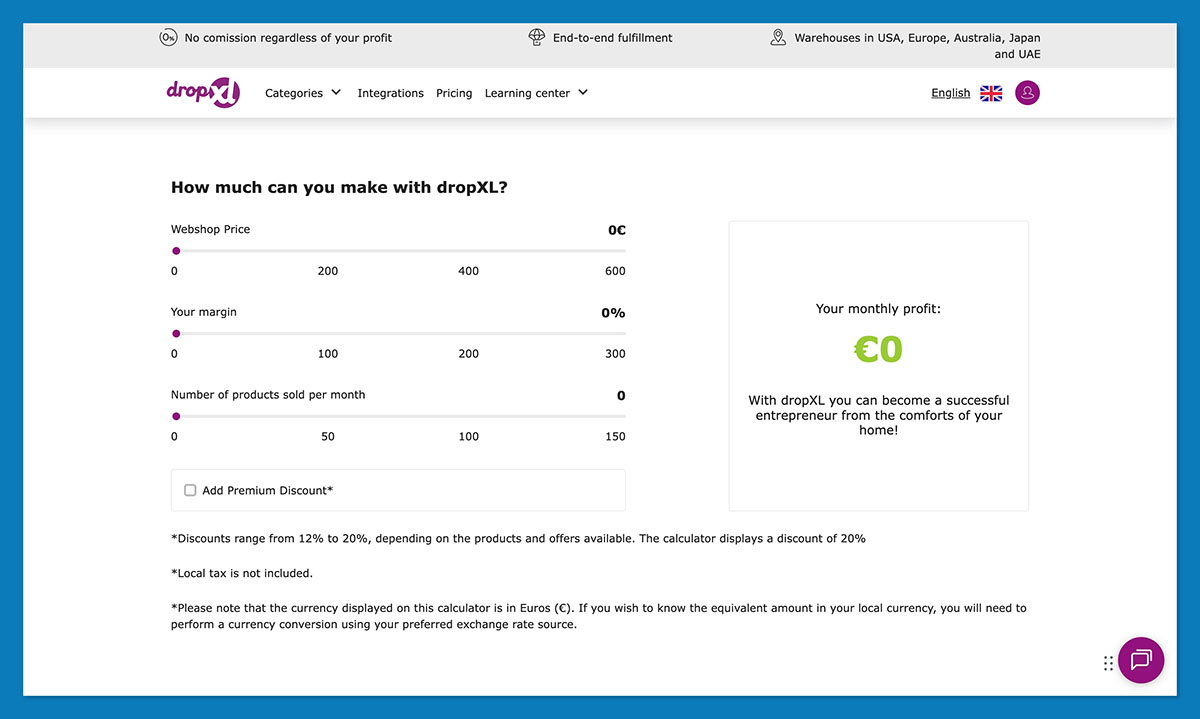
Once you’re approved, you can check the product catalog, pick the products you want, and import them into your store or a marketplace and apply your own pricing. You’ve got a margin calculator if you’re not sure exactly what to charge.
The connection between dropXL and your store can happen through a plugin for something like WooCommerce, a partner connector, the API, and the feed includes up-to-date insights into pricing, stock, descriptions, images, plus translated content. You can even see how many packages your buyer will probably receive, which is helpful information to add to a product description.
When someone buys something, you have to send the order to dropXL either through a dedicated dropXL B2B order portal Then you pay the company and they handle all the prep work, carrier selection and fulfillment stuff.
With all of this, you maintain control over the retail price you set, the content you share, plus the overall customer service aspect of things (a good CRM built for dropshipping helps a lot there), dropXL just gets the products to your buyer.
dropXL Pricing and Value for Money
The flat subscription fee is €30 a month for an account which gives you access to all of dropXL’s features. You also get a 30-day cashback promise if you don’t place any orders in that first month.
The €30 is pretty reasonable. A lot of other dropshipping companies like Doba, Spocket, or Zendrop charge something similar for access to their catalog and network.
With dropXL, there aren’t any hidden fees (like commissions you have to pay on each sale), but do have to pay for a separate account for every country you’re going to sell in. It’s also worth remembering that you still need to account for the base cost of every product you’re going to offer, plus the cost of things like ecommerce platform prescriptions, or marketing.
One final thing worth considering early is the “full aftersales” and “partial aftersales” service offerings. Full aftersales gives you standard B2B pricing, but you get complete return and issue handling support. Partial aftersales gives you extra discounts on the base cost of products, but it reduces the amount of support assistance you get.
dropXL Product Types and Quality
Compared to something like Doba, dropXL has a smaller catalog, but that isn’t necessarily a bad thing. There are about 90,000 products, and they mostly fall into categories like furniture or pet goods. Generally, dropXL is going to appeal most to companies interested in selling furniture, because there’s a huge range here.
You can source everything from garden furniture and storage, to desks, beds, sporting goods, or office supplies. There are other options too, like:
- Hardware and DIY products
- Toys or games
- Cameras
- Business and industrial goods
- Clothing and accessories
- Luggage and bags
Still, furniture is where dropXL really excels, probably more than most of the other dropshipping companies I’ve seen. I’d class the collection as a “mid-level” range, intended for people who want to spend a little more on good home items, but don’t want to splash out a fortune.
The main problem with dropXL’s catalog is getting access to it, because you can’t see what’s available until you’re approved for an account. Still, once you are, you get the whole live feed, with descriptions, stock information, images, copy that can be localized to your audience, prices, plus the little “number of packages” thing I mentioned earlier.
If I was just getting started here, I’d probably aim for about ten to twenty products to begin with, and pay attention to the reviews I get from customers before I started building a massive furniture store.
dropXL Fulfillment, Shipping, and Returns
Usually, the first thing I praise about a dropshipping company’s fulfillment service is the reach. dropXL’s is definitely decent, covering about 33 markets, which isn’t the same as 33 local warehouses, by the way. The delivery times are surprisingly fast depending on where you’re located too, with some products arriving within three business days in the UAE, or four in Belgium, Poland, the Netherlands, and Japan.
In Germany and France the average delivery time is about five days, then six days for the US, and seven for the UK and Canada. You can also keep a close eye on shipping speeds and supplier stock issues with the live feeds, so it’s easy enough to keep your customers up to date.
As with most dropshipping suppliers, the carriers you’ll have access to will depend on your location, the destination of the delivery, and the parcel type, although dropXL does partner with well-known names like FedEX, DBD, or Evri.
Surprisingly, dropXL can also help you out with a lot of awkward returns issues, too. You still have to deal with the initial part of speaking to the customer and gathering evidence, then you pass that information over to dropXL and relay the instructions back.
Still, dropXL can handle returns through pick-up, which is helpful if you’re selling large pieces of furniture. Also, if the product comes with a warranty, dropXL can handle those issues for most countries except the US.
Obviously, it’s worth remembering that the level of support with Aftersales does depend on the plan you choose, if you accept the bigger discounts on base costs, you’ll get less help here.
dropXL Integrations and Scalability
dropXL gives vendors both CSV and XML feeds, as well as a plugin for WooCommerce, connectors for Shopify (through third-party apps), and API access.
Using an integration partner is probably the easiest option, and it’s the best way to take advantage of the automatic updates from dropXL’s catalog. Though it is worth noting that some updates happen every hour, while others can take up to a day.
If you’re selling on a marketplace like Amazon or Ebay, dropXL has options for that too, again through the partners like GoGetters and SyncX.
If you do want more control, the API lets you create orders, receive status and tracking updates on demand, pull invoices and credit notes, plus send queries about product prices and stock.
The biggest challenge dropXL has with scale is the fact that you need a separate account for every country you’re selling in. Still, that won’t be much of a problem for a company only focusing on one market, or a larger company with extra money to invest in global expansion. The good thing about the separate accounts is also that you get the right pricing, stock details, and localized content for the region you’re selling in, so you don’t have to double-check everything.
dropXL Ease of Use and Customer Support
Overall, dropXL is reasonably easy to use, similar to most dropshipping platforms. Initially, all you need to do is set up your account and choose your country. Then you pay the fee, wait a few days for verification, and scour through the product feeds.
You can pull products straight into your website if you’re using an integration, along with all the details you’ll need for the actual product pages. The details match the currency and language of the region you’re selling in, so there’s less editing required, though I’d still make some tweaks.
Once you’re set up, you’ve got the regular feed updates to keep you informed, and processing orders is as simple as passing the right details onto dropXL. One thing to note is that managing a huge catalog can be a little exhausting here, which is why I’d probably start with a smaller collection.
Support-wise, dropXL is decent too, split into pre-sales and aftersales teams. From what I’ve seen online, the teams are helpful enough, although they will advise you not to send unhappy customers straight to them, which is common for a dropshipping supplier.
My Verdict: Should You Use dropXL?
dropXL is a more “niche” option for dropshipping companies than most. It’s not going to suit companies or resellers looking for a huge amount of variety and very low prices. It’s also not ideal if you’re looking for comprehensive branding options, or a way to expand quickly across a number of global markets.
It’s more tuned to sellers that want to sell high-quality furniture and similar products, without having to worry about extremely long fulfillment times.
The shipping is fast, the product quality is good, and the level of support you get with things like aftersales work can be excellent, if you’re on the right plan.
If you’re going to try it out, my advice would be to start small with a basic collection of products, see what your customers say about the overall experience, then gradually add options to your collection over time. That way, you’re less likely to end up getting into a mess. And if the store itself isn’t set up yet, this guide to starting an online store on a tiny budget pairs nicely with that approach.