Print on demand has changed the ecommerce game, allowing entrepreneurs to create and sell custom products without the big upfront costs.
These platforms let sellers design and market items like clothing, accessories and home decor and only produce them when customers order.
As the market for personalized products grows more and more, print on demand sites are popping up left and right.
Each one has its own features, product catalog and pricing structure to suit different business needs and target markets. Choosing the right one can make all the difference for a seller in this crowded space.
The Best Print on Demand Services



Printful is the top choice for print on demand overall. Printify is great for Etsy sellers. Gelato is good for global shipping. Artists like Redbubble. Sellfy is all-in-one for simplicity. Small businesses like Gooten. Modalyst is Wix friendly.
What are the top print on demand services in 2026?
1. Printful – Overall Best

Printful is the top print on demand service for 2026. The platform has a simple design interface and integrates with many ecommerce platforms. You can create custom products from apparel to accessories to home decor.
Printful’s mockup generator allows you to see the design before production. They offer sublimation and embroidery printing. Sample orders are 20% off so you can test before full production.
Fulfillment time is 2-5 business days with shipping from USA, Europe and Mexico. Pricing varies by product and method but shipping starts at $3.99 for most items.
Pricing
Printful runs on a pay-as-you-go model with no monthly fee required to start. You pay the base product cost plus shipping when an order comes in, and you keep whatever margin you set on top. There’s a Growth plan at $24.99/month that unlocks up to 33% off product base prices and discounted branding add-ons. It effectively pays for itself once you’re moving 10 to 15 items a month.
Printful Enterprise is available for high-volume brands with custom pricing, enhanced branding, and warehousing services. If you hit $12K in annual sales, the Growth plan becomes free.
As of February 2026, Printful increased base prices on Cotton Heritage products (hoodies, heavyweight tees, sweatshirts, sweatpants) by 0.4%–1.7% and raised shipping rates on stickers, phone cases, and knitted accessories. Core catalog items like Bella + Canvas, Gildan, mugs, and posters were not affected.
Pros
- Highest product quality and consistency of any major POD platform
- In-house fulfillment with DTG, DTF, and embroidery means fewer print quality surprises
- 490+ products across apparel, accessories, and home decor
- Integrates with Shopify, WooCommerce, Etsy, and 20+ other platforms
- Branding options: inside labels, outside labels, packaging inserts
- Global fulfillment network (USA, EU, UK, Canada, Australia)
Cons
- Base product prices are higher than Printify on the free plan
- Add-on costs (labels, extra placements, embroidery digitization) add up fast — though digitization is waived on orders of 25+ items and on Growth plan sample orders
- Quick Stores (free built-in storefront) is basic and limited to US sellers — most businesses still need a separate ecommerce platform
- Growth plan is needed to stay competitive on margins
Best For
Printful suits sellers who are building a real brand and don’t want to gamble on print quality. If you’re selling premium products at higher price points and consistency matters to your customers, the higher base costs are worth it. Less suited to volume-first sellers chasing the cheapest per-unit cost.
Read more about Printful pricing here.
2. Fourthwall
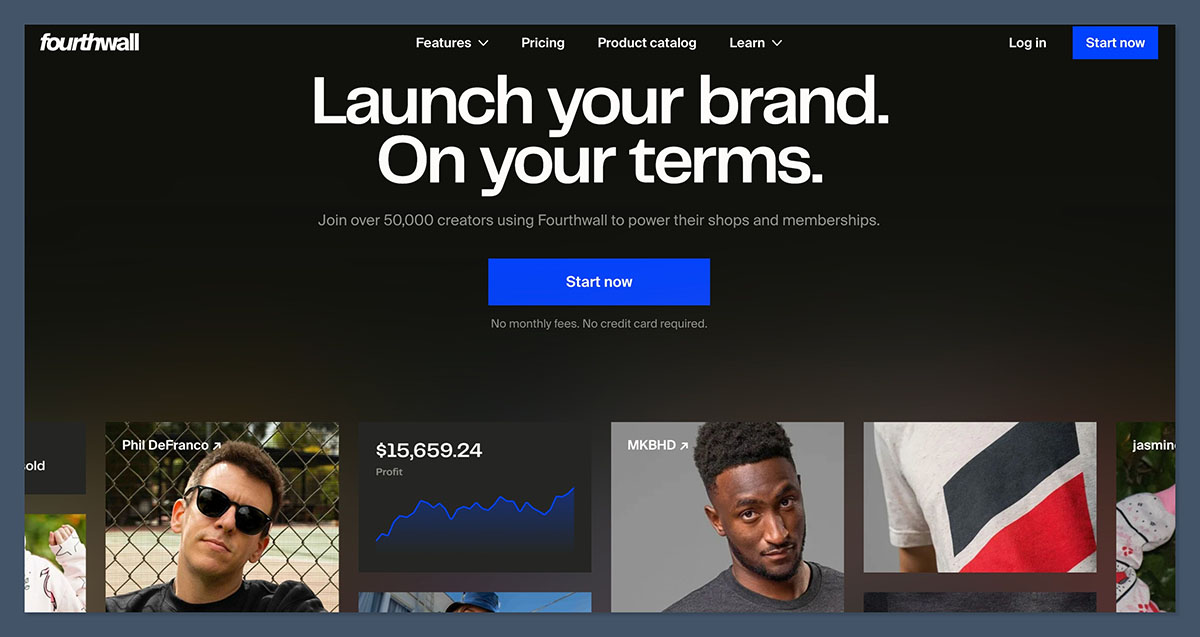
Fourthwall isn’t a typical print-on-demand company, it’s actually a complete brand platform, it just had POD built in. Not just any print-on-demand either, everything you get is premium quality. Fourthwall works with selected production partners and emphasizes retail-grade blanks and consistent output.
There’s even a Signature collection for higher-end pieces. If you want to go beyond standard tees and hoodies, Fourthwall can also help source custom items like plushies or specialty products, too. The platform also supports digital product and membership sales.
The best thing about Fourthwall is all the extra support you get. First, you don’t need a separate storefront from something like Shopify, because it’s already included. Fourthwall also acts as the Merchant of Record for you, so it handles sales tax and VAT. The team even manages customer support for products in its catalog.
If you already have an audience and want premium merch without building a full ecommerce career around it, Fourthwall makes a lot of sense.
Pricing
Fourthwall is free to start. There’s no monthly platform fee required to launch your store, add products, or begin selling. You set your retail price on merch, and when something sells, Fourthwall deducts the base cost and pays you the margin.
For digital products and memberships, there’s a small platform fee on the free plan. There is a premium plan starting at $15 per month if you want extra perks like sample credits and quarterly success calls, but you can get everything done without upgrading.
Pros
- Storefront included (unlike with most POD solutions)
- Premium, consistent merch quality
- Merchant of Record support for VAT and sales tax
- Customer support managed for catalog products
- Digital downloads and memberships included
- Custom sourcing options beyond basic POD
- No mandatory monthly platform fee
Cons
- Smaller product catalog than massive POD marketplaces
- Less flexibility than running a fully customized ecommerce stack
- Not designed for complex wholesale or B2B operations
Best For
If you care more about launching good merch than managing backend tools, Fourthwall is worth a look. It suits creators and organizations that already have attention and don’t want to spend their time dealing with compliance, shipping questions, or store plugins.
3. Printify – Best for Etsy Sellers
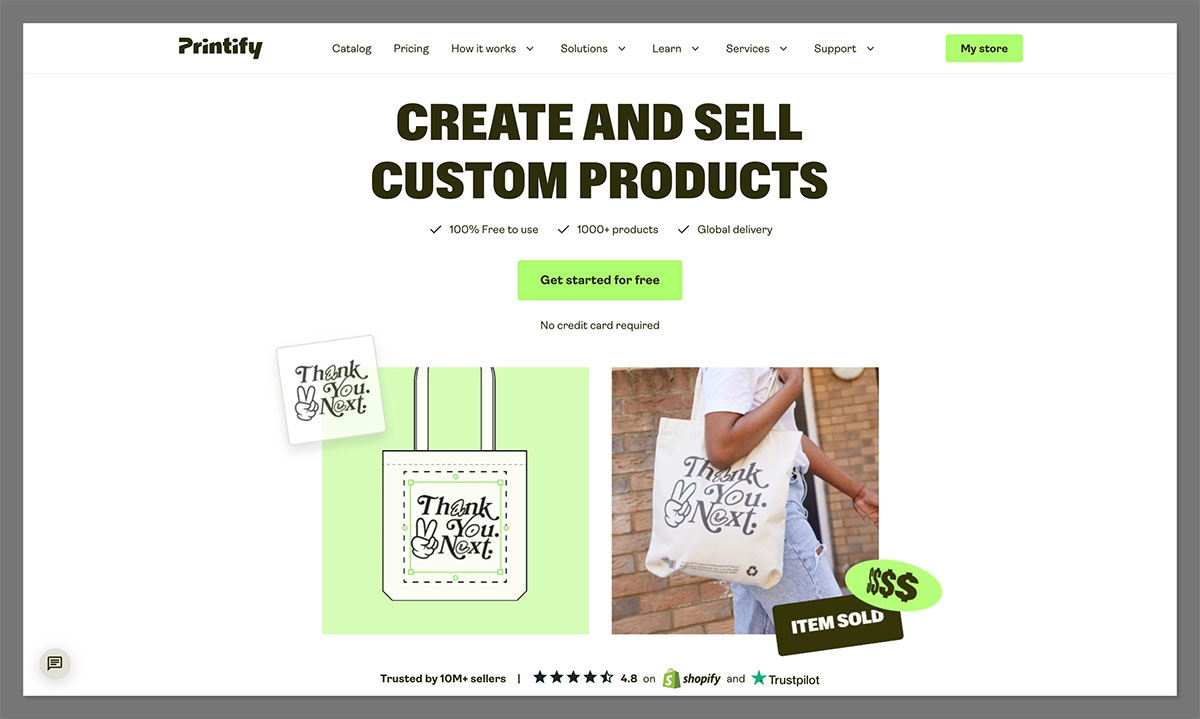
Printify is great for Etsy sellers and other ecommerce entrepreneurs. The platform connects you with a network of third party manufacturers and offers a wide range of custom products.
You can choose from different printing methods, cut and sew, sublimation and direct to garment. Printify’s global network of providers offers worldwide shipping but costs and production time varies by provider.
Pricing
Printify has a free plan that gives you access to their full provider network and up to five active stores. The Premium plan is $29/month and unlocks unlimited stores, up to 20% discount on all products, and is the tier most serious sellers end up on. There are no transaction fees on top of that. You pay the product cost and shipping per order, set your own retail price, and keep the margin.
Pros
- Largest provider network of any POD platform (100+ print partners)
- Ability to choose and switch between providers for the same product
- Often the lowest base product costs, especially on Premium
- Wide product catalog across apparel, accessories, and home goods
- Integrates with Shopify, Etsy, WooCommerce, TikTok Shop, and more
- Free plan is genuinely usable for new sellers
Cons
- Quality can vary between print providers, so you need to vet carefully
- No in-house fulfillment means less consistency control
- Support experience varies depending on which provider fulfills the order
- Switching providers mid-catalog can disrupt your product listings
Best For
Printify is the go-to for Etsy sellers and cost-conscious entrepreneurs who want the most flexibility on pricing. The ability to shop around between print providers is genuinely useful, but it puts more due diligence on you to find the right one.
4. Gelato – Worldwide Shipping

Gelato has an extensive global production network with over 130 locations across multiple continents. This means faster shipping to many international markets.
They offer a range of custom products, apparel, wall art and photo books. While the product range is not as big as some competitors, Gelato focuses on high quality products popular among designers and illustrators.
Gelato’s free plan gives you access to their full product catalog and integrations with multiple e-commerce stores.
Pricing
Gelato’s free plan covers unlimited products and integrations with no monthly cost. You pay per order: product base cost plus shipping. The Gelato+ plan is $23.99/month (or $19.99/month billed annually) and gives you up to 25% off products, access to branded packaging, AI mockup tools, and the Personalization Studio for custom customer-facing product options. A Platinum tier exists for high-volume sellers at custom pricing, with up to 35% off and a dedicated account manager. No commission is ever charged on top of sales.
Pros
- 130+ local fulfillment centers across 32 countries
- Fastest international shipping of any major POD platform
- Strong print quality, especially for wall art and fine art prints
- Eco-friendly fulfillment model reduces shipping distances and emissions
- No commission, you keep 100% of your margin above product cost
- AI-powered mockup and personalization tools on paid plans
Cons
- Smaller product catalog than Printify
- Base product prices can be higher on the free plan
- Some users report inconsistent customer support on complex issues
- Personalization Studio and branded packaging locked behind paid tier
Best For
Gelato is the strongest option for sellers targeting international markets, particularly Europe. If a significant portion of your customers are outside the US, the local fulfillment model alone can justify choosing Gelato over competitors. Faster delivery times and lower shipping costs make a real difference.
5. Redbubble – Artist Marketplace
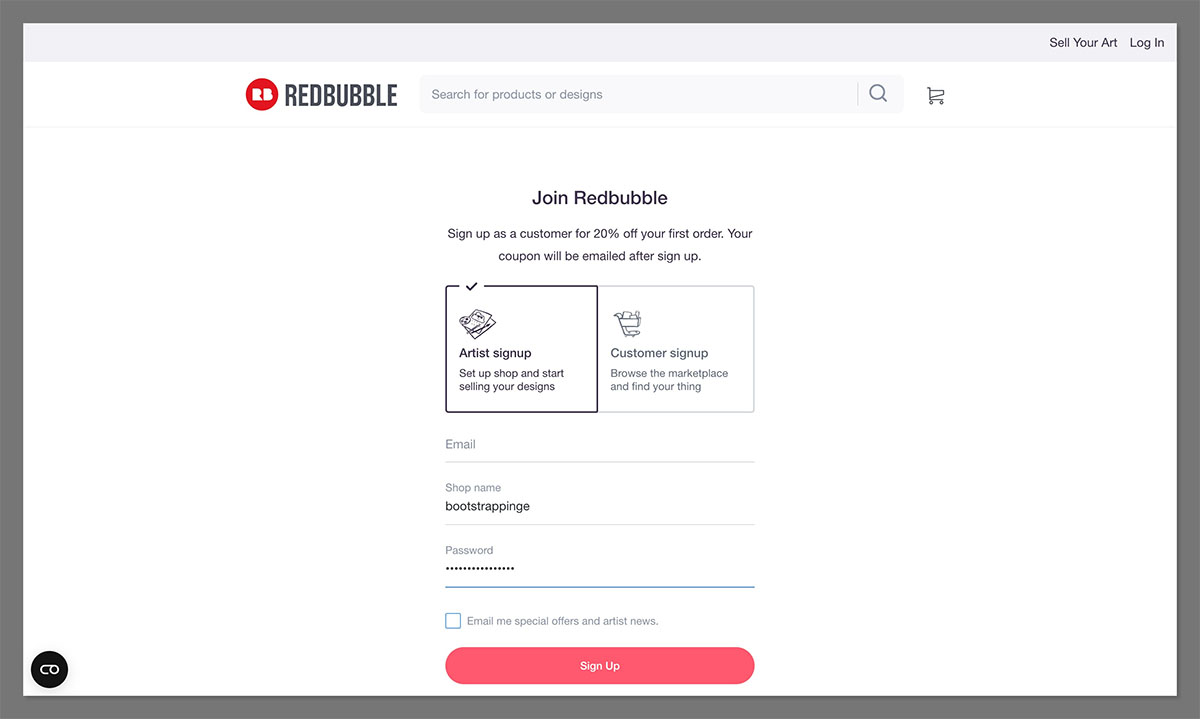
Redbubble is a marketplace for artists and designers. You can upload your designs and sell them on products without handling production or shipping.
Artists set their own profit margin on top of the base price of each item. Redbubble handles production, customer service and shipping so it’s a great option for designers who just want to focus on design.
They offer products from clothing to stickers and home decor.
Pricing
Redbubble is free to join with no monthly fees or setup costs. You don’t pay for production or shipping. Redbubble handles all of that and sets a base price for each product. You add your own margin on top (called your “artist margin”) and earn that percentage on every sale. The default margin is 20%, but you can set it higher. There’s no premium tier or subscription. Redbubble takes its cut from the base product cost before paying you out.
Pros
- Zero upfront costs or monthly fees
- Built-in marketplace with existing customer traffic
- Handles all production, shipping, and customer service
- No need for a separate ecommerce store
- Passive income potential, upload once and sell indefinitely
- Wide product range including clothing, stickers, phone cases, and home decor
Cons
- Very limited control over branding and customer experience
- Marketplace competition is intense, discoverability isn’t guaranteed
- You don’t own the customer relationship or their data
- Margin control is limited compared to running your own store
- No integrations with external ecommerce platforms
Best For
Redbubble works best for artists and illustrators who want to monetize existing work without dealing with ecommerce infrastructure. If you have a design portfolio and just want a passive revenue stream, it’s a low-effort starting point. Just don’t expect to build a brand through it.
6. Gooten – Small Business Friendly
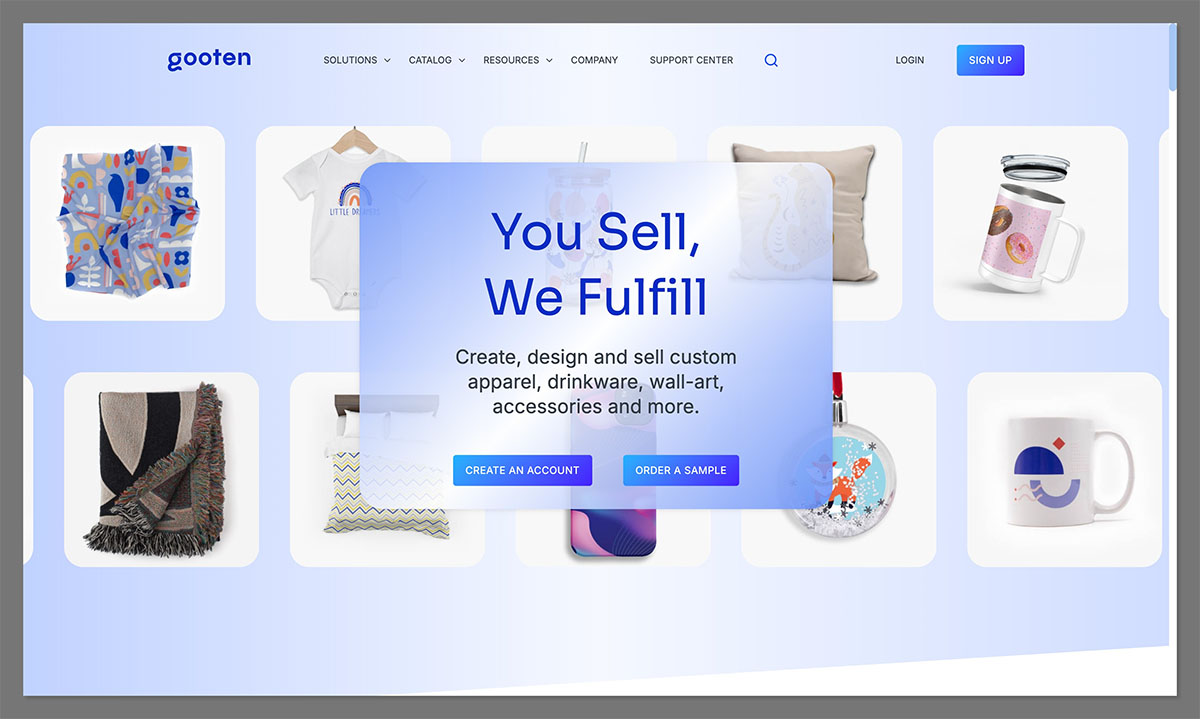
Gooten is for small business with a simple interface and big product range. They integrate with many e-commerce platforms and marketplaces.
Gooten’s network of manufacturers offers competitive pricing and fast turnaround. They provide detailed analytics so you can track performance and make data driven decisions.
Pricing
Gooten has no monthly platform fee and no upfront costs. You pay per order: product cost plus shipping, and you set your own retail price. Pricing is competitive, and the platform offers volume-based discounts as your order count scales. There’s no tiered subscription model like Printful or Gelato, which keeps things straightforward for smaller operations.
Pros
- No monthly fees, only pay when you sell
- 70+ manufacturing partners with competitive base pricing
- Solid product range across apparel, home goods, and accessories
- Detailed analytics dashboard for tracking performance by product
- Integrates with Shopify, Etsy, WooCommerce, and BigCommerce
- Volume discounts available as you scale
- Custom branding options including packaging and inserts
Cons
- Less brand recognition than Printful or Printify
- Smaller fulfillment network than Gelato for international shipping
- No built-in storefront, needs an external ecommerce platform
- Customer support quality reported as inconsistent by some users
Best For
Gooten is a solid choice for small businesses that want straightforward per-order pricing without committing to a monthly plan. If you’re in a growth phase and want access to real analytics without paying a premium subscription, it’s worth a close look alongside the bigger names.
Print on Demand Providers Comparison
This table compares 10 print on demand providers across different features. Most offer free sign up, a few offer premium subscription. All support DTG printing, embroidery, sublimation and cut & sew vary.
| Feature | Printful | Fourthwall | Printify | Gelato | Redbubble | Gooten |
|---|---|---|---|---|---|---|
| Free Sign-up | ✓ | ✓ | ✓ | ✓ | ✓ | ✓ |
| Premium Plans | Coming soon | $15/month | $29/month | $14.99/month | Account fee | ✗ |
| DTG Printing | ✓ | ✓ | ✓ | ✓ | ✓ | ✓ |
| Embroidery | ✓ | ✗ | ✓ | ✗ | ✗ | ✓ |
| Sublimation | ✓ | ✗ | ✓ | ✗ | ✓ | ✓ |
| Cut & Sew | ✓ | ✗ | ✓ | ✓ | ✗ | ✓ |
| Provider Choice | ✗ | ✗ | ✓ | ✗ | ✗ | ✗ |
| Print Facilities | 15+ | N/A | 100+ | 130+ | N/A | 70+ |
| Fulfillment Time | 1-3 days | 3-6 days | 2-5 days | 2-4 days | 2-4 days | 2-4 days |
| Shipping Time | 2-7 days | 5-14 days | 4-12 days | 3-10 days | 5-15 days | 5-12 days |
| Flat Shipping Rates | ✓ | ✓ | ✓ | ✓ | ✗ | ✓ |
| Live Shipping Rates | ✓ | ✗ | ✓ | ✓ | ✓ | ✗ |
| Custom Return Address | ✓ | ✗ | ✓ | ✗ | ✗ | ✓ |
| Live Chat Support | ✓ | ✓ | ✓ | ✓ | ✗ | ✗ |
| Email Support | ✓ | ✓ | ✓ | ✓ | ✓ | ✓ |
| Phone Support | ✗ | ✗ | ✗ | ✗ | ✗ | ✗ |
| Neck Labels | ✓ | ✓ | ✓ | ✓ | ✗ | ✓ |
| Sleeve Printing | ✓ | ✓ | ✓ | ✓ | ✗ | ✓ |
Printify is the only one that lets you choose your print provider. Print facilities range from 1 to over 130 (Gelato). Fulfillment time is 1-5 business days, shipping time varies from 2-20 days depending on the provider.
Many offer flat shipping rates, some offer live shipping rates. Custom return addresses are available with a few providers. Customer support options vary, email support is universal.
Product branding options like neck labels and sleeve printing are available with most providers so you can customize more for your sellers.
How to Choose the Right Print on Demand Service
Print on demand (POD) services allow entrepreneurs to sell custom designed products without holding inventory.
They handle production and shipping so you can focus on design and marketing. When choosing a POD partner consider product range, print quality and integrations.
Look for providers with a wide range of products from apparel to accessories. This will allow you to expand into different product lines.
Print quality is important as it affects customer satisfaction. Research reviews and request samples to test the provider’s output.
Integration is key to a smooth operation. Many POD services offer plugins for popular e-commerce platforms to automate the order fulfillment process.
Check the shipping options and costs as this will affect the delivery time and profit margin.
Pricing structures vary between providers. Compare the base cost and profit margin across different providers. Some offer volume discounts or special features that will benefit your business as it grows.
Customer support is another factor to consider. Choose a provider with good support so you can get help when you need it.
Print on Demand Marketplaces vs Dedicated POD Services
Print on demand (POD) solutions offer two ways for sellers: marketplaces and dedicated services. Each has its pros and cons for entrepreneurs who want to sell custom products online.
POD marketplaces like Redbubble and Zazzle provide ready made platforms for sellers to showcase their designs.
These environments have built in audiences so you don’t need to create your own website and manage sales. The simplicity of this is appealing to many new sellers.
Dedicated POD services like Printful and Printify are different. They integrate with your existing e-commerce platform so you can have your own branded store. This gives you more control over pricing, marketing and brand identity.
Marketplace pros:
- Easy to set up
- Built in audience
- No website required
Marketplace cons:
- Limited branding options
- Pricing restrictions
- High competition
Dedicated service pros:
- Full brand control
- Flexible pricing
- Integrates with your store
Dedicated service cons:
- Requires separate e-commerce platform
- More setup and management needed
The choice between a marketplace and a dedicated POD service depends on your business goals, technical skills and level of control.
Marketplaces offer simplicity and exposure, dedicated services offer flexibility and brand control.
Global Shipping and Product Delivery Strategies
Print on demand companies have different fulfillment approaches. Many can ship globally but production is often done in specific regions to reduce costs. This can result to longer delivery times for customers.
Businesses looking for a competitive edge should consider partners with local fulfillment centers near their target market. This will significantly reduce shipping times and increase customer satisfaction.
Some providers have expanded their printing facilities to multiple countries. This not only speeds up delivery but also reduces environmental impact by minimizing long distance shipping.
Benefits of Local Fulfillment:
- Faster delivery times
- Lower shipping costs
- Lower carbon emissions
- Better customer experience
When choosing a print on demand service, businesses should check the provider’s fulfillment network. A global, localized network can give you a competitive edge in meeting customer expectations and being in the market.
2026 Predictions for the Print on Demand Industry
The print-on-demand game is changing fast—and 2026 is where things really speed up.
After the massive Printful and Printify merger in late 2024, the industry is now in the middle of a major shift. Their combined platform is still dominating—but that’s just the start.
Here’s what to expect in 2026:
1. AI Will Make Store Building Dead Simple
Shopify’s new AI Website Builder officially rolled out — and it’s changing the game.
Now anyone can spin up a full print on demand store with branded pages, product listings, and SEO-optimised descriptions — just by answering a few prompts.
No devs. No themes. No guesswork.
Other platforms like Wix, Squarespace, and BigCommerce are pushing their own AI site builders to keep up, but Shopify’s version is leading the pack right now.
2. Hyperlocal Fulfilment Will Be The Standard
Customers in 2026 don’t want to wait.
That’s why Printful, Gelato, and even newer players like CloudPrinter are ramping up hyperlocal fulfilment centers.
Print-on-demand providers now prioritise local production, cutting delivery time and shipping costs by up to 50% in key markets.
You’ll see faster fulfilment in places like:
- UK
- Germany
- Australia
- Canada
- US
3. Niche Sellers Will Dominate Using Data
Big POD providers like Printful-Printify are going broad.
But the smart sellers? They’re going deep.
2026 is seeing a huge rise in niche POD stores using AI tools and zero-party data to launch ultra-specific product lines.
Expect a boom in:
- Anime fan merch
- Dog breed-specific products
- Minimalist spiritual wear
- B2B niche stores (e.g. corporate gifting)
Using tools like Triple Whale and Shopify Magic, these sellers can launch, test and scale fast.
4. Bespoke Branding Becomes Non-Negotiable
In 2026, generic POD products won’t cut it.
Sellers are demanding more from providers—expect to see:
- Custom inside neck labels
- Custom packaging
- Branded packing slips
- Personalised order inserts
POD providers who don’t offer these will lose out to platforms like Gooten, which now gives full branding packages for businesses.
5. TikTok Shops + POD Go Big
TikTok Shops exploded in 2025.
Now, in 2026, TikTok is a core sales channel for many POD sellers.
Services like Printify now integrate directly with TikTok Shop, giving you:
- Direct product syncing
- Fulfilment tracking
- UGC-friendly mockups
If you’re not on TikTok Shops with your POD brand in 2026—you’re leaving money on the table.
6. Printful-Printify Super Platform Rolls Out Fully
After the merger announcement in November 2024, the two giants have been gradually integrating.
By Q3 2026, expect the Printful-Printify combined dashboard to be live for all users.
That means:
- Access to 130+ global fulfilment partners
- Best-in-class mockup tools
- Streamlined pricing and shipping calculations
- One-click product porting across stores
This will likely become the default platform for most mid-size to large POD operations.
7. Newcomer POD Startups Will Double Down on Eco-Friendly Products
With one giant (Printful-Printify) controlling most of the mainstream market, smaller POD platforms are going niche.
Expect to see eco-first POD startups gain traction in 2026 by offering:
- Organic cotton only
- Plastic-free packaging
- Carbon-neutral shipping
- Integration with carbon offset tools like Cloverly
Platforms like Teemill and Apliiq are already leading the way here.
8. Subscription-Based POD Brands Take Off
Sellers are moving away from one-time purchases.
With platforms like Recharge and Skio making it easier, 2026 is seeing a rise in POD subscription businesses—think:
- Monthly T-shirt clubs
- Art print deliveries
- Motivational mug subscriptions
Recurring revenue = more predictability. Expect more sellers to build brand loyalty using subscription POD offers.
Choosing the Right Print on Demand Service to Make Money
Print on demand (POD) services have many options for online businesses. The right one for you depends on your needs and goals.
If you sell custom products like beanies or phone cases you might want to check out Redbubble. These marketplaces have existing customer bases already.
If you want to have a full ecommerce presence more robust solutions are needed. Printful is a popular choice and has integrations with major platforms like Shopify and WooCommerce.
This gives you more control over branding and customer experience.
Starting a POD business is easy. Many services have mockup tools so designers can see their products before production. This helps to create designs that will appeal to your target audience.
POD companies simplify the selling process by taking care of production and shipping. While you focus on design and marketing, they take care of logistics. This is perfect for those new to ecommerce.
Pricing structures differ between POD providers. Some offer upfront pricing so you can calculate your profits.
Integration capabilities vary, some services integrate with popular ecommerce platforms like WordPress and Shopify.
When choosing a POD service consider:
- Subscription and transaction fees
- Branding opportunities
- Marketing support
- Product range
- Print quality
- Shipping times and costs
Customer support is key especially for newbies. Some providers are better than others in providing guidance and resources to help you grow. High quality mockups is another important feature so you can see your products accurately.
Each POD service has its own strengths. Some specialize in certain products, others have a wide range of products. Evaluating these against your business goals will help you choose the best one.
Entrepreneurs should consider:
- Ease of use
- Integration
- Product range
- Pricing
- Branding
By thinking through these you can choose a POD service that matches your goals and maximizes profit.
A Few Words About the Printful and Printify Merger
With the recent merger between Printful and Printify announced on November 5, 2024, the print-on-demand landscape is set to experience significant changes.
This merger promises to unify the strengths of both platforms, offering enhanced product selection, streamlined fulfillment, and potentially improved shipping options for sellers worldwide.
However, for now, both companies will continue to operate independently, and no immediate changes will impact existing sellers or orders.
Over the coming months, we’ll be watching closely to see how this merger shapes the future of print on demand, but rest assured that current operations remain stable.
FAQs
What is print-on-demand?
Print-on-demand services allow online sellers to create and sell custom products without inventory. They handle design, production and shipping so you can focus on marketing and sales.
How to choose the best POD company?
A top POD company has a wide range of products, great customer support, competitive pricing and integrates with popular ecommerce platforms.
How do POD platforms work?
Some POD platforms have marketplaces to sell custom products to existing audiences. Others have design tools and fulfillment services that integrate with your ecommerce store.
What can you sell through POD?
POD companies offer customizable products like apparel, accessories, home decor, drinkware and art prints. Some have eco friendly and premium options.
Which one has the best quality?
Printful is known for its high quality print, they use advanced quality control methods and AI powered tools. Gelato and Gooten also have high standards for their products.
Are there startup costs?
Many POD services are free to start but sellers may need to pay for ecommerce platform subscriptions and domain names. Some companies charge monthly fees for advanced features.
Can POD integrate with ecommerce sites?
Many POD services integrate with popular ecommerce platforms like Shopify, Wix and WooCommerce. Some have APIs for custom automation.
How to choose the best POD service?
Consider your target audience and products. Look for vendors with good products, affordable prices, global fulfillment, great customer support and integrates with your preferred selling platforms.
What are the profit margins?
Profit margins for POD products are 20% to 60% for t-shirts. Actual margins depend on base product cost and item chosen.
How long is production and shipping?
Production time varies by vendor, some are 48 hours. Total delivery time depends on the company’s fulfillment network and customer location.
Can I have custom branding?
All POD services allow custom designs on products. Some have additional branding options like custom tags, packing slips and packaging.
Do POD companies ship internationally?
Many POD services including Gelato, Printful and Printify ship worldwide. Check with a vendor before committing.
How do returns and exchanges work?
Most POD companies require sellers to handle returns and exchanges. Refunds and replacements are usually only for quality issues, not customer change of heart.
Can I order product samples?
Reputable POD companies usually allow sample orders, often at discounted price. So sellers can test the product and take product photos.
Are there eco friendly options?
POD can be more eco friendly than traditional manufacturing as products are only made when ordered. Some vendors use eco friendly materials and work with local manufacturers to reduce carbon footprint.
What are the marketing strategies?
Effective marketing strategies are landing pages, building email lists, social media, SEO and video ads.
How do top POD services differ?
POD companies differ in products, print quality, shipping time and branding options. Some have additional services like warehousing or design assistance.
Are there eco friendly POD options?
Yes, companies like Printful, Printify, Gooten and Gelato are eco conscious, using sustainable materials and optimizing shipping routes.