
Best for Your Store

Shopify
See pricing Try Shopify →$39/month, or $29/month billed yearly
3 days free, then $1/month for 3 months
- Full store with your own domain
- Checkout, discounts and email built in
- 24/7 live chat on every plan
Best for Fulfillment

Gelato
See pricing Try Gelato →Free plan: $0/month, pay per order
Gelato+: $19.99/month billed yearly, or $29.99/month
- 680 products with DTG, DTF and embroidery
- Local production in 32 countries
- 24/7 support on every plan
Gelato and Shopify are two names you’ll come across quickly when researching print-on-demand businesses, but they don’t actually compete with each other.
One prints and ships products; the other powers your online store. Understanding what each platform does will save you a lot of confusion when you’re setting up your first POD brand.
We’ve compared both companies’ current plans, fees and features to give you a clear-eyed breakdown. Here’s what you need to know upfront.
Quick Verdict
- Gelato: Best global POD fulfillment network for Shopify stores
- Shopify: Best all-in-one ecommerce platform to build and grow your store
In this article, I’ll break down what Gelato and Shopify each do, how they compare across pricing, features, and use cases, and when you’d use one, the other, or both together.
Quick Comparison: Gelato vs Shopify
| Category | Gelato | Shopify |
|---|---|---|
| Platform type | Print-on-demand production and fulfillment | All-in-one ecommerce platform |
| Starting price | Free (pay per order) | $39/month, or $29/month billed yearly |
| Product catalog | 680 products across apparel, wall art, drinkware, stationery and more | Any product type (physical, digital, services) |
| Production network | Local production in 32 countries | Not applicable (no fulfillment) |
| Storefront | No storefront | Full hosted storefront and checkout |
| Best for | POD fulfillment, global shipping, EU/UK sellers | Building and scaling an ecommerce business |
| Integrations | Shopify, Etsy, Amazon, TikTok Shop, WooCommerce, Wix, Squarespace and BigCommerce | Shopify App Store, including Gelato’s official app |
What Gelato and Shopify Actually Do
Before comparing features, it’s worth being direct about one thing: Gelato and Shopify are not alternatives to each other. They operate at different layers of a print-on-demand business.
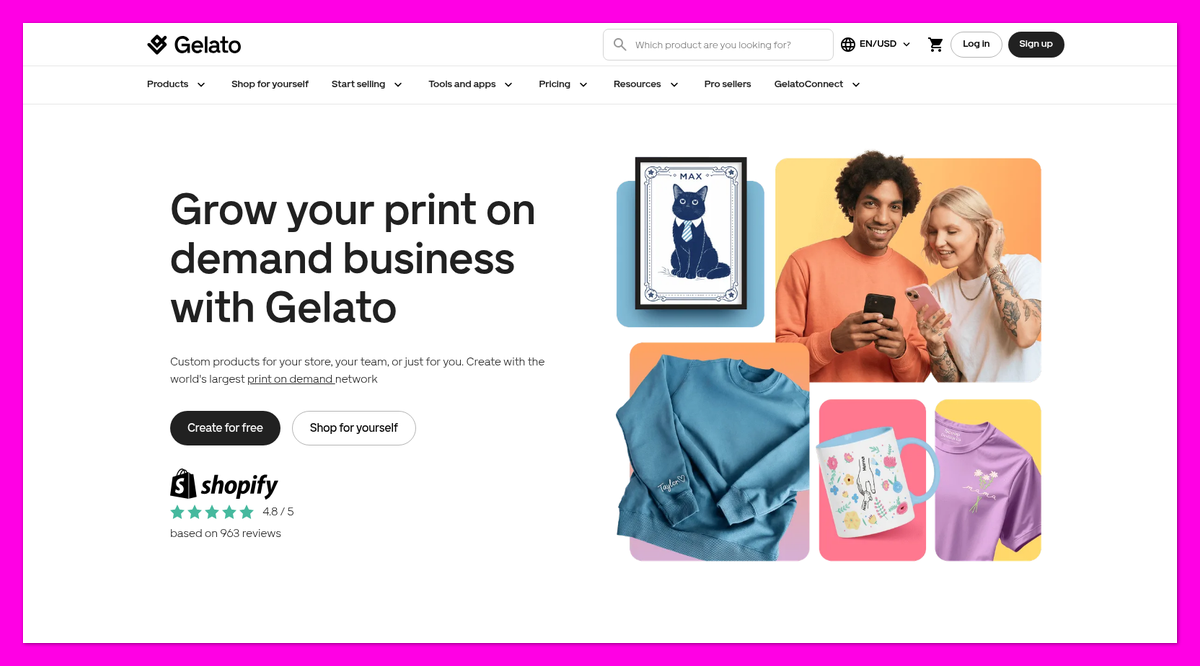
Gelato is a global POD fulfillment network. When a customer places an order, Gelato routes it to the nearest print partner, produces the item, and ships it. It handles the production and logistics side of your business but doesn’t give you a storefront. Our Gelato review covers the service in full.
Shopify is an ecommerce platform. It gives you a hosted store, a checkout, payment processing, marketing tools, and channel integrations. It does not print or ship anything on its own. See our Shopify review for the full picture.

For most POD sellers, the realistic setup is: Shopify as your storefront, Gelato connected via its official app to handle fulfillment.
The comparison below focuses on what each platform contributes to that stack, and whether either might be used without the other.
Pricing: Gelato vs Shopify
Gelato and Shopify have very different pricing models, which makes a direct comparison tricky but important to understand before you commit.
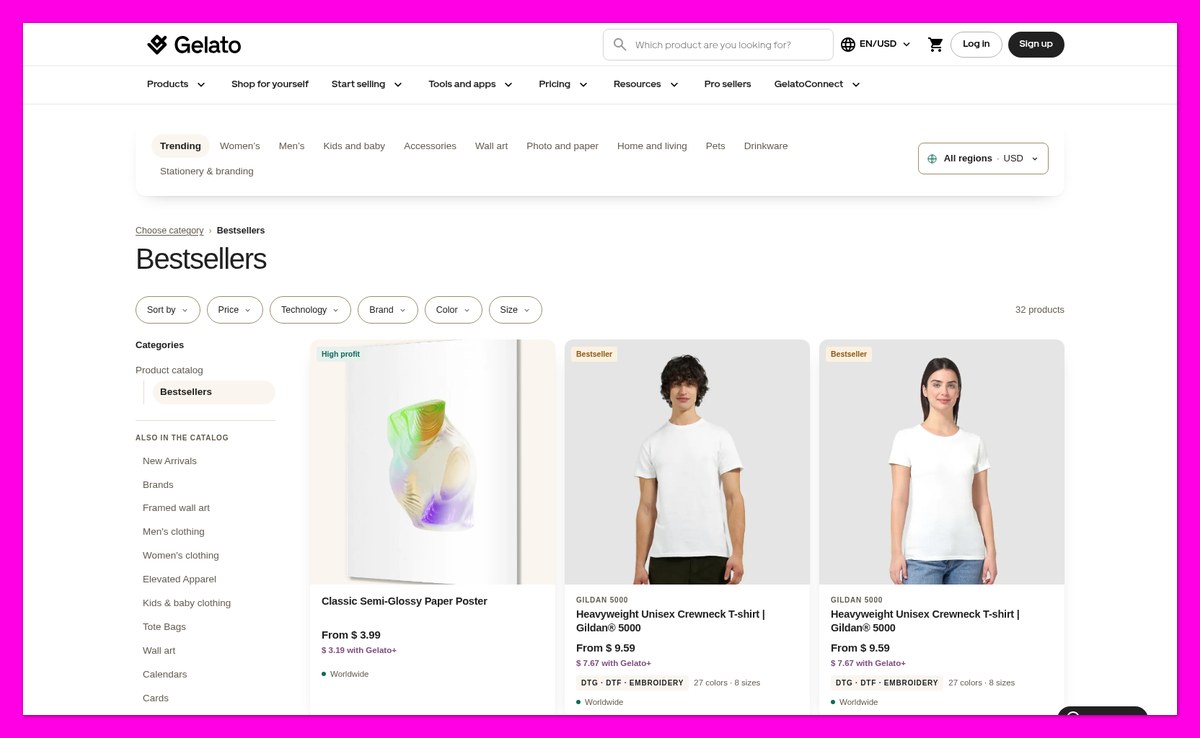
Gelato is free to start. The Free plan costs $0 with no monthly fee, commission or order minimum; you pay per order, covering Gelato’s product price and shipping. A Gildan 5000 tee, for example, costs $9.59 plus $4.99 shipping to a US customer.
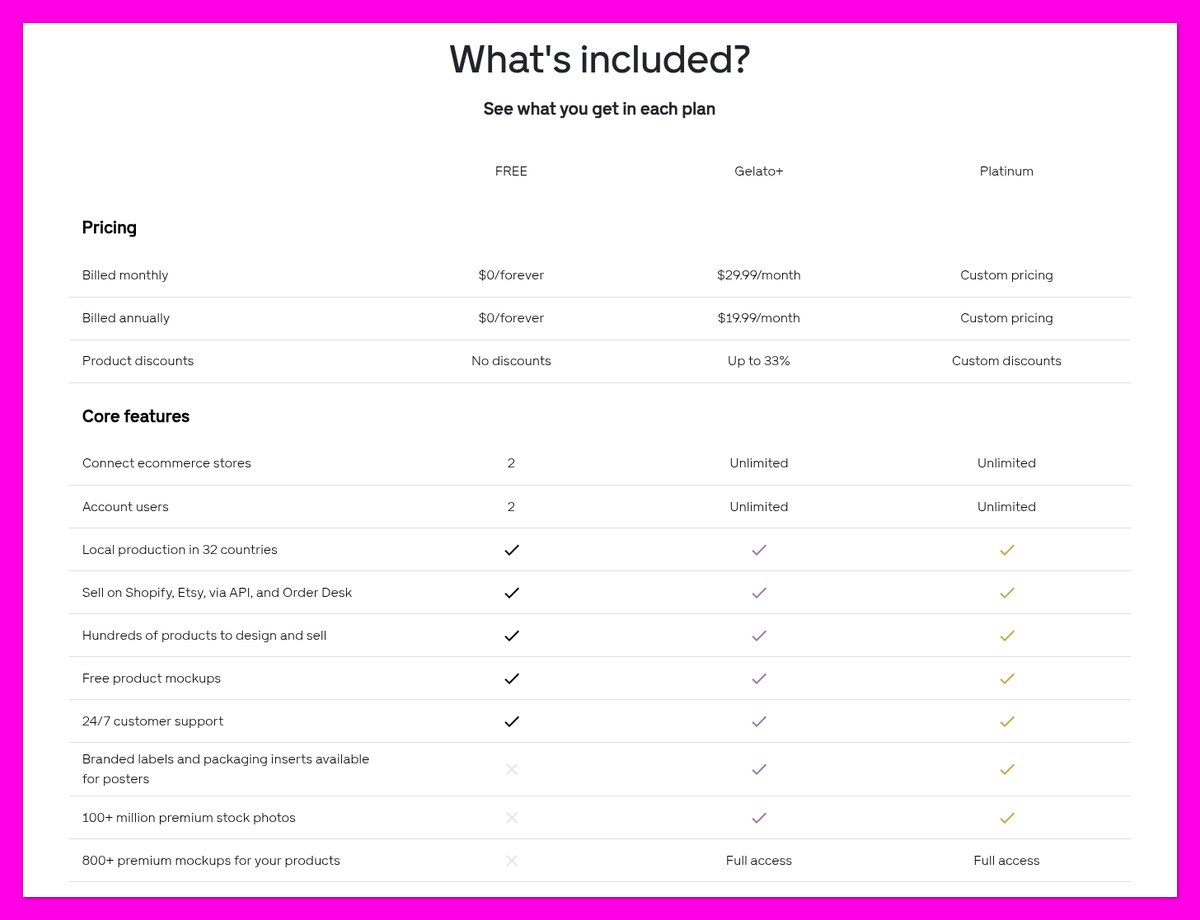
This makes it low-risk for new sellers testing their first products. The optional Gelato+ plan costs $29.99 a month, or $19.99 a month billed yearly ($239.88), with a 14-day free trial. It takes up to 33% off product prices, raises the Free plan’s limit of two connected stores and two users, and adds premium mockups and branded inserts for posters. On the US product pages we checked, the Gelato+ price was 20% lower: that $9.59 tee drops to $7.67. Platinum, the top tier, is custom-priced.
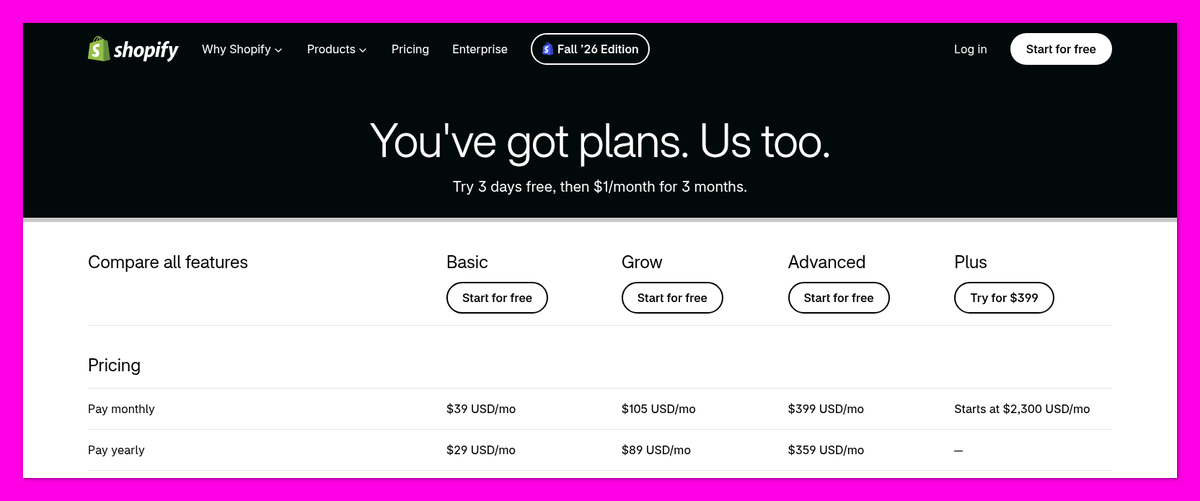
Shopify charges a monthly subscription. Shopify plans cost $39 (Basic), $105 (Grow) and $399 (Advanced) a month on monthly billing, and Basic drops to $29 a month when you pay yearly. New merchants get 3 days free, then $1 a month for the first 3 months.
Every sale also carries a card fee. Shopify Payments charges 2.9% + $0.30 per online card sale on Basic, 2.7% on Grow and 2.5% on Advanced. If you use another payment gateway, Shopify adds an extra fee of 2% on Basic, 1% on Grow and 0.6% on Advanced. You’ll also need to factor in the cost of apps and potentially a premium theme.
Here’s how the two bills add up on one sale. Say you sell that Gildan 5000 tee for $25 and pass the $4.99 shipping on to your customer, who pays $29.99. Shopify Payments keeps $1.17, Gelato charges you $14.58 for the tee and shipping, and you keep $14.24. Three sales a month cover the $39 Basic plan. For a fuller budget, see our cost breakdown for starting a print-on-demand business with Shopify and our guide on how to price print-on-demand products.
| Plan | Gelato | Shopify |
|---|---|---|
| Entry level | Free (pay per order) | $39/month, or $29/month billed yearly (Basic) |
| Mid tier | Gelato+: $29.99/month, or $19.99/month billed yearly | $105/month (Grow) |
| Advanced | Platinum: custom pricing | $399/month (Advanced) |
| Transaction fees | None (product and shipping costs apply) | 2.9% + $0.30 card rate on Basic with Shopify Payments; extra 2% with other gateways |
| Free trial | Free plan; 14-day trial of Gelato+ | 3 days free, then $1/month for 3 months |
The Winner
Gelato wins on entry cost; Shopify is the unavoidable subscription. For new POD sellers, Gelato’s free-to-start model removes upfront risk. Shopify’s monthly fee is a real cost to account for, though it’s justified once you’re generating consistent sales and need a scalable storefront.
Fulfillment and Production: Gelato
This is Gelato’s core strength and the main reason POD sellers choose it over rival fulfillment platforms.
Gelato produces in 32 countries through a network of local print partners. The model is “produce locally, deliver globally,” meaning orders are routed to a print partner near the end customer rather than shipping from a single warehouse.
Gelato says 90% of orders are produced near the customer and arrive within 5 days. In the US, its product pages quote 4 to 6 business days for economy shipping and 3 to 4 days for express. The EU and UK benefit most from this setup, where local production avoids cross-border friction. Local production isn’t guaranteed for every order, though: routing depends on the product, stock and capacity.

The product catalog lists 680 products: apparel, wall art, drinkware, stationery, calendars, and more. Apparel can be decorated with DTG, DTF or embroidery. If you’re not sure where to start, we’ve picked the best Gelato products to sell on Shopify.
Gelato also leans into sustainability as a differentiator; shorter shipping distances mean fewer emissions, which is an angle some brands use directly in their marketing.
Gelato’s free Design Maker editor and its Magic Mockups tool (10 AI mockups a month on the Free plan, 100 on Gelato+) reduce the time from idea to live listing. Once set up, orders from your connected store are automatically routed to the nearest print hub without any manual intervention.
Gelato Pros
- Production in 32 countries with fast regional delivery
- Strong EU/UK performance with local production
- Sustainability angle built into the model
- Automatic order routing, no manual fulfillment
- Free to start with pay-per-order pricing
- Design Maker and mockup tools included
Gelato Cons
- No returns: validated problems reported within 30 days get a reprint or refund
- No storefront; requires a separate selling platform
- Margins vary significantly by product and destination
- Branded inserts and labels need Gelato+ and only cover posters and framed posters
Ecommerce Features: Shopify
Shopify’s job is to be the storefront, checkout, and growth engine for your business. For POD sellers, it handles everything Gelato doesn’t.
The platform comes with hosted, mobile-optimized themes, a visual store editor, and a checkout you can put on your own domain.
Shopify Payments removes Shopify’s extra third-party gateway fee (the card rate still applies) and supports a wide range of payment methods including PayPal, Apple Pay, and Google Pay. For stores not using Shopify Payments, over 100 third-party payment gateways are available.
Shopify Magic, the platform’s AI toolset, can generate product descriptions, produce smart merchandising recommendations, and personalize email campaigns.
Shopify Functions lets advanced users customize discount logic, shipping rules, and checkout behavior without relying on heavy theme modifications. For sellers targeting multiple regions, Shopify Markets handles localized pricing, currencies, duties, and tax compliance from a single dashboard.
The Shopify App Store adds third-party integrations covering CRM, subscriptions, loyalty programs, marketing automation, and ERP tools. For POD sellers, this is also where Gelato’s official app lives, alongside the other Shopify print-on-demand apps we’ve compared.
Shopify Pros
- Full ecommerce infrastructure, checkout, and payments
- Large app store, including Gelato’s official integration
- Shopify Magic AI tools for content and merchandising
- Shopify Markets for multi-currency global selling
- Scales from early-stage to high-volume operations
- Strong multichannel selling across social and marketplaces
Shopify Cons
- Monthly subscription is a fixed cost regardless of sales
- POD requires pairing with a fulfillment app like Gelato
- App-heavy model can add up in additional monthly fees
- Extra 2% fee on Basic without Shopify Payments
Ease of Use: Shopify
Both platforms are designed for non-technical users, but they solve different setup challenges.
Shopify’s onboarding is straightforward. You answer a few questions about your business stage and goals, and the platform builds a setup checklist tailored to your answers.
The section-based store editor is simple enough for first-time sellers; you stack content blocks like image carousels, product grids, and text sections without touching code.
Gelato’s setup is similarly approachable once you understand what it is. You connect your Shopify store, design your products inside Gelato, publish them to your storefront, and the fulfillment side runs automatically from there.
Sellers rate the integration well: Gelato’s Shopify app holds 4.8 out of 5 from 1,046 reviews on the Shopify App Store. Our guide on how to use Gelato with Shopify walks through each step.
Where friction tends to appear is in understanding the relationship between the two platforms during initial research. Sellers who approach “Gelato vs Shopify” expecting a direct choice between two alternatives will spend time getting confused before realizing both platforms serve different purposes and are best used together.
The Winner
Shopify edges ahead for overall ease of use. Its onboarding, editor, and setup checklist are polished and beginner-friendly. Gelato’s interface is clean once you’re in, but you’ll need to understand how it connects to your storefront before the setup makes sense.
Integration: Gelato on Shopify
Gelato’s official Shopify app is the main bridge between the two platforms and is worth covering in its own right.
The app is free to install. It lets you connect an existing Shopify store, build products inside the Gelato catalog, publish listings directly to your Shopify storefront, and have incoming orders automatically routed to a Gelato print partner.

You manage pricing and product details inside Shopify; Gelato handles everything from production to delivery. Live shipping rates and express shipping at your Shopify checkout are Gelato+ features. If you’re starting from zero, follow our guide to starting a Shopify POD store with Gelato.
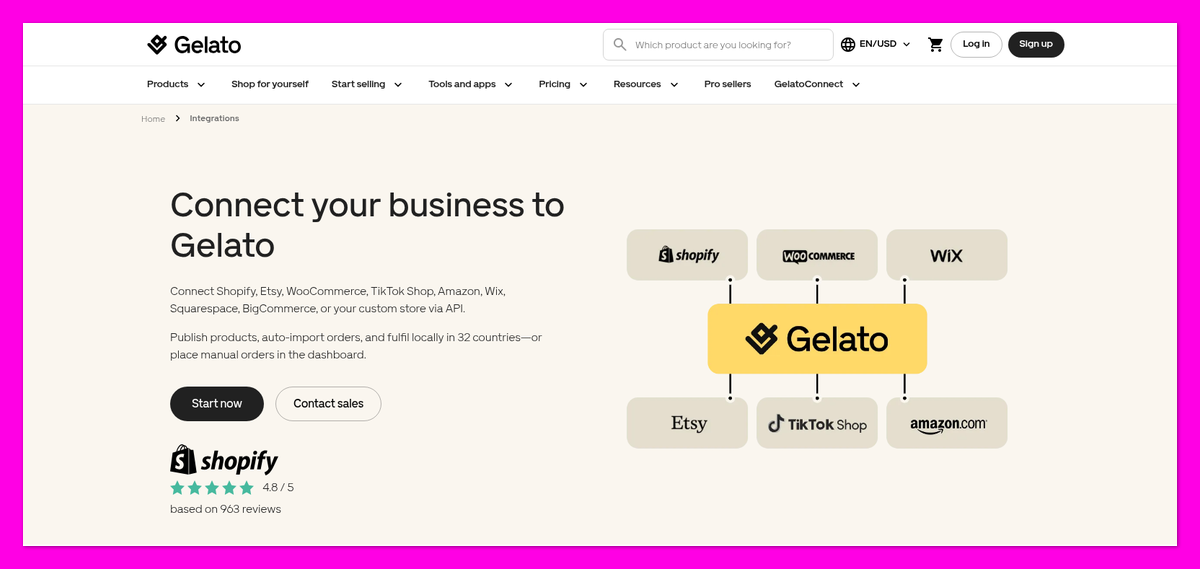
Beyond Shopify, Gelato also integrates with Etsy, Amazon, TikTok Shop, WooCommerce, Wix, Squarespace and BigCommerce. This makes it viable for multi-channel POD operations where your Shopify store is one of several sales touchpoints rather than the only one.
Marketing and Sales Tools
For marketing, Shopify carries the weight. Gelato’s contribution is indirect: faster delivery and a sustainability story are genuine brand differentiators that can inform your marketing angle, but the tools to execute that marketing live inside Shopify.
Shopify’s built-in email marketing lets you build and send campaigns directly from your account. You can connect your store to Instagram, TikTok, and other social platforms for organic and paid selling, or use Shopify Marketplace Connect to list products on Amazon and Etsy. Our guide on how to market a new print-on-demand business on Shopify covers where to start.
The Winner
Shopify wins on marketing tools. Its native social integrations, email marketing, SEO features, and AI tools are all available from one dashboard, while Gelato has no marketing tools of its own.
Templates and Storefront Design
Gelato doesn’t have a storefront, so this category belongs to Shopify entirely.
The Shopify Theme Store lists 1,379 themes spanning a wide range of industries and aesthetics. For POD sellers, categories like “Clothing and fashion,” “Art and photography,” and “Home and garden” cover most product types with ready-to-use designs.
There are 24 free themes; paid themes cost $100 to $500 as a one-time purchase on top of your subscription.

The section-based editor lets you rearrange page elements, swap color palettes, and adjust typography without writing code. For sellers who want deeper customization, Shopify’s App Blocks allow third-party components to be embedded directly into theme sections.
The Winner
Shopify by default. Gelato has no storefront. Shopify’s 1,379 themes give POD sellers a solid range of professional starting points, though only 24 are free and the rest carry a one-time fee.
Support
Both platforms offer customer support, but the nature of what you need help with differs by platform.
Shopify provides 24/7 live chat support on every plan, with complex queries escalated to a human advisor. Priority phone support is reserved for Shopify Plus, which starts from $2,300 a month.
The Help Center includes written guides, video tutorials, a community forum, and business courses through Shopify Learn.
Gelato offers 24/7 chat support on every plan, including the Free plan, plus a “Report a problem” button on each order.
Print quality issues, shipping delays, and production problems are the support categories most relevant to Gelato users. Report a problem within 30 days of delivery and, if Gelato validates it, you get a free replacement or a refund. Gelato doesn’t accept returns.
The Winner
Shopify has the more developed support infrastructure. Its Help Center, live chat escalation paths, and learning resources are thorough. Gelato’s support is well-regarded among users but built around a narrower, fulfillment-specific set of needs.
How We Reviewed These Platforms
Our assessment covers seven areas weighted by their importance to print-on-demand sellers:
| Category | Weight | What we looked at |
|---|---|---|
| Fulfillment and sales features | 40% | Production network, catalog, order automation, checkout |
| Platform features | 15% | SEO, AI tools, marketing, integrations |
| Help and support | 12% | Availability, channels, and quality of resources |
| Design and storefront | 10% | Templates, editor, and customization options |
| User experience | 10% | Onboarding, setup flow, and day-to-day usability |
| Market reputation | 8% | User reviews, adoption, and competitive positioning |
| Value for money | 5% | Pricing structure and cost relative to features |
Gelato vs Shopify: Final Verdict
The honest conclusion is that this isn’t really an either/or decision. For most print-on-demand sellers, the right answer is both: Shopify as the storefront and ecommerce engine, Gelato connected via its official app as the fulfillment backbone.
That said, here’s how to think about each platform on its own terms:
Choose Gelato if you’re a POD seller who wants fast, globally distributed fulfillment, particularly if you’re targeting EU or UK customers. Its local production model offers delivery speeds and sustainability credentials that most competing POD platforms can’t match.
It integrates cleanly with Shopify, Etsy, Amazon, and TikTok, so it works whether or not Shopify is your primary storefront.
Choose Shopify if you’re building a standalone ecommerce brand and need a scalable, feature-rich storefront that can grow with you.
Its checkout infrastructure, marketing tools, multichannel selling, and app ecosystem make it the most capable platform for running a POD business at any stage. Without a fulfillment partner like Gelato, though, it can’t produce or ship your products on its own.
If you’re just starting out and want to test the model before committing to a Shopify subscription, launching on Etsy or another marketplace through Gelato first is a viable low-cost entry point. Here’s how to start selling on Etsy with Gelato.
Once you’re generating consistent sales and want more control over your brand and customer experience, migrating to or adding Shopify is a natural next step. Our Shopify vs Etsy comparison shows what changes when you move, and our Shopify print-on-demand startup guide covers the launch.
Frequently Asked Questions
Is Gelato better than Shopify?
They serve different functions, so it’s not a fair comparison. Gelato handles print production and shipping; Shopify provides the storefront and checkout. For a POD business, you typically need both: Shopify to sell, Gelato to fulfill.
Can I use Gelato without Shopify?
Yes. Gelato integrates with Etsy, Amazon, TikTok Shop, WooCommerce, Wix, Squarespace and BigCommerce, so you don’t need a Shopify store to use it. However, if you want your own branded storefront with full control over the customer experience, Shopify is the most capable platform to pair with it.
Does Gelato work with Shopify?
Yes, Gelato has an official app on the Shopify App Store. Once connected, products created in Gelato are published directly to your Shopify storefront, and incoming orders are automatically routed to a Gelato print partner for fulfillment. The app is free to install and rated 4.8 out of 5.
How much does it cost to use Gelato with Shopify?
Gelato’s base plan is free; you pay per order for production and shipping. Shopify costs $39 a month on its Basic plan, or $29 a month billed yearly, plus a 2.9% + $0.30 card fee per sale with Shopify Payments. Optional upgrades on both platforms add features but aren’t required to get started.
Is Gelato good for beginners?
Yes. Gelato’s free-to-start model, automatic order routing, and built-in design tools make it accessible for new POD sellers. The main learning curve is understanding how Gelato fits alongside a selling platform rather than replacing one.
What are the best alternatives to Gelato for Shopify?
Printify and Printful are the two most commonly compared alternatives. Printify offers a larger catalog and more supplier options; Printful is known for stronger branding and packaging customization. Gelato’s main edge is its global production network and regional delivery speeds, particularly in Europe. We compare all three in Printful vs Printify vs Gelato, and list more options in our best Gelato alternatives.