
Etsy and Redbubble come up time and time again when you’re deciding where to sell print-on-demand designs, but they work in completely different ways. After comparing both, Etsy is the better platform if you want to earn real money from print on demand. Redbubble is the easier, more hands-off option, but pays far less per sale.
This Etsy vs Redbubble comparison isn’t quite apples to apples. On Etsy, you run a shop while a print-on-demand (POD) supplier such as Printify prints and ships orders. Redbubble is one of the free print-on-demand sites where you upload designs and it handles fulfillment and support.
I’ll score them across six rounds, using one $24 T-shirt example to show what you keep.
Key Takeaways
- Etsy pays far more per sale: you keep $9.60 on the $24 tee with Printify, against $3.20 on Redbubble Premium and $2.00 on Standard.
- Redbubble is far less work: one upload covers over 70 products, with printing, shipping and support handled. Etsy leaves listings and buyer messages to you.
- Etsy brings far more buyers: Etsy reported 87.5 million active buyers, versus 3.1 million Redbubble customers according to coverage of Articore Group’s FY26 results.
- Redbubble decides your tier, including whether it keeps 20% or 50% of your monthly earnings. You can’t buy or choose one.
- Etsy’s new terms allow AI training from December 16, 2026. Redbubble’s User Agreement doesn’t mention AI. You can sell the same designs on both.
Best Overall

Etsy
See pricing Try Etsy →$0/month, $0.20 per listing
6.5% transaction + 3% + $0.25 processing
- 87.5 million active buyers
- You set the price and margin
- Free Printify and Printful integrations
Best Hands-Off Option
Redbubble
See pricing Try Redbubble →$0/month, no listing fees
Platform fee: 20% Premium, 50% Standard
- Over 70 products per upload
- Printing, shipping and support handled
- Off-site ads at no direct fee
A Quick Comparison of Etsy vs Redbubble
Get a quick and clear overview of Etsy and Redbubble in the table below:
| Etsy | Redbubble | |
|---|---|---|
| Overall rating | 4.3/5 | 3.6/5 |
| Cost to start | $0/mo • $0.20 per listing • one-time set-up fee may apply; varies by location | $0 • free account and shop • no listing fees |
| Fees per sale | 6.5% transaction fee • 3% + $0.25 processing (US) • 15% or 12% Offsite Ads fee on ad-driven orders | 50% (Standard) or 20% (Premium) platform fee on monthly earnings • 0% on Pro • Standard/Premium: 50% fee on earnings from markup above 20% |
| You keep on a $24 T-shirt | $9.60 with Printify • $5.40 if the sale came through Offsite Ads | $3.20 on Premium • $2.00 on Standard • $4.00 on Pro |
| Who sets the price | You | Redbubble sets the base price • you set the markup (10% by default) |
| Buyers | 87.5 million active buyers (Q3 2026) | 3.1 million customers (FY26, as reported) |
| Printing and shipping | Your POD supplier, such as Printify or Printful | Third-party printers that Redbubble chooses |
| Customer service | You | Redbubble |
| Products | Your supplier’s catalog | Over 70 products |
| Payouts | Daily, weekly, biweekly or monthly deposits • payment reserves possible | Monthly; should arrive by the 15th • $10 minimum after fees |
| AI terms | From December 16, 2026, Etsy and its partners may use your content to train AI | No AI wording in the User Agreement |
| Pros | • Far higher profit per sale • 87.5 million active buyers • You choose the product, printer and price • Shop branding and reviews | • Free to start • One upload, over 70 products • Printing, shipping and support handled • Off-site ads at no direct fee |
| Cons | • Fees on every sale, including shipping • You write listings and answer buyers • Production partner disclosure and Creativity Standards • AI-training clause | • Low payouts • Redbubble assigns your tier • Paid once a month • No customer contact details |
If Society6 is also on your list, our Society6 vs Etsy comparison covers it.
What Kinds of Business Is Etsy or Redbubble Best For?
Have a specific goal in mind? Here’s a summary of what kinds of business Etsy and Redbubble are best for:
Etsy Is Best for…
- Print-on-demand sellers who want to set prices and keep a real margin
- Sellers ready to write listings, make mockups and answer buyers
- Designers building a shop name buyers remember and return to
Redbubble Is Best for…
- Artists who want to upload designs and leave fulfillment and support to someone else
- Beginners who want no upfront cost
- Etsy sellers seeking a second, hands-off outlet for the same designs
1. Best for Pricing and Profit per Sale: Etsy
The Winner
Etsy pays you far more per sale
On a $24 T-shirt, you keep $9.60 on Etsy with Printify, against $3.20 on Redbubble Premium and $2.00 on Standard. Etsy’s fees stack up, but you set the price.
After platform fees and supplier costs, Etsy leaves you with far more profit per sale in this example. Redbubble charges nothing up front, but its cut of your earnings makes the difference.
What Etsy Charges on Every Sale
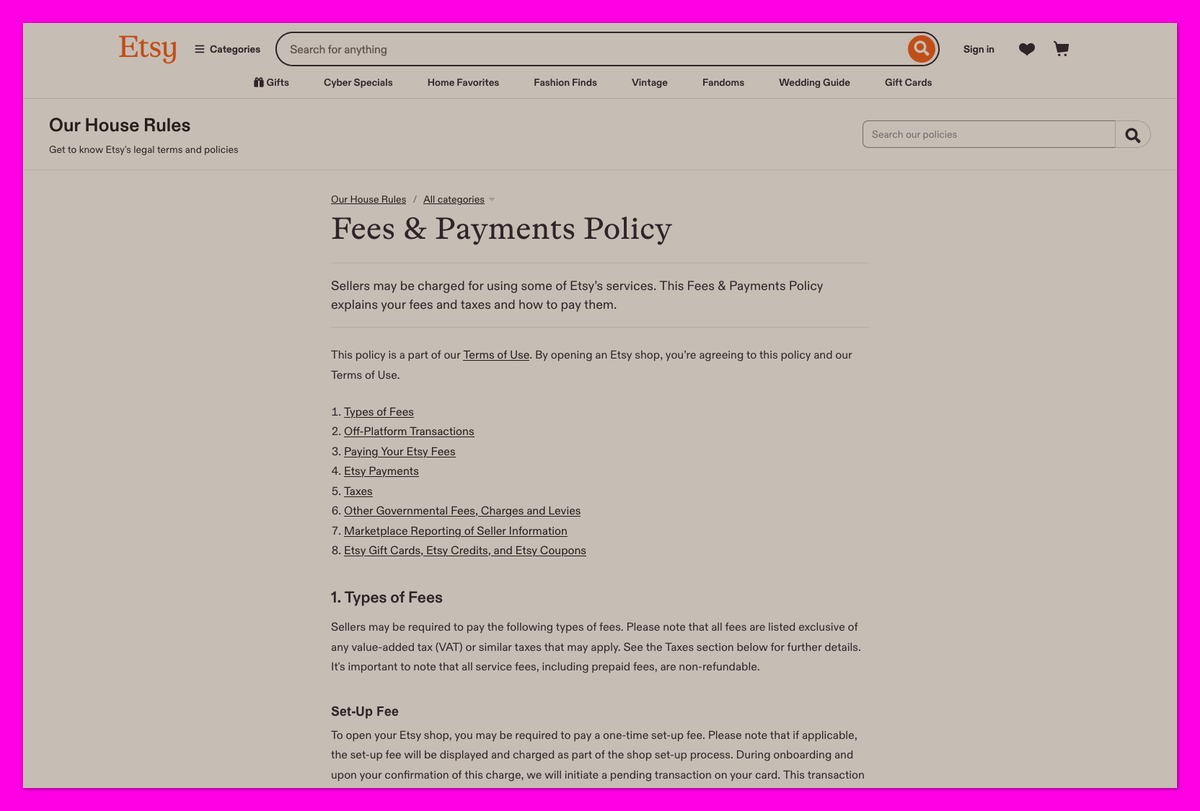
Etsy’s fees look small individually, but they stack on every order, including the shipping you charge. Prices here are in USD, as of November 2026.
| Etsy fee | Amount (US) | When you pay it |
|---|---|---|
| Listing fee | $0.20 per listing | Each listing lasts 4 months and auto-renews • charged again when a multi-quantity item sells |
| Transaction fee | 6.5% | On the item price plus shipping and gift wrap |
| Payment processing (Etsy Payments) | 3% + $0.25 | On every order |
| Offsite Ads | 15% if your shop made under $10,000 in the past 365 days (you can opt out) • 12% and mandatory from $10,000 | Only when an ad click leads to a sale within 30 days • capped at $100 per order |
| Set-up fee | Varies by location | One time, when you open your shop, if it applies • Etsy shows it during set-up |
| Etsy Plus (optional) | $10/month | 15 listing credits, a $5 Etsy Ads credit, extra banner and layout options |
Etsy doesn’t print anything, so your POD supplier’s product and shipping costs come on top.
Our breakdown of how much commission Etsy takes covers every fee in more detail.
How Redbubble Sets Your Price
Redbubble works the other way around: it’s free to join, and you never pay a fee out of pocket.
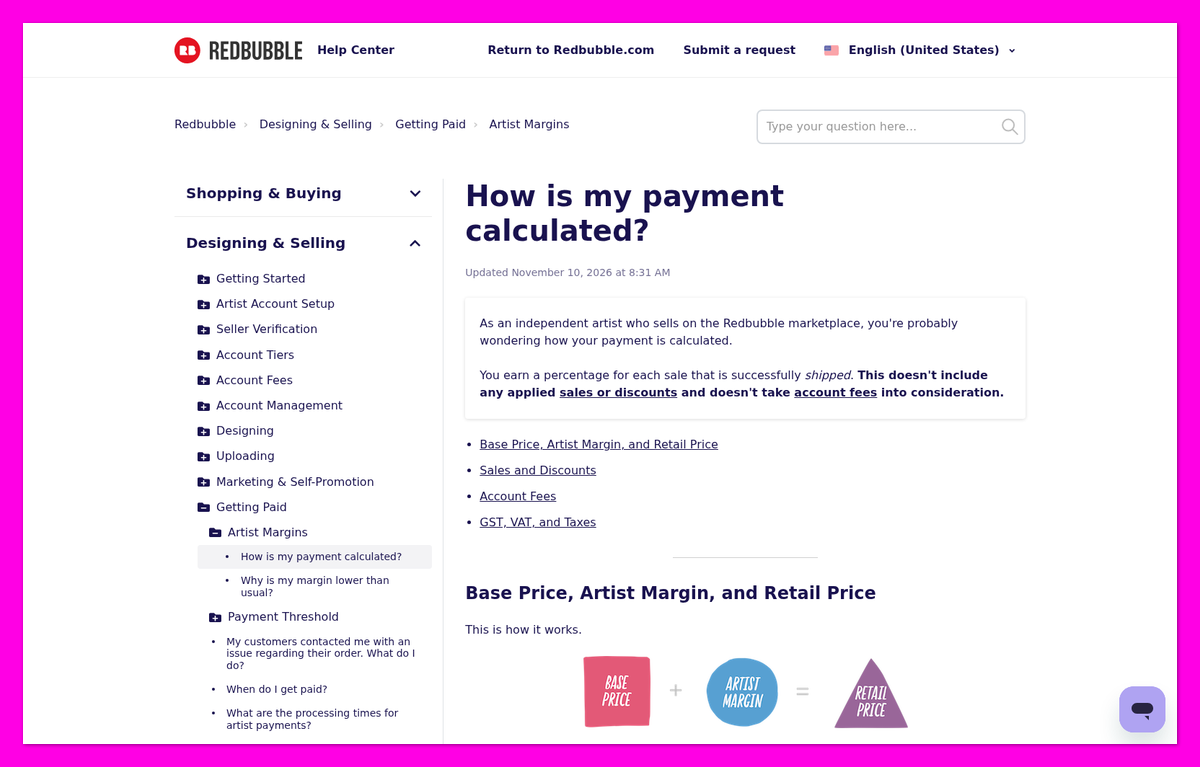
Retail price equals base price plus artist margin. The base price includes Redbubble’s service fee and the manufacturer’s fee; your markup is a percentage of that base, defaults to 10%, and is adjustable per product on the Product Pricing page.
Redbubble’s own US Classic T-Shirt example uses a $20.00 base price. A 20% markup adds a $4.00 artist margin for a $24.00 retail price before tax; the default 10% earns $2.00 before account fees.
Sitewide sales and bundle discounts lower the base price, shrinking your margin too.
Our guide on how to make money on Redbubble covers pricing your designs there.
What Redbubble’s Account Fees Cost You
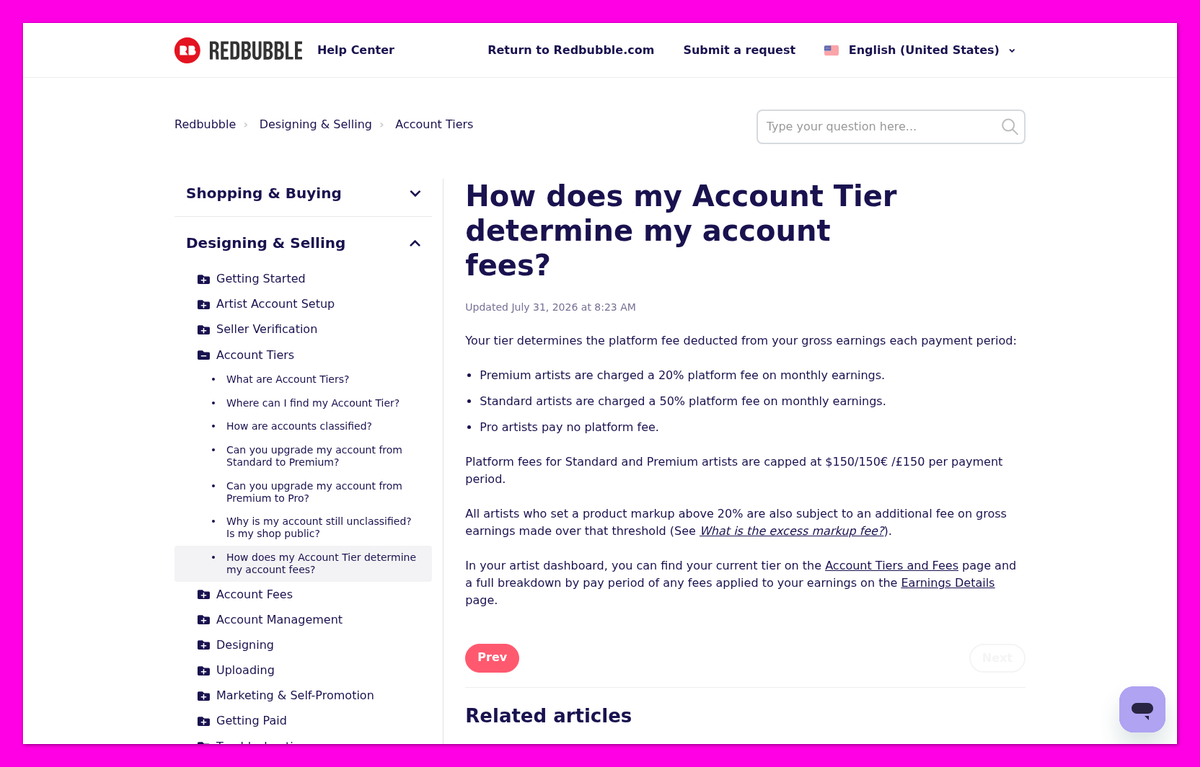
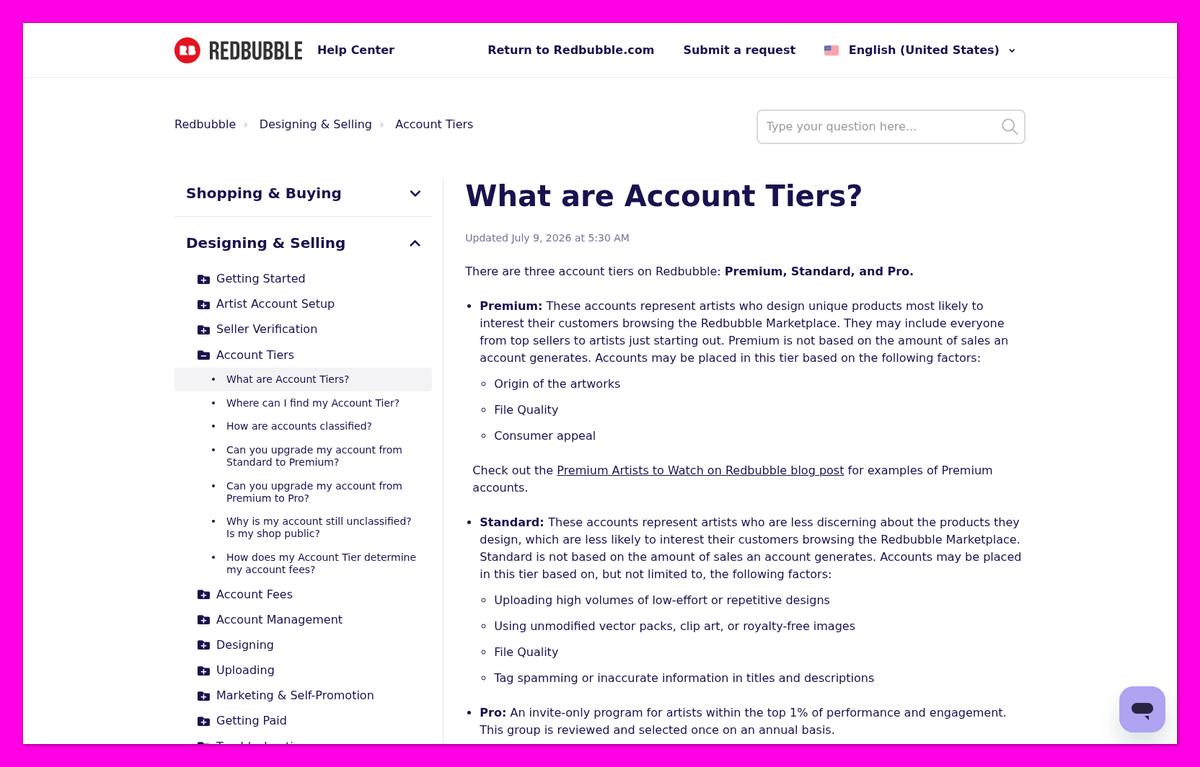
Since September 1, 2025, Redbubble takes a platform fee of 20% or 50% of your monthly earnings on Premium and Standard accounts, replacing its older flat account fee. Pro accounts pay neither the platform fee nor the excess markup fee.
| Redbubble tier | Platform fee (monthly earnings) | Excess markup fee | How you get the tier |
|---|---|---|---|
| Standard | 50% | 50% of earnings from markup above 20% | Assigned by Redbubble, for example for high volumes of low-effort or repetitive designs, clip art or tag spamming |
| Premium | 20% | 50% of earnings from markup above 20% | Assigned by Redbubble on origin of artwork, file quality and consumer appeal |
| Pro | 0% | None | Invite-only for the top 1%, reviewed once a year |
Total account fees are capped at $150 per payment period, with excess credited back, and apply only in months with sales. Premium classification isn’t based on sales volume, and you can’t choose or buy a tier; round 6 covers upgrades.
What You Keep on a $24 T-Shirt
I ran the numbers on a $24.00 T-shirt sold to a US buyer, with buyers paying shipping on both platforms. For Etsy, I priced a Bella+Canvas 3001 on Printify’s Free plan with Printify Choice Economy shipping. These are different shirts at the same item price: Redbubble’s example uses its Classic T-Shirt.
| One $24 T-shirt, US buyer | Etsy + Printify | Redbubble Premium | Redbubble Standard |
|---|---|---|---|
| Buyer pays | $27.99 ($24.00 + $3.99 shipping) | $24.00 + shipping | $24.00 + shipping |
| Your costs | $15.28 ($11.29 tee + $3.99 shipping) | None: printing is in the $20.00 base price | None: printing is in the $20.00 base price |
| Your earnings before fees | $12.71 | $4.00 margin (20% markup) | $4.00 margin (20% markup) |
| Platform fees | $3.11 ($0.20 listing + $1.82 transaction + $1.09 processing) | $0.80 (20% platform fee) | $2.00 (50% platform fee) |
| You keep | $9.60 | $3.20 | $2.00 |
| If the sale came from an ad | $5.40 (15% Offsite Ads fee: $4.20) | $3.20 (no direct fee for off-site ads) | $2.00 (no direct fee for off-site ads) |
Etsy’s $9.60 is 3 times Redbubble Premium’s $3.20 and 4.8 times Standard’s $2.00. Even an Offsite Ads order at $5.40 beats the $4.00 a Redbubble Pro artist keeps.
At 20 shirts a month, that’s $192.00 on Etsy, $64.00 on Premium and $40.00 on Standard, excluding Etsy’s set-up fee and any Etsy Ads spend. These are example totals, not typical earnings: Etsy also leaves listings and buyer support to you.
Should You Raise Your Redbubble Markup?
- On Premium, a higher markup pays a little more. At 30% ($26.00 retail, $6.00 margin), the excess markup fee takes $1.00 and the platform fee takes $1.20. You keep $3.80 instead of $3.20.
- On Standard, it pays nothing extra. You still keep $2.00: earnings above a 20% markup go entirely to fees until the $150 monthly cap.
2. Best for Finding Customers: Etsy
The Winner
Etsy puts your designs in front of far more buyers
Etsy reported 87.5 million active buyers for Q3 2026. Redbubble had 3.1 million customers in FY26, down from 3.5 million, according to coverage of Articore’s FY26 results.
For finding customers, Etsy is the clear winner, though its larger audience doesn’t guarantee visibility for your listings. It also means competing with more sellers.
Etsy’s Built-In Audience
Etsy reported these figures for Q3 2026:
- 87.5 million active buyers, up 1%
- 5.8 million active sellers, up 6.5%, so sellers grew faster than buyers
- $2.65 billion in marketplace sales in the quarter
I recommend Etsy for its larger buyer pool, not as a shortcut to orders. Seller growth outpaced buyer growth, so the audience advantage comes with increasing competition.
Etsy Ads are paid promotions inside Etsy. Offsite Ads promote listings elsewhere, with a 15% fee for smaller shops when an ad click produces an order within 30 days, capped at $100 per order.
You can opt out only while your shop is under $10,000 in sales over the past 365 days. From $10,000, participation becomes mandatory and the fee drops to 12%.
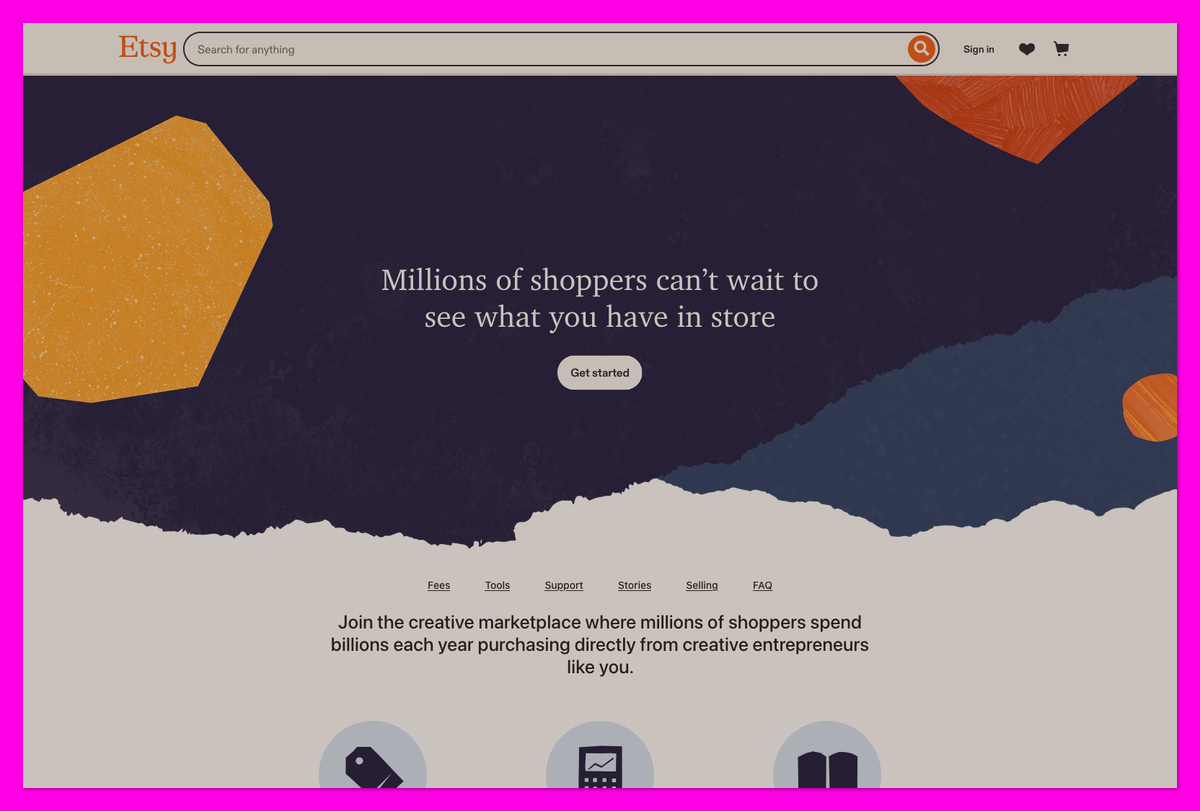
If you’re deciding whether selling on Etsy is worth it, that guide weighs the fees against the traffic.
Redbubble’s Audience
Redbubble’s marketplace is smaller, and its customer count is shrinking. According to coverage of Articore’s FY26 results, for the year to June 30, 2026:
- 3.1 million Redbubble customers, down from 3.5 million a year earlier
- 468,000 selling artists, down from 542,000
- A$354.5 million in marketplace revenue across Articore, down 6.5%
Redbubble does market your work for you. Opting into off-site marketing sends your products to advertising platforms, including:
- Google and Bing
- Instagram and Facebook
- Pinterest and TikTok
Redbubble states: “Independent artists are not charged any direct fees to advertise their products off-site.” That’s a real advantage over Etsy’s 12% or 15% Offsite Ads fee: an advertised sale doesn’t trigger another direct advertising charge.
If you want another marketplace that prints and ships for you, our Zazzle vs Redbubble comparison weighs a close rival.
Starting without an audience? Etsy gives your designs far more chances to be seen through its larger buyer pool. Price listings so an Offsite Ads order still leaves a profit, like the $5.40 in round 1.
3. Best for Ease of Use: Redbubble
The Winner
Redbubble is the easier way to start selling your designs
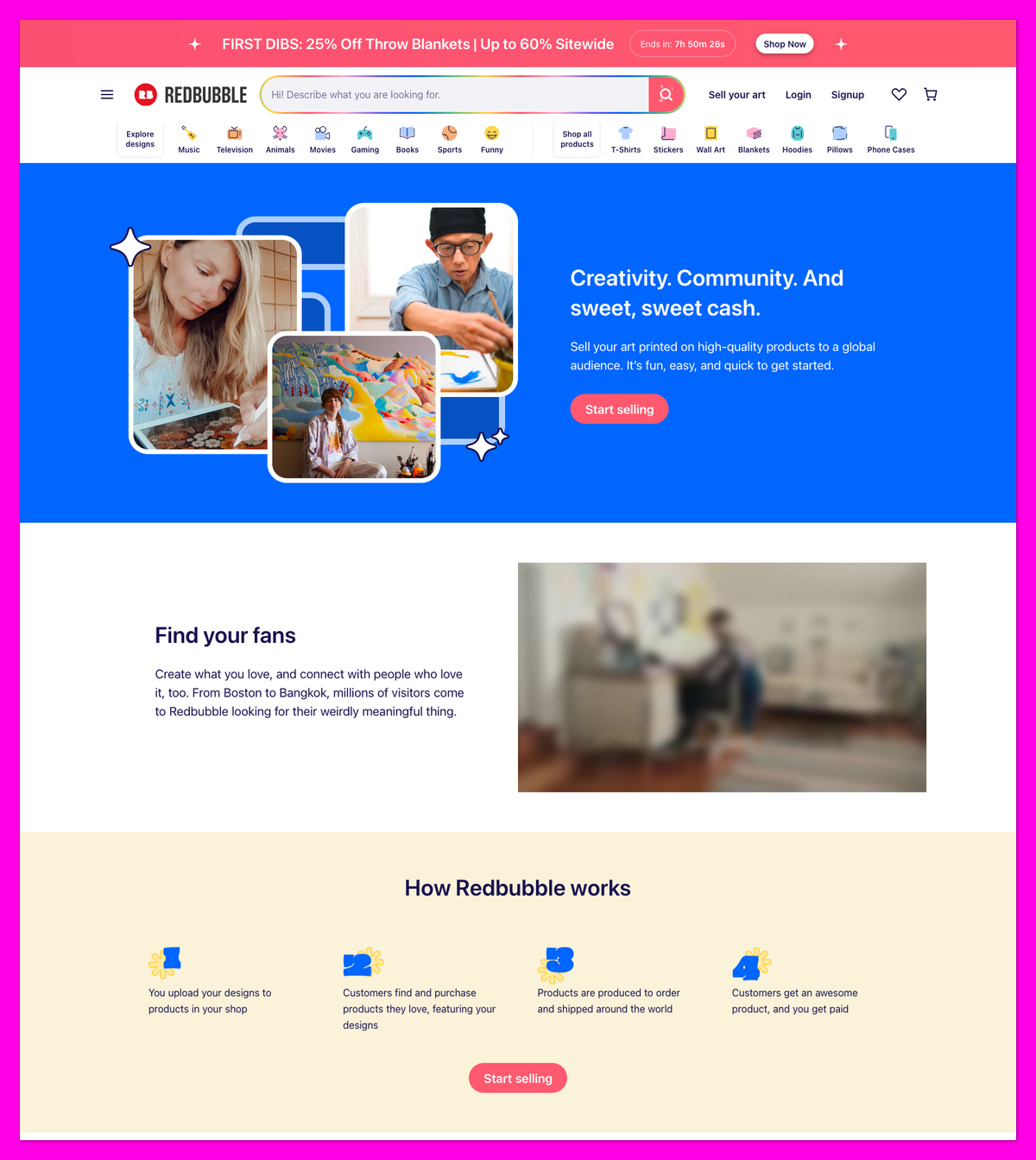
It’s free, one upload can go on over 70 products, and Redbubble prints, ships and handles customer service. On Etsy, you connect a supplier, build each listing and answer buyers yourself.
Based on how much work each platform leaves to you, Redbubble is the clear winner for ease of use.
Getting Started on Redbubble
Opening a Redbubble shop is free, with no listing fees or monthly subscription. To go live:
- Sign up as an artist
- Upload at least 5 public designs, each with at least 1 product enabled
- Set up your shop with a profile picture, cover picture, social links and bio
- Add your payment details and verify your phone number
Redbubble then classifies your account, which can take up to 5 business days. Your shop stays private until classification is finished, so completing those steps doesn’t make it public immediately.
Each design needs a title, up to 15 tags and a description of up to 250 characters. “Upload to All Products” places one design on the whole range, rather than making you create a separate upload for each product.
After that, Redbubble prints and ships every order. If a buyer contacts you with an order problem, direct them to the Redbubble Help Center instead of managing the problem yourself.
Getting Started on Etsy
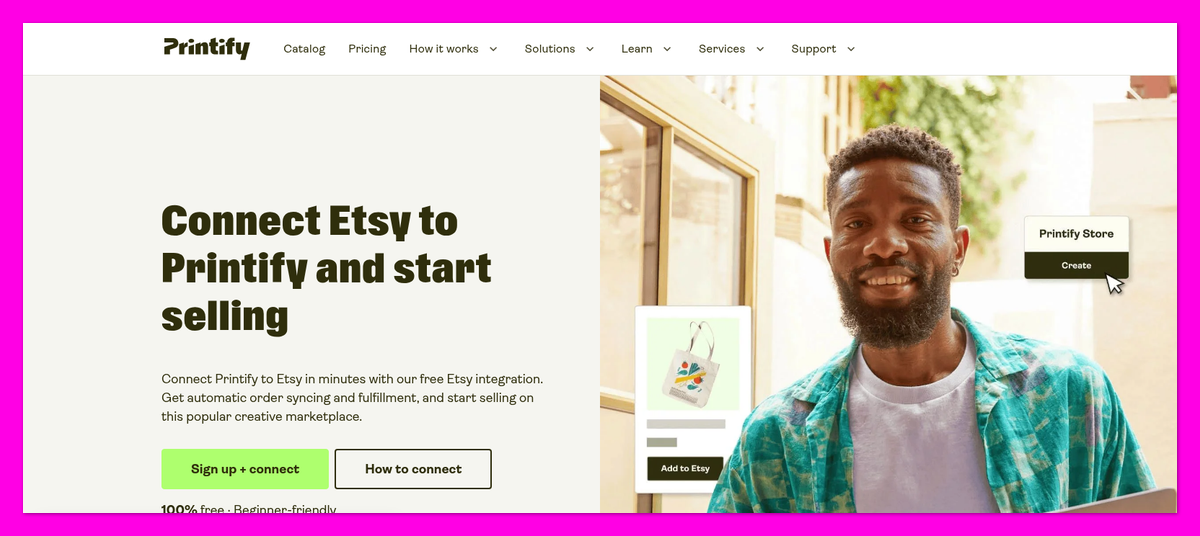
An Etsy shop may incur a one-time set-up fee, which varies by location and appears during set-up. You then connect a print-on-demand supplier.
Printify’s and Printful’s Etsy integrations are free, and our guides show how to connect Printify to Etsy and how to connect Printful to Etsy.
From there, the work Redbubble handles becomes yours:
- Create each product in your supplier’s catalog and make the mockups
- Write every listing and set its price, at $0.20 per listing
- Add your production partner in Shop Manager, as covered in round 4
- Answer buyer messages and handle problems yourself: the supplier prints and ships, but you look after the buyer
Connecting a supplier automates fulfillment, not your responsibility for buyer questions. Choose Etsy only if you’re willing to manage that ongoing customer-service work alongside your designs.
Our take
Redbubble removes fulfillment and support work, but you hand over control in return. You won’t know your tier, and whether Redbubble keeps 20% or 50% of your earnings, until classification is done.
4. Best for Products and Print Control: Etsy
The Winner
Etsy lets you choose the product, the printer and the price
With Printify or Printful behind your Etsy shop, you choose your products and retail prices. Printify also lets you select a print provider. Redbubble offers over 70 products, but picks the printer and blank for you.
For control over production, Etsy wins this round. Redbubble gives you a wide ready-made range, but you can’t choose who makes it or its production cost.
Products and Printing on Etsy
On Etsy, you pick the supplier, the blank and the price. For a Bella+Canvas 3001 tee:
- Printify: from $11.29 on the Free plan, or from $9.04 with Printify Premium at $39 a month; US shipping starts at $3.99 with Printify Choice Economy, or $4.95 with Standard
- Printful: $11.92 for the same tee
With Printify, you also choose which print provider makes each product. That choice affects which supplier cost you use when setting your Etsy retail price.
We’ve ranked the best print-on-demand companies for Etsy, and put Printify vs Redbubble and Printful vs Redbubble head to head.
Products and Printing on Redbubble
- Over 70 products, including T-shirts, kids’ clothing, tote bags, wall art, mugs, stickers and phone cases
- Printers chosen for you: third-party fulfillers use DTG, DTF, sublimation or inkjet; you can’t choose the printer or blank
- Redbubble sets the base price, covering its service fee and the manufacturer’s fee; you only set the markup
On Redbubble, a T-shirt takes one print placement, front or back, which the buyer picks on the product page. Its broad range earns credit, but I favor Etsy here because you choose the supplier and product rather than accepting Redbubble’s choices.
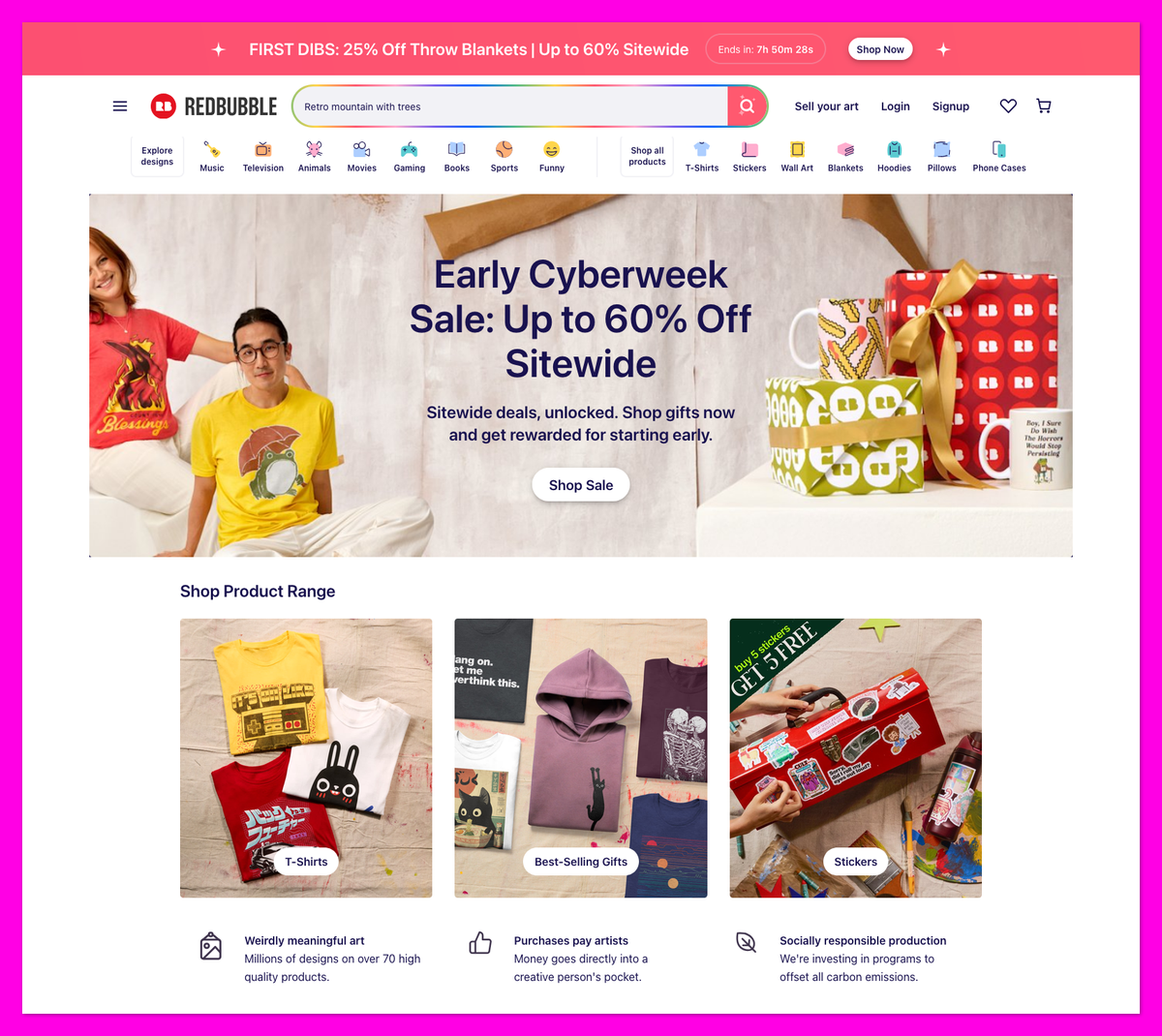
Stickers come from the same upload, and our guide shows how to sell stickers on Redbubble.
What About Disclosing Your Print Provider on Etsy?
- In Shop Manager, edit the listing. Under “Who made it?”, choose “Another company or person”.
- Create a production partner, such as Printify, located in Wilmington, DE, USA.
- Answer the role questions, such as “I design everything myself”.
- Optionally hide partner details behind a title such as “A print shop”.
Printify fills this in only if a partner named Printify already exists. Otherwise, the listing defaults to “Made by seller” and needs correcting. Redbubble has no equivalent step because it picks the printer.
5. Best for Branding and Customer Ownership: Etsy
The Winner
Etsy lets you build a shop buyers can come back to
Your Etsy shop has its own name, logo, banner, About section and reviews, and you message buyers directly. On Redbubble, checkout, customer service and the customer relationship stay with Redbubble.
For a recognizable shop and direct buyer conversations, Etsy gives you far more of a brand than Redbubble does. You still operate under Etsy’s marketplace rules, rather than running an independent storefront.
Your Shop’s Identity
- Etsy: shop name, logo, banner, About section, shop policies and announcement; optional Etsy Plus at $10 a month adds extra banner and layout options
- Redbubble: profile picture, cover picture, bio and social links
You can embed your Redbubble shop on your own website, but checkout always happens on Redbubble. Embedding it doesn’t give you a separate place to accept orders.
And neither platform gives you a custom domain for its marketplace shop. If you want your own domain and checkout, our Shopify vs Redbubble comparison covers that route.
Who Owns the Customer?
Buyers contact you through Etsy Messages, and reviews build up on your shop, so repeat buyers can find you again. But buyer email use is restricted to the order, and Etsy’s search and rules still influence who sees your listings.
On Redbubble, buyers are Redbubble’s customers. You send them to the Redbubble Help Center and don’t receive their contact details.
I favor Etsy because you can maintain a recognizable shop and speak directly with buyers. That isn’t the same as owning an unrestricted customer list.
If you’d rather manage customer relationships through your own store, our Shopify vs Etsy comparison weighs that route.
Top Tip
Don’t add Etsy buyers to a mailing list. Etsy restricts buyer email use to the order, so build repeat sales through your shop page, reviews and Etsy Messages instead.
6. Best for Payouts and Platform Rules: It’s a Tie!
The Winner
Etsy pays you faster, and Redbubble’s terms ask less of your work
Etsy offers daily to monthly deposits; Redbubble pays monthly. Etsy’s AI-training clause takes effect December 16, 2026, while Redbubble’s User Agreement doesn’t mention AI.
Both can cost you money or control, so this round is a tie.
Etsy Payouts and Rules
Etsy gets money to you faster, with conditions:
✔️ Daily, weekly, biweekly or monthly deposits; new sellers default to weekly.
✔️ Original POD designs qualify as “Designed by a seller” under Creativity Standards.
✔️ Etsy Payments is built in, and your fees come out of your payment account automatically.
❌ Reserves can hold part of physical-item funds until tracking shows transit.
❌ Production partner disclosure is required; Creativity Standards breaches risk removals or suspension.
❌ AI-training rights begin December 16, 2026.
Redbubble Payouts and Rules
Redbubble’s rules are simpler, but it holds more control:
✔️ The threshold dropped from $20 to $10 after fees on July 1, 2026: 4 example Premium shirts ($12.80) or 5 Standard ($10.00).
✔️ Sub-threshold earnings roll over without repeat fees.
✔️ PayPal, or bank transfer for US, UK or Australian banks.
❌ Monthly processing starts at the beginning of the month; payment should arrive by the 15th. Only shipped orders count.
❌ Redbubble assigns tiers; it says upgrades from Standard to Premium “only happen on rare occasions”. Pro is invite-only.
❌ Suspension freezes your balance.
What About AI Training?
Etsy revised its Terms of Use on October 26, 2026; the change takes effect on December 16, 2026:
“This also includes the right for us and our third party partners and vendors to use Your Content to develop, train, test and improve artificial intelligence and machine learning technologies, including to improve the Services and/or help keep them safe, subject to any applicable opt-out rights described in our Privacy Policy.”
Press reports say there’s no general opt-out switch for US sellers. Etsy’s response: “We do not use your content to train AI models designed to copy your original work or replace your creativity.”
As of November 23, 2026, the clause remains published.
Redbubble’s User Agreement, updated May 15, 2026, contains no AI or machine-learning wording: neither an explicit training right nor a no-training promise. Its license is “non-exclusive, worldwide, royalty-free, sublicensable and transferable”, for operating and promoting the marketplace and making products.
If Etsy’s clause is a deal-breaker, consider these Etsy alternatives.
Can You Sell on Both?
Yes, you can sell the same designs on Etsy and Redbubble. Redbubble’s license is non-exclusive; Etsy requires original designs and production partner disclosure.
Both platforms remove work that copies someone else’s, and Redbubble can suspend or close accounts for it. Learn how to avoid copyright infringement in print on demand.
Redbubble’s dashboard shows best-selling designs, helping you prioritize Etsy listings. The example tee earns $9.60 there versus $3.20 on Premium, but Etsy’s AI clause applies from December 16, 2026.
How We Test Print-on-Demand Platforms
Profit per sale carries the most weight in this comparison because it determines what you keep after platform and supplier costs. I scored Etsy and Redbubble across six areas:
- Pricing and Profit per Sale: 25%: we calculate earnings after costs
- Finding Customers: 20%: we compare audiences and advertising costs
- Ease of Use: 15%: we compare setup steps and ongoing workload
- Products and Print Control: 15%: we compare ranges and production choices
- Payouts and Platform Rules: 15%: we examine payments, account rules and AI terms
- Branding and Customer Ownership: 10%: we compare customization and buyer relationships
Etsy won rounds worth 70% of the score, Redbubble won 15%, and the remaining 15% was tied. Etsy leads overall; Redbubble wins for reducing your workload.
In November 2026, I compared both platforms’ pricing pages, fee policies, help centers and seller terms, plus Printify’s and Printful’s product pages, and worked out every fee in the $24 T-shirt example.
Etsy vs Redbubble: Our Winner
For print-on-demand sellers who want to earn real money from each design, Etsy is the better platform. It won pricing, finding customers, product control and branding: the $24 tee pays $9.60 with Printify, against $3.20 on Redbubble Premium and $2.00 on Standard, and Etsy reported 87.5 million active buyers. The price is more work and more rules, including Etsy’s AI-training clause from December 16, 2026.
Redbubble wins if you want hands-off sales. It’s free, one upload covers over 70 products, and Redbubble prints, ships and answers your buyers; expect small payouts and a tier you don’t choose. You can run both because Redbubble’s license is non-exclusive; if its cut feels too steep, our list of Redbubble alternatives covers other marketplaces that print for you.
While Etsy is our top choice overall, I recommend opening an Etsy shop backed by Printify, and uploading the same designs to Redbubble for extra, hands-off sales.