Redbubble lets artists and designers upload artwork and sell it on products like stickers, t-shirts and phone cases, while the platform handles printing, shipping and customer service in exchange for a cut of each sale. Stickers are the usual starting point: they cost nothing upfront to list, they sell across almost every niche, and one design can carry over to dozens of other products.
The trade-off is real. You are entering a crowded marketplace, per-sticker margins are thin, and Redbubble’s fee structure takes a meaningful share of what you earn. Results come less from any single design and more from volume, niche focus and listing optimisation over time.
This guide covers setting up a store, designing stickers that sell, pricing them under the current fee rules, and marketing them, plus the realities worth knowing before you commit.
Quick Facts
- No upfront investment to start: you only earn when a design sells.
- Redbubble handles printing, shipping and customer service, so you can focus on designing.
- High-quality, niche designs consistently outperform generic ones.
- Income is passive only after the work: design and setup are upfront, and earnings depend on consistent uploads in a crowded market.
- Account-tier and markup fees reduce your take, so your pricing strategy matters (covered below).
- SEO and social media promotion can lift sales significantly.
What is Redbubble?
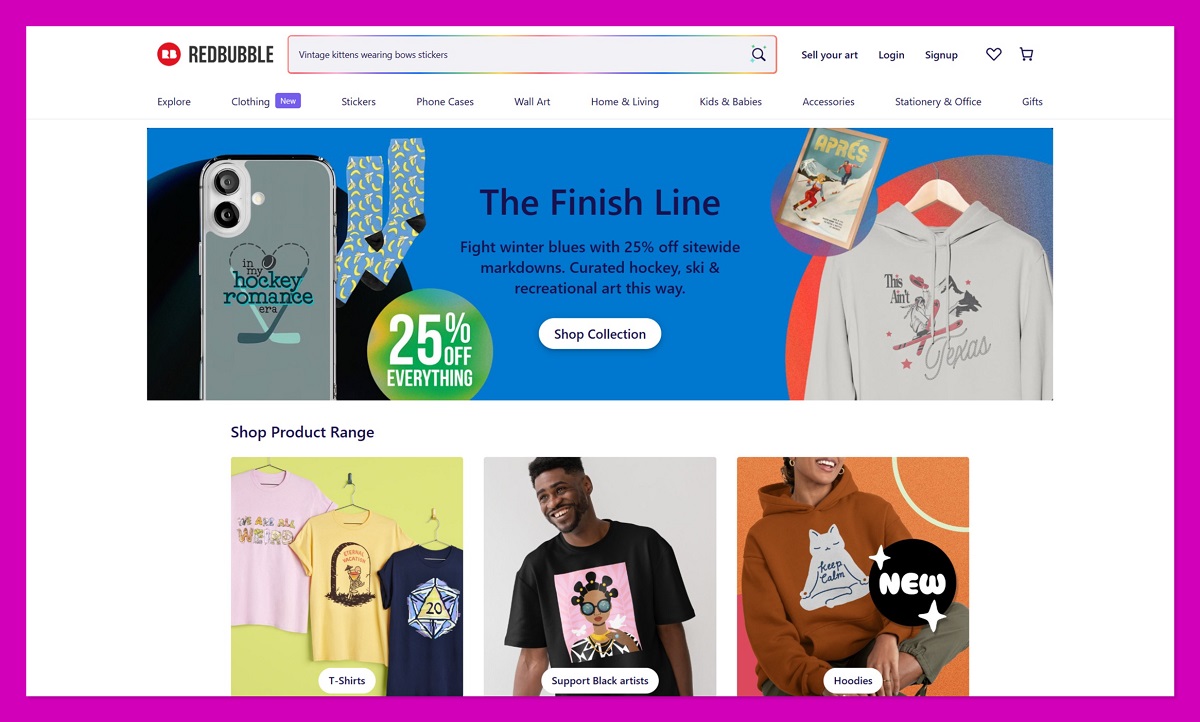
Redbubble is an online Print on Demand (POD) marketplace where artists can sell their designs on products like stickers, t-shirts, phone cases and more.
When a customer buys, Redbubble’s third-party printers produce the item, Redbubble handles shipping and customer service, and you earn an artist margin on top of the base price.
It is one of the largest POD marketplaces, with millions of artists, which is both its strength and its challenge: a huge built-in audience, but also heavy competition for visibility. Stickers suit the model well because they are inexpensive, broadly appealing and easy to apply to other products once designed, whether that is cute animal art, motivational quotes or detailed illustrations.
Why Stickers are the Perfect Product for Beginners
Why Stickers Are a Good Starting Point
Stickers are low-risk with a low barrier to entry, which makes them a sensible first product on Redbubble. Here is why:
- Low cost to start: you do not produce or stock anything, and Redbubble only takes its cut when a design sells.
- Broad demand: stickers sell across many niches, from memes and quotes to nature and hobbies, so almost any style has potential buyers.
- Versatile designs: once a sticker design works, you can apply it to mugs, t-shirts, phone cases and more without extra design work.
The honest caveat: low risk does not mean easy money. Because stickers are cheap and simple to make, the market is crowded and individual margins are small. Treat your first stickers as a way to learn the platform, not a shortcut to quick income.
Setting Up Your Redbubble Store
How to Create an Account
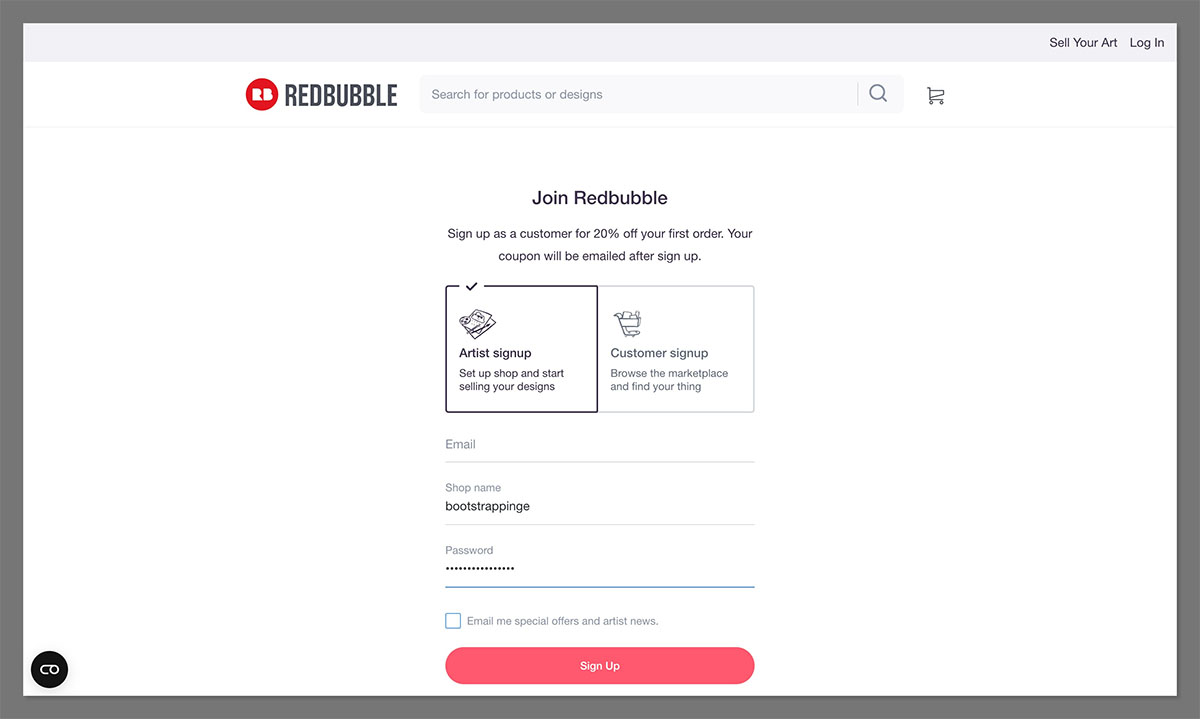
- Go to Redbubble.com and select “Sign Up”.
- Enter your email address, choose a username and create a password.
- Verify your email to activate your account.
- Once logged in, add a profile picture and fill out your bio to start building your store.
Creating an account and opening a shop is free, and you are never charged simply to list designs.
Optimise Your Profile for Sticker Sales
Your profile is part of your store’s branding, and a consistent, professional look helps turn browsers into buyers.
- Bio: describe your style and what you sell, and add links to your social accounts to build your brand.
- Avatar and banner: use clear, eye-catching images, since these form a buyer’s first impression of your shop.
A tidy, cohesive profile signals credibility, which matters on a marketplace where buyers are choosing between many similar sellers.
How to Design for Redbubble
Now that your store is set up it’s time to focus on designing for sales. The quality and appeal of your designs will be key to your success on Redbubble.
Sticker Design Best Practices on Redbubble
- Use High Res Images: Stickers should be uploaded at high res to print clearly. Redbubble recommends a minimum res of 2,800 x 2,800 pixels.
- Transparent Background: Stickers need a transparent background so the design doesn’t appear as a solid block when printed.
- Bright Colours and Simple Shapes: Stickers with bold colours and clean lines will stand out more and appeal to a wider audience.
Designing for Niche: What Works
One of the keys to success on Redbubble is to target specific niches. The more niche and focused your designs are the more likely they will attract a dedicated audience. Here are a few profitable sticker niches:
- Pop culture (TV shows, memes, movies)
- Motivational quotes (self-care, productivity)
- Nature and animals (flowers, cats, dogs)
- Humour (funny sayings, puns)
Research current trends and design around them to capture keywords and attract buyers.
Uploading and Listing your Stickers on Redbubble
Now you’ve designed your sticker it’s time to upload it to Redbubble. Here’s how:
- Upload your design: Go to your account and click “Add New Work”. Select your file and upload your design. Make sure it has a transparent background and is a high res PNG.
- Choose your Products: Select “Sticker” as the main product but you can also apply the design to other products like t-shirts or phone cases.
- Optimize your Title, Tags and Description: Include keywords like “funny stickers”, “cute animal stickers” or “motivational stickers” to improve search visibility.

Choosing the Right Keywords for your Sticker Listings
To be discovered by buyers you need to choose the right keywords. Use Redbubble’s search bar to see what customers are searching for and try to include those in your titles and descriptions.
For example instead of a generic title like “Cat Sticker” use something more descriptive like “Cute Cat Sticker for Laptops and Water Bottles”.
Pricing your Stickers
Redbubble allows you to set your own markup for each product. While the base price for stickers is low you can add a 15-25% markup to make sure you’re making a profit without scaring off buyers.
Check out your competitors’ prices to stay competitive.
Marketing Your Redbubble Stickers
Designing is only half the job; you also need to drive traffic to your listings.
SEO Within Redbubble
Redbubble’s internal search is where most discovery happens, so listing SEO is critical.
- Use relevant keywords across your title, tags and description.
- Write descriptions that speak to the buyer and the use case.
- Include synonyms, alternative terms and trending phrases to widen reach.
For a motivational quote sticker, for example, you might tag “motivational sticker”, “self-care quote” and “positive vibes sticker”.
Social Media
Outside Redbubble, social platforms are the most effective free promotion.
- Instagram: share your design process and finished stickers, using tags like #stickers, #stickerart and #redbubble.
- Pinterest: Pinterest works as a visual search engine, so create keyword-rich pins that link back to your store.
- TikTok: short clips of stickers applied to laptops, water bottles and journals perform well, since buyers like to see them in context.
Consistency matters more than any single post: a steady presence builds an audience that returns to your store over time.
Pricing Your Stickers (and How Redbubble’s Fees Work)
Pricing on Redbubble changed substantially with recent fee updates, so older advice (such as “add a 15 to 25% markup”) can now actually cost you money. Here is how it works in practice.
Base price and markup
Every product has a base price set by Redbubble, which covers the platform’s service fee and the third-party manufacturer’s fee. You add an artist markup on top, and that markup is your margin. Markup defaults to 20% and you can adjust it from the Product Pricing page. To see any product’s base price, add your own design to your cart: Redbubble does not charge you your own markup, so the cart price is the base price.
The fee that changes the math
Redbubble now applies an excess markup fee: any earnings from markup set above 20% are charged a 50% fee. In effect, pushing markup past 20% gives sharply diminishing returns, so most sellers now keep sticker markup at or near 20%.
Account-tier fees
Redbubble also charges platform fees based on your account tier, applied only when you make a sale:
| Account tier | Platform fee on monthly earnings |
|---|---|
| Standard | 50% of earnings |
| Premium | 20% of earnings |
| Pro (top sellers / Artist Ambassadors) | Reduced or no platform fee |
Fees are capped at $150 (or £150 / 150 euro) per month, and you are never charged in a month where you make no sales.
Payout note: from 1 July 2026, the payout threshold drops from $20 to $10, so you need at least $10 in earnings (after fees) before Redbubble pays out.
What this means for your pricing
- Keep sticker markup at or just below 20% to avoid the excess markup fee.
- Remember your real take-home is your margin minus your tier’s platform fee. On a Standard account, half of your earnings go to fees.
- Check comparable listings to stay competitive, but compete on design and volume rather than by inflating markup.
How Much Can You Earn Selling Stickers on Redbubble?
Earnings vary widely, and an honest answer is that most sellers earn modestly, especially at the start. Your income depends on how many designs you have, how well they are optimised, your niche, and how much you promote.
A realistic worked example
A small sticker in the US has a base price of around $2. At a 20% markup, your margin is about $0.40 per sticker.
On a Standard account, the 50% platform fee then takes half of that, leaving roughly $0.20 per sale. To reach the $10 payout threshold, you would need around 50 sticker sales in a payout period.
Premium and Pro accounts keep more, but the takeaway holds: per-sticker profit is small, so volume and a strong catalogue matter far more than any single listing.
What actually moves your earnings
- Number of designs: more well-optimised listings means more chances to be found. Most consistent earners have large catalogues built over time.
- Niche: a focused niche with real demand and less competition tends to convert better than broad, generic art.
- Marketing: SEO and social promotion are what turn a quiet store into one that sells regularly.
- Account tier and fees: your tier directly determines how much of each sale you keep.
Set expectations accordingly: stickers alone rarely become significant income, but they can build into a steady, mostly hands-off stream once you have a catalogue that works, and they are a low-risk way to learn what sells before expanding to higher-margin products.
The marketplace is saturated, margins per sticker are slim, fees reduce your take, and getting found takes deliberate SEO and promotion. Treat it as a long game: design for a specific niche, stay clear of copyrighted and trademarked material, optimise every listing, and keep uploading.
The sellers who earn consistently are the ones who run it like a catalogue business, not a get-rich-quick scheme.