Best Overall

Fourthwall
See pricing Visit Fourthwall →$0 per month for 50 listings
Pro: $19 per month
- Free customizable storefront with POD
- Merchant of Record tax handling
- Sell digital products and memberships too
Best supplier plan

Printify
See pricing Visit Printify →$0 per month
Premium: $24.99/month billed annually
- Full catalog of 2,000+ products free
- Up to five connected stores
- Lowest base costs via provider choice
Best print quality

Printful
See pricing Visit Printful →$0 per month
Growth: $24.99 per month
- Own fulfillment centers
- Consistent print quality
- Strong branding options
Almost every print on demand platform calls itself free. Most of them are, in the narrow sense that you can create an account, upload designs and list products without paying a subscription. What separates them is what happens after that first sale lands: whether a platform quietly skims your earnings, caps your catalog, controls your pricing, or hands you a real storefront and gets out of the way.
I have run stores on most of the platforms below, and I have watched several of them change their fee structures in ways that turned a profitable side project into a break even one overnight. So this is not a list of every service with a $0 signup button. It is a ranked look at which free tiers are actually worth building on, where the money leaks out, and which platform fits which kind of seller.
Short on time?
Fourthwall is my top pick overall. The free plan gives you a customizable storefront with a premium print on demand catalog, 50 listings, Merchant of Record tax handling and support with POD customer service, plus room to sell digital downloads and memberships later.
Printify has the strongest free supplier plan. No monthly fee, the full catalog of more than 2,000 products, unlimited designs and up to five connected stores, with nothing gated behind a paywall except discounts. If you already sell on Shopify, Etsy or WooCommerce, start here.
Printful is the better free plan when print consistency matters more than base cost, because it runs its own fulfillment centers rather than brokering to third parties.
Amazon Merch on Demand is the only option here with meaningful built in buyer traffic, but the royalty changes have made it a much worse deal for anyone who cannot drive their own audience.
The best free print on demand sites at a glance
- Fourthwall, best free plan for building a full brand with print on demand built in
- Printify, best free plan for supplier choice and low base costs
- Printful, best free plan for consistent print quality and branding
- Amazon Merch on Demand, best for built in marketplace traffic
- Redbubble, best for passive uploads, with a serious fee caveat
- TeePublic, best for the lowest friction start
- Zazzle, best for personalized and occasion products
- Teemill, best free plan for sustainable apparel
- Bonfire, best for fundraisers and campaign style merch
- CustomCat, best free plan for embroidery and fast US fulfillment
- Spring, best for social first selling, with reservations
- Gelato, best free plan for international sellers
Free print on demand platforms compared
|
|
|
|
|

|

|

|

|

|
|

|

|
|---|---|---|---|---|---|---|---|---|---|---|---|
|
Fourthwall
|
Printify
|
Printful
|
Amazon Merch on Demand
|
Redbubble
|
TeePublic
|
Zazzle
|
Teemill
|
Bonfire
|
CustomCat
|
Spring
|
Gelato
|
|
Free tier cost: $0/month, up to 50 listings |
Free tier cost: $0/month |
Free tier cost: $0/month |
Free tier cost: $0, application required |
Free tier cost: $0/month |
Free tier cost: $0/month |
Free tier cost: $0/month |
Free tier cost: $0/month |
Free tier cost: $0/month |
Free tier cost: $0/month (Lite) |
Free tier cost: $0/month |
Free tier cost: $0/month |
|
Ongoing cut: None on POD beyond base cost and shipping |
Ongoing cut: None beyond base cost and shipping |
Ongoing cut: None beyond base cost and shipping |
Ongoing cut: Amazon keeps production cost plus a 15% referral fee |
Ongoing cut: Up to 50% platform fee depending on account tier |
Ongoing cut: None, but you do not set retail prices |
Ongoing cut: You choose a royalty between 5% and 99% |
Ongoing cut: None beyond product and shipping cost |
Ongoing cut: None, you keep the difference over base cost |
Ongoing cut: None beyond base cost and shipping |
Ongoing cut: None stated beyond base cost |
Ongoing cut: None beyond base cost and shipping |
|
Storefront model: Free customizable storefront |
Storefront model: Supplier for your existing store |
Storefront model: Supplier for your existing store |
Storefront model: Amazon listings, no store |
Storefront model: Marketplace shop page |
Storefront model: Marketplace shop page |
Storefront model: Marketplace shop page |
Storefront model: Free hosted store or Shopify app |
Storefront model: Hosted campaign or storefront |
Storefront model: Supplier for your existing store |
Storefront model: Hosted storefront plus social integrations |
Storefront model: Supplier for your existing store |
|
Best suited to: New brands selling POD, digital and memberships |
Best suited to: Shopify and Etsy sellers |
Best suited to: Brands that care about print consistency |
Best suited to: Sellers who want existing traffic |
Best suited to: Artists uploading at volume |
Best suited to: Beginners testing designs |
Best suited to: Invitations, weddings, personalized gifts |
Best suited to: Sustainability led apparel brands |
Best suited to: Nonprofits, teams, fundraisers |
Best suited to: Embroidery and fast US shipping |
Best suited to: YouTube and TikTok creators |
Best suited to: Sellers with customers outside their home country |
|
Paid upgrade: Pro, $19/month |
Paid upgrade: Premium, $39/month or $24.99/month annually |
Paid upgrade: Growth, $24.99/month |
Paid upgrade: None |
Paid upgrade: None, tiers are assigned |
Paid upgrade: None |
Paid upgrade: None |
Paid upgrade: None advertised |
Paid upgrade: None |
Paid upgrade: Pro, $30/month |
Paid upgrade: None |
Paid upgrade: Gelato+, $29.99/month or $19.99/month annually |
| Visit Fourthwall | Visit Printify | Visit Printful | Visit Amazon Merch on Demand | Visit Redbubble | Visit TeePublic | Visit Zazzle | Visit Teemill | Visit Bonfire | Visit CustomCat | Visit Spring | Visit Gelato |
Key takeaways
- Free never means free. Every platform on this list makes money somewhere: base product cost, shipping markup, payment processing, a platform fee on your earnings, or all four. The subscription line is usually the least important number.
- Suppliers and marketplaces solve different problems. Printify, Printful, CustomCat and Gelato fulfill orders for a store you already own. Redbubble, TeePublic, Zazzle and Amazon give you an audience but almost no control. Fourthwall, Teemill, Bonfire and Spring sit in between with a hosted store of your own.
- Marketplace economics have gotten worse. Redbubble’s Standard tier now loses half of gross earnings to platform fees, and Amazon’s Creator Tier royalties are roughly half what they used to be for sellers relying on organic Amazon traffic.
- Paid upgrades are arithmetic, not status. Every discount tier here pays for itself somewhere between roughly 10 and 20 orders a month. Below that, staying free is the correct decision.
- Running two platforms is normal and usually smart. A marketplace for discovery plus your own storefront for margin is the standard setup for anyone doing this seriously.
1. Fourthwall
Type: Ecommerce platform with built-in print on demand
Free plan: $0 per month for 50 product listings and full catalog access
Paid plan: $19 per month
Fees on free: Product base cost and shipping for POD items, no percentage fee
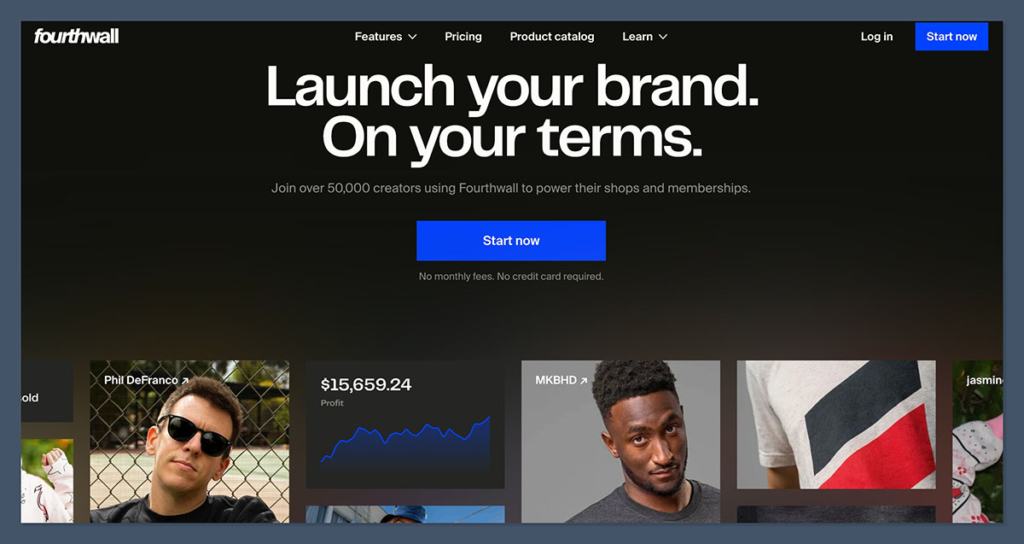
Fourthwall might seem like an odd option to put first on this list because it’s not really a “print on demand site” as much as it’s a brand-building platform that happens to include POD. Other print on demand vendors give you a bigger catalog, but Fourthwall gives you consistent premium quality, support with POD customer service, as well as a comprehensive storefront you can customize.
Aside from giving you a brilliant range of customizable items, including quite a few unique and sustainable options, Fourthwall lets you sell other things too, such as your own sourced physical items, memberships, or digital downloads.
The company also works as your Merchant of Record, so sales tax collection and remittance are handled for you, plus there’s a fantastic AI assistant to help you with organizing products, creating promotions, or just updating pricing.
It’s worth saying that the free plan does limit you to listing only 50 products, and that limit applies to everything you sell, not just POD catalog items. Still, it’s more than enough for a small company building their first brand.
Pros
- Free customizable storefront with print on demand production and fulfillment
- Excellent range of retail-grade catalog products
- Options to sell digital products and memberships alongside POD
- Merchant of Record tax support and customer support help for POD
- Genuinely useful AI assistant to help with growth
Cons
- Free accounts are limited to 50 listings
- The catalog is smaller than what you’d see from Printify
- Base prices can be slightly higher due to a focus on quality
- No built-in marketplace to help you find your audience
- Payment processing fees still apply
Why use it: If you want to start a print on demand company but don’t want to be locked into POD forever, Fourthwall lets you develop a full ecommerce brand with plenty of room to scale. You can even sell memberships and digital downloads
Suitable for: New sellers, startups, schools, creators, and nonprofits that want their own branded store, plus a premium print on demand catalog.
Not suitable for: Sellers who already have an ecommerce platform and just need a print on demand supplier with the highest range of products for the lowest cost.
My full assessment: Fourthwall review.
2. Printify
Type: Print on demand supplier network
Free plan: $0/month, unlimited designs, up to 5 connected stores, full catalog
Paid plan: Premium, $39/month or $24.99/month billed annually
Fees on free: None beyond base product cost and shipping
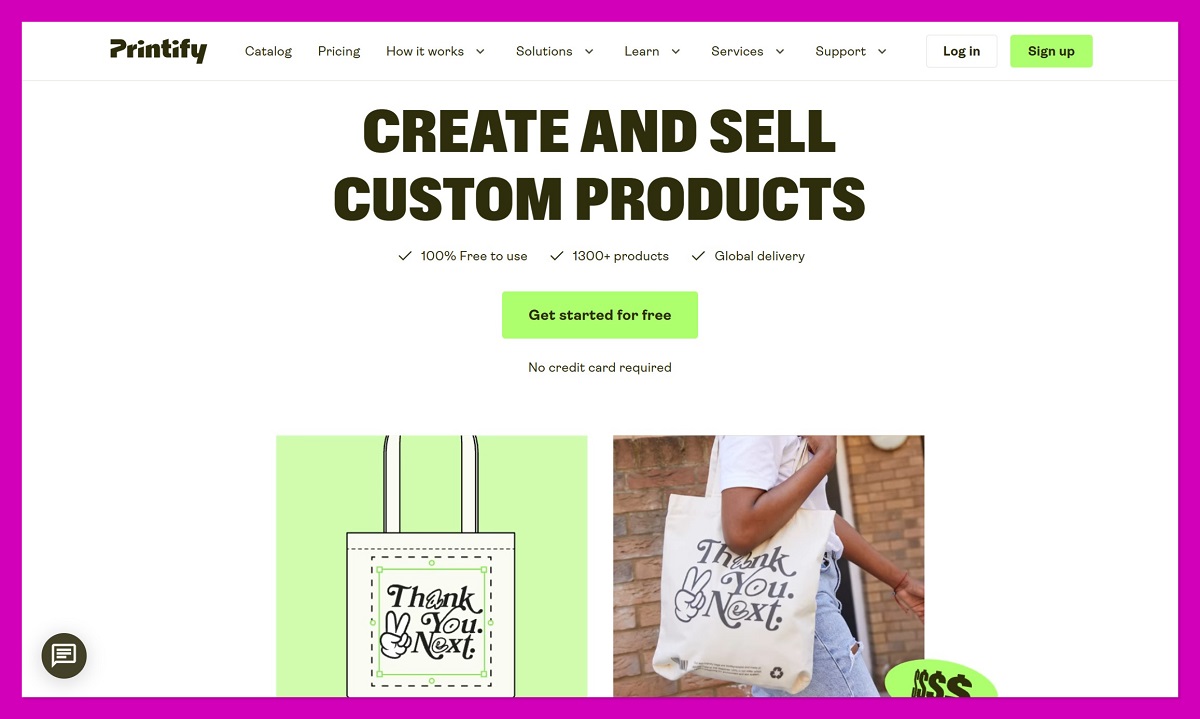
Printify’s free tier is the most generous in the supplier category. You get the full catalog of more than 2,000 products, unlimited product designs, the mockup generator, and up to five connected stores, all without a subscription. Nothing is gated behind a paywall except discounts and store count.
The model is a marketplace of independent print providers rather than a single factory. For each product you can compare providers on base price, location, fulfillment speed and rating. That is Printify’s biggest advantage and its biggest risk in the same breath: you can find a mug $1.25 cheaper by switching provider, and you can also end up with wildly inconsistent print quality across a catalog if you never order samples.
One structural detail worth knowing. Printify raised the monthly Premium price from $29 to $39 on 17 February 2026, while leaving annual billing unchanged at $299 per year, which works out to $24.99 per month. If you ever do upgrade, annual is now the only sensible way to buy it.
Pros
- Full catalog access on the free plan with no feature gating
- Up to five connected stores without paying anything
- Provider competition keeps base costs among the lowest available
- Strong integrations across Shopify, Etsy, WooCommerce and more
- No per order commission on top of product and shipping
Cons
- Print quality and turnaround vary meaningfully between providers
- Multi provider orders can generate multiple shipping charges
- International shipping gets expensive because most providers are US based
- You are one step removed from the people actually printing your work
- Free plan pays full list price on every unit
Why use it: if you already have a store and you want the widest product range at the lowest base cost with zero monthly commitment, this is the default answer.
Suitable forShopify, Etsy and WooCommerce sellers who want maximum catalog breadth and are willing to vet providers and order samples.
Not suitable forSellers who want one accountable manufacturer, or brands where a single bad print run would damage a hard won reputation.
My full assessment: Printify review.
3. Printful
Type: Print on demand supplier with in house fulfillment
Free plan: $0/month with no order minimums and no expiring features
Paid plan: Growth, $24.99/month in the US, with a 14 day trial
Fees on free: None beyond base product cost and shipping
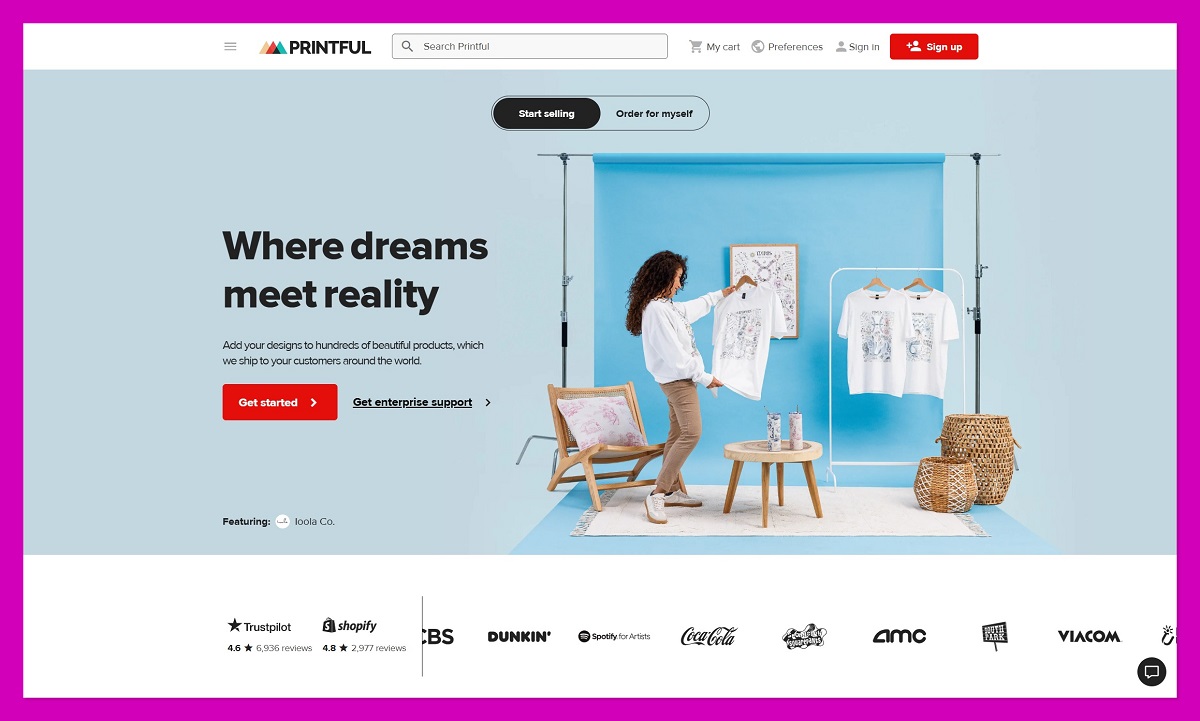
Printful sits at the opposite end of the trade off from Printify. It runs its own fulfillment centers rather than brokering to third parties, so quality is consistent and you have one company to hold accountable when something arrives wrong. You pay for that with higher base costs.
The free plan is not a trial. There are no order minimums and no features that expire, and you can run a store on it indefinitely. The optional Growth plan at $24.99 per month unlocks up to 33% off products plus branding and sample discounts, and Printful waives the fee for the following twelve months once you cross $12,000 in trailing twelve month Printful fulfilled sales. Realistically the discount does not recover the subscription until you are moving somewhere around ten to fifteen orders a month, so there is no reason to rush.
Watch the add ons. Extra print placements, inside labels and embroidery digitization all carry separate charges, and Printful applied a targeted price increase on 26 February 2026 covering Cotton Heritage products such as hoodies and heavyweight tees, along with shipping on some accessories.
Pros
- Free plan with no order minimums and no time limit
- In house production means predictable print quality
- Best in class branding options: inside labels, pack ins, custom packaging
- Very wide integration support across platforms and marketplaces
- Growth plan fee waived for a year at $12,000 in qualifying sales
Cons
- Base costs are higher than Printify on comparable items
- Add on charges for extra placements and labels stack up quickly
- Some branding features are effectively gated behind the paid plan
- Price adjustments have hit specific product lines with limited notice
Why use it: when your brand reputation depends on the product arriving right the first time, paying a dollar or two more per unit for consistency is the cheaper decision.
Suitable for: Apparel brands, agencies and creators with established audiences where returns and complaints cost more than margin.
Not suitable for: Price sensitive testing where you need the lowest possible base cost to validate a niche.
More detail on the numbers: Printful pricing explained.
4. Amazon Merch on Demand
Type: Amazon’s own print on demand royalty program
Free plan: $0, no sign up, subscription or listing fees, application required
Paid plan: None
Fees on free: Amazon retains production cost plus a 15% referral fee
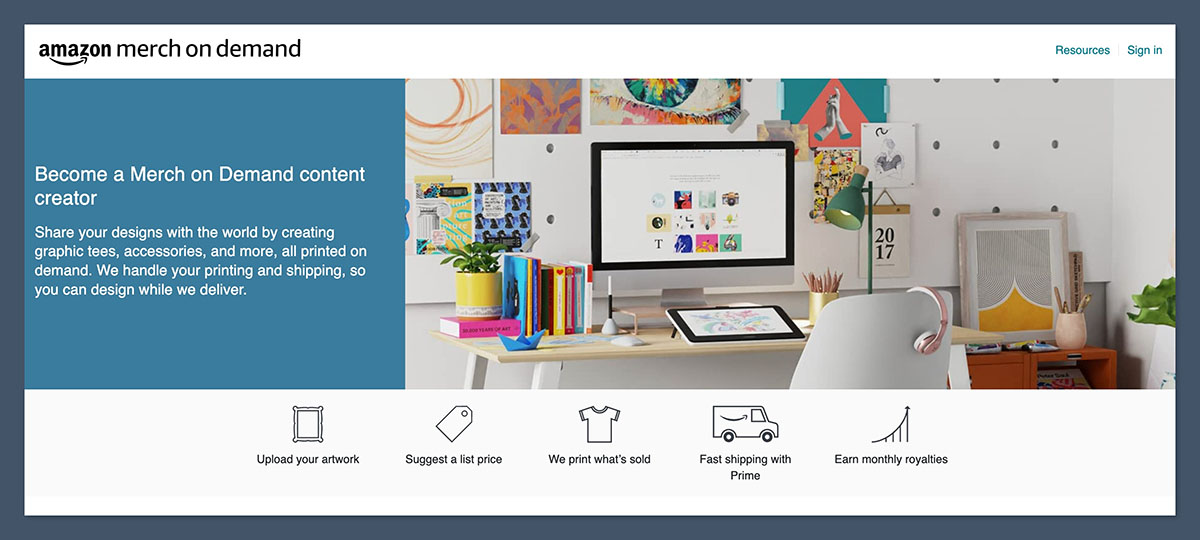
Nothing else on this list puts your designs in front of Amazon’s buyer base for free. You upload artwork, set retail prices, and Amazon handles printing, Prime shipping, customer service and returns. You earn a royalty on each sale, paid monthly around 60 days after the sale month closes.
Two constraints shape whether this is worth your time. Access is by application, and approval is not guaranteed, with waitlists that can run weeks or months. Upload slots are tiered, and most new sellers start at ten designs and unlock more by selling.
The bigger change is economic. On 1 June 2026 Amazon replaced its flat royalty model with a three tier system based on how much external traffic you bring to your listings. On a $19.99 t-shirt, Creator Tier now pays around $2.44, Plus Tier (roughly 15% or more of sales from external sources) pays about $4.88, and Premium Tier (around 35% or more external) pays about $5.27. If you were relying purely on Amazon’s organic search, your effective royalty roughly halved.
Worth knowing: the June 2026 royalty change means most published Amazon Merch earnings guides are now wrong. If you plan to build here, budget for driving your own traffic through tracked external links rather than assuming organic Amazon search will carry you.
Pros
- Access to Amazon’s buyer traffic at no cost
- Prime shipping and Amazon handled customer service and returns
- No inventory, no minimums, no upfront spend at all
- Higher ticket items like hoodies carry meaningfully better royalties
Cons
- Application gated with an unpredictable waitlist
- Creator Tier royalties are roughly half what the flat model paid
- Upload slots are limited until you prove sales
- No storefront, no branding, no customer relationship to speak of
- Payouts arrive roughly 60 days after month end
- Strict content rules and account suspension risk
Why use it: it is still the cheapest distribution channel in existence for a design that works. Treat it as one channel among several rather than the plan.
Suitable for: Designers with volume, keyword discipline and an external audience they can point at listings.
Not suitable for: Anyone building a brand, or sellers who need reliable near term cash flow.
5. Redbubble
Type: Artist marketplace
Free plan: $0, free to create an account and open a shop
Paid plan: None, account tiers are assigned by Redbubble
Fees on free: Platform fee up to 50% of gross earnings depending on tier
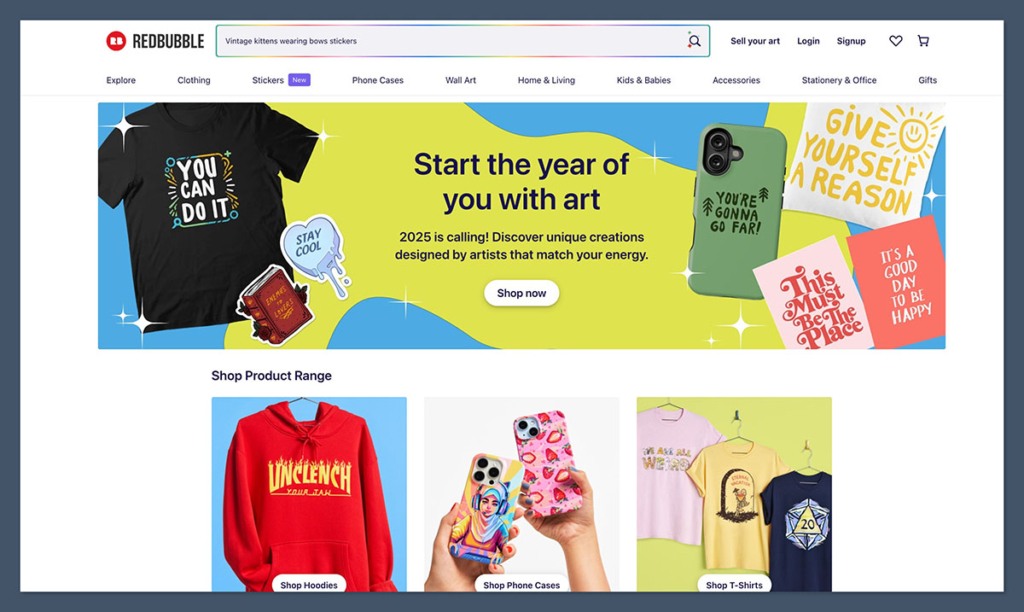
Redbubble remains one of the easiest places to start. One upload can populate more than 70 product types, you never touch fulfillment, and creating a shop costs nothing. The problem is what happens to your earnings.
Redbubble classifies every account into Standard, Premium or Pro. Standard accounts, where most new sellers land, lose 50% of monthly gross earnings to a platform fee. Premium accounts pay 20%. Pro accounts pay nothing. On top of that, Standard and Premium accounts pay an excess markup fee on earnings from products priced above a 20% markup. The fees only apply against sales, never out of pocket, and total account fees are capped at $150 per payment period. You do not choose your tier, and the criteria for moving up are not fully disclosed.
That is a real deterrent, but it is not automatically disqualifying. Redbubble has a genuine audience actively searching for printed art, and sticker sales in particular still work. Just do the math on your actual tier before you plan around the income.
Pros
- Costs nothing to open a shop and upload
- One design populates more than 70 product types
- Established organic search traffic from buyers looking for art
- Fees are capped and never charged out of pocket
- Zero operational overhead once a design is live
Cons
- Standard tier loses half of gross earnings to platform fees
- Tier assignment criteria are opaque and outside your control
- Excess markup fees penalize pricing above a 20% markup
- Heavy competition across most popular niches
- No brand ownership and no customer data
Why use it: as a zero effort distribution channel for designs you have already made for another platform. Uploading existing artwork costs you nothing but time.
Suitable for: Illustrators with large back catalogs who want passive exposure alongside a primary storefront.
Not suitable for: Anyone treating print on demand as a primary income stream from a standing start.
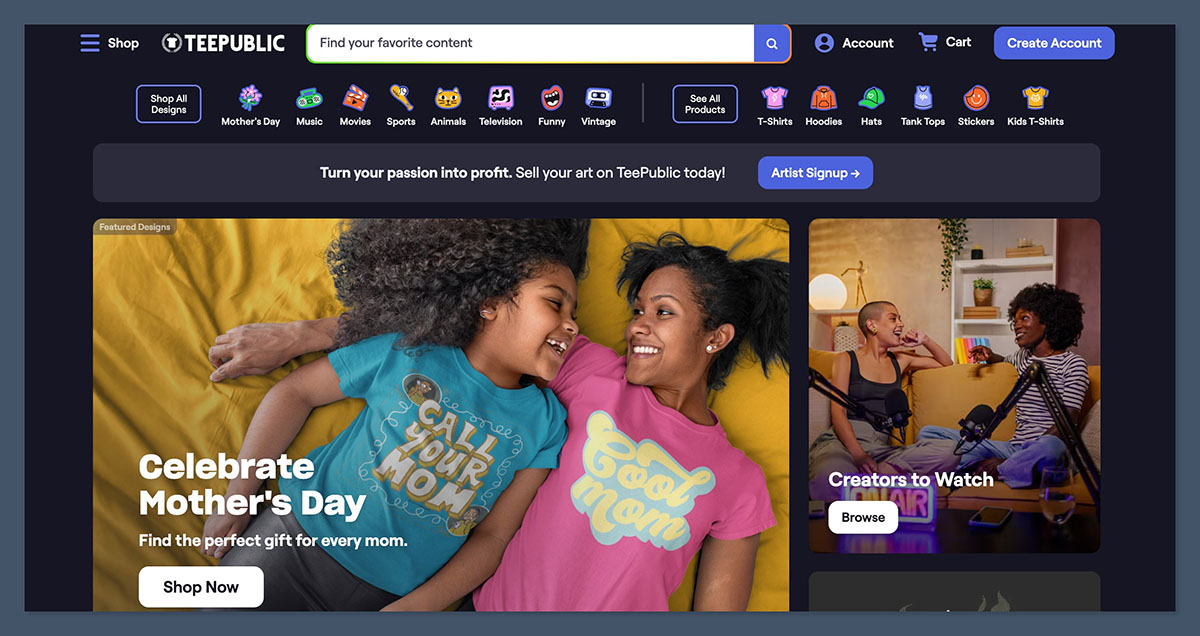
6. TeePublic
Type: Artist marketplace
Free plan: $0, no signup, listing, subscription or commission fees
Paid plan: None
Fees on free: None deducted from royalties, but the platform sets retail prices
TeePublic is the lowest friction entry point in print on demand. Upload one PNG and it lands on more than 75 products automatically. There is no signup fee, no listing fee, no subscription and no commission pulled out of your royalty. TeePublic makes its money on the gap between base cost and the retail price it sets.
Royalties are flat dollar amounts rather than percentages. Artisan tier accounts earn around $4 on a t-shirt at full price and $2 during a sale, while Apprentice accounts earn roughly $3 and $1. Hoodies pay in the region of $8, stickers between $0.20 and $1.00 depending on size.
The catch nobody puts in the headline: TeePublic runs a sitewide sale nearly every single day. The full price royalty figures are the exception, not the rule, so plan around the sale rate.
Pros
- Absolutely no fees taken from your royalty
- One upload becomes listings on more than 75 products
- Flat royalties are easy to forecast
- Fastest path from design file to live listing of anything here
Cons
- Near daily sitewide sales cut royalties roughly in half
- You have no control over retail pricing
- New accounts start on the lower Apprentice royalty rate
- Shop pages are effectively unbrandable
- New listings sit buried in internal search until you drive outside traffic
Why use it: it is the cheapest possible way to test whether a design concept has any commercial pull before you invest in a real storefront.
Suitable for: Complete beginners validating designs, and artists diversifying across multiple marketplaces.
Not suitable for: Sellers who need pricing control or want to build a recognizable brand.
More on how it performs: TeePublic review.
7. Zazzle

Type: Customization focused marketplace
Free plan: $0, free to join with no setup or listing fees
Paid plan: None
Fees on free: You set your own royalty between 5% and 99%
Zazzle is not really competing with the t-shirt platforms, and that is its advantage. Its strength is deep buyer side personalization: customers add their own names, dates and photos to templates. That opens categories the apparel focused platforms barely touch, particularly invitations, wedding stationery, business cards and personalized gifts.
You set your own royalty anywhere from 5% to 99%. Zazzle’s own guidance is to sit in the 10% to 15% range, and after testing higher rates I would agree: push much past that and products stop converting. The exception is referral traffic. When a buyer reaches your product through your own link, you can capture a far larger share of the profit, which makes Zazzle disproportionately good for anyone with a blog, a Pinterest presence or an email list.
Be aware that Zazzle runs frequent sitewide promotions, and those discounts come out of your royalty as well as Zazzle’s margin.
Pros
- Free to join with no listing or setup costs
- Best in class buyer side personalization tools
- Access to high value categories like weddings and stationery
- Referral sales can pay dramatically better than marketplace sales
- You control your own royalty percentage
Cons
- Sitewide promotions eat into your royalty without your input
- The design and template tooling feels dated
- Competition in popular categories is intense
- Realistic royalties in the 10% to 15% band mean small per sale earnings
- Slow to build momentum without external traffic
Why use it: if you can design a good wedding invitation suite, Zazzle gives you access to buyers with genuine intent and real budgets, at zero cost to enter.
Suitable for: Stationery and template designers, and anyone who can send their own referral traffic.
Not suitable for: Generic apparel or wall art sellers looking to scale quickly.
My longer assessment: Zazzle review.
8. Teemill
Type: Sustainable print on demand with a free hosted store
Free plan: $0, free store with hosting, payments and fulfillment included
Paid plan: None advertised
Fees on free: Product and shipping cost per order, you keep the profit
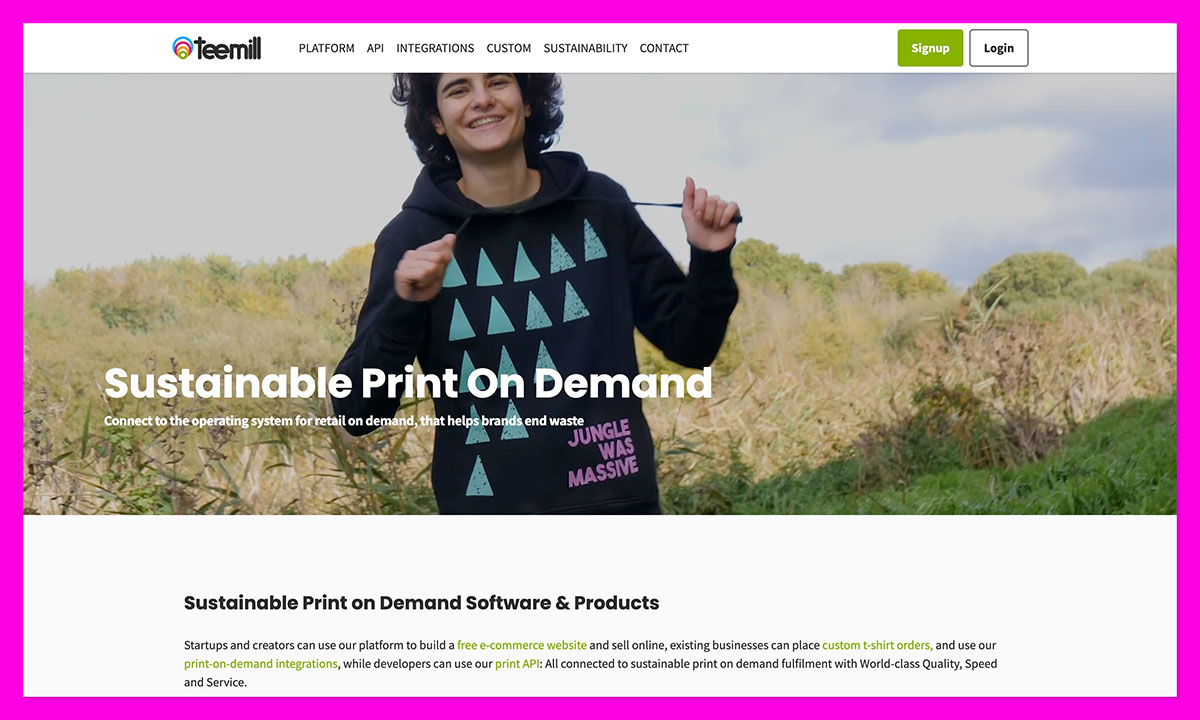
Teemill is the only platform here where sustainability is the business model rather than a product line. Everything is made from certified organic cotton in factories powered by renewable energy, printed with water based inks, shipped in plastic free packaging, and designed from the start to be sent back and remade into new products through its circular return program.
The commercial offer is straightforward: no setup cost, a free hosted store with a mockup generator and thousands of pre made designs to work from, and Shopify, Ecwid and EKM integrations if you already have a store. Products print within seconds of an order landing, which is faster than most of this field.
The trade offs are catalog breadth and geography. The range is apparel led with some accessories and homewares, and production is centered on the Isle of Wight, India and Europe, so US sellers should check delivery times before committing.
Pros
- Free hosted store with no setup or subscription cost
- Credible, audited sustainability rather than marketing language
- Circular return and remake program is a genuine differentiator
- Very fast fulfillment after an order is placed
- Thousands of free designs and illustrations to build from
Cons
- Narrower catalog than the big supplier networks
- Production geography favors UK and European customers
- Store customization is more limited than a full site builder
- Organic materials mean higher base costs than budget blanks
Why use it: if your audience actually cares about where their clothes come from, Teemill lets you make that claim honestly without paying a monthly fee for the privilege.
Suitable for: Environmental brands, charities, UK and EU based creators, and anyone whose audience scrutinizes supply chains.
Not suitable for: US focused sellers needing fast domestic delivery, or stores that need a wide non apparel catalog.
9. Bonfire
Type: Campaign based print on demand and fundraising platform
Free plan: $0, no startup, platform, service or subscription fees
Paid plan: None
Fees on free: Base product cost only, you keep the difference
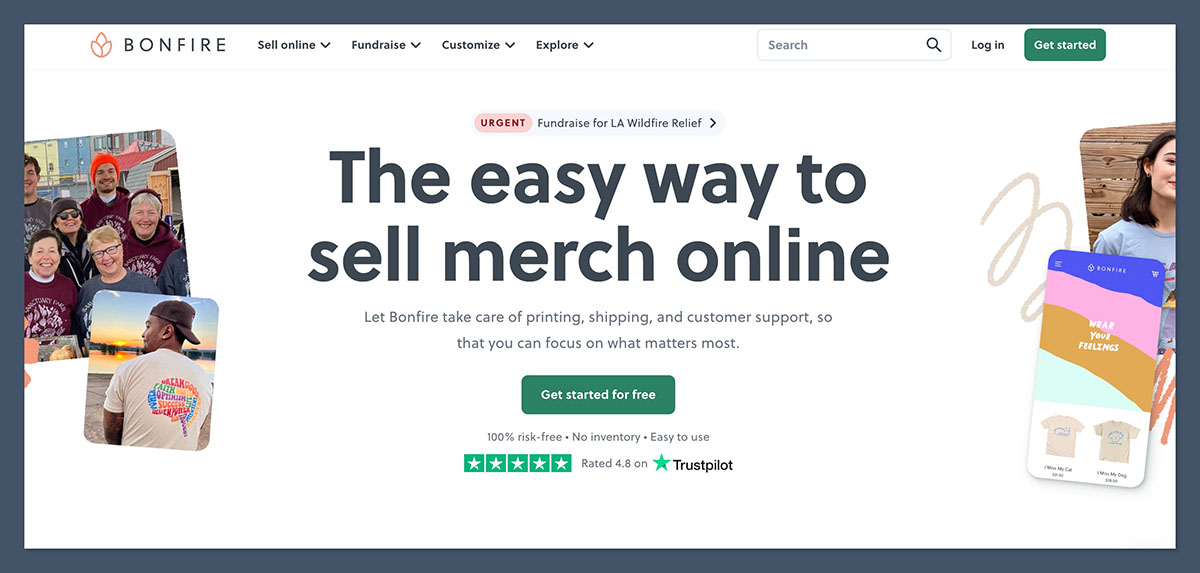
Bonfire started as a t-shirt fundraising tool and grew into a general print on demand platform, and that history still shows in the best possible way. If you are organizing merch for a team, a school, a nonprofit or a one off campaign, nothing else here is built for the job.
It is genuinely free. No startup cost, no platform fee, no service fee, no subscription. You set your selling price, the base cost is deducted automatically, and the profit is paid out to you. Nonprofits get verified profiles and peer to peer fundraising tools that let supporters raise money on the organization’s behalf, which is the feature that actually justifies choosing Bonfire over a cheaper supplier.
The honest criticism is cost per shirt. Bonfire’s base prices run higher than the supplier networks, and multi location prints (front, back and sleeve) push them higher still, which is exactly the wrong direction for a fundraiser trying to maximize what reaches the cause.
Pros
- Completely free with no platform or service fees of any kind
- Purpose built fundraising and peer to peer tools
- Verified nonprofit profiles build donor trust
- Centralized quality control rather than a broker network
- Fast payouts of campaign profits
Cons
- Higher base costs than the major supplier platforms
- Multi location printing raises unit cost sharply
- Catalog is narrower and apparel weighted
- Campaign model suits time bound drives more than always on stores
- Fulfillment focused on the US and Canada
Why use it: for a fundraiser or group order, the built in tooling saves more time and administrative pain than the base cost difference costs you.
Suitable for: Nonprofits, sports teams, schools, community groups and creators running time bound merch drops.
Not suitable for: Margin optimized ecommerce stores selling continuously at volume.
Deeper look here: Bonfire review.
10. CustomCat
Type: US based print on demand supplier
Free plan: Lite, $0/month, unlimited product creation and full catalog access
Paid plan: Pro, $30/month, plus custom Enterprise pricing
Fees on free: Base product cost and shipping only, charged when a sale is made
CustomCat is the least discussed platform on this list and one of the more useful. It has been printing since well before print on demand was a category, operates out of Detroit, and ships a large daily volume from its own facilities. Most US orders are fulfilled within about three days, which is competitive with anything here.
The catalog runs to roughly 230 products, which is modest next to Printify, but it covers decoration methods most competitors handle poorly: embroidery, dye sublimation and its DIGISOFT digital process. If you want embroidered caps or polos without minimum orders, CustomCat is a better first stop than the general purpose networks.
The Lite plan is free, includes unlimited product creation, the mockup generator and product sync, and integrates with Shopify, Etsy, WooCommerce and BigCommerce, with API and CSV support for anything else.
Pros
- Free Lite plan with unlimited product creation
- Strong embroidery and sublimation capability with no minimums
- Fast US fulfillment, typically around three days
- Wholesale style pricing direct from the printer
- Round the clock support by phone, email and chat
Cons
- Catalog is roughly a tenth the size of Printify’s
- Design tooling is basic compared to newer platforms
- Heavily US centric, with limited international production
- Fewer marketplace integrations than the larger networks
Why use it: embroidery at zero minimum order, fulfilled fast from the US, without a subscription. That is a narrow but genuinely underserved combination.
Suitable for: US sellers wanting embroidered apparel and headwear, or anyone prioritizing fast domestic delivery.
Not suitable for: International sellers, or stores needing a very wide non apparel catalog.
Full breakdown: CustomCat review.
11. Spring
Type: Creator commerce platform, formerly Teespring
Free plan: $0, no monthly, listing or upfront fees
Paid plan: None
Fees on free: Base product cost, you set the retail price and keep the margin
Spring built the original creator merch playbook. You get a free hosted storefront, roughly 180 products, design tools with Adobe Express integration, and the social selling integrations that made Teespring the default for a generation of YouTubers: product shelves, TikTok, Twitch and Streamlabs alerts. It handles production, shipping and customer service, and there are no monthly or listing fees.
I have reservations about this one. Teespring rebranded to Spring in 2021 and its assets were acquired by Amaze Software in November 2022, and creator payout complaints have been accumulating since 2025. The platform is still processing orders, and if your payouts are arriving on schedule there is no urgent reason to leave. But I would not build a new store here as a primary channel without a fallback, and I would keep a supplier backed store of your own running alongside it.
Proceed with care: the free plan and feature set are legitimately good, but payout reliability is the one thing a merch platform cannot afford to get wrong. Test with a small drop before you point a large audience at it.
Pros
- Free with no subscription, listing or upfront costs
- Mature social selling integrations across YouTube, TikTok and Twitch
- Roughly 180 products with Adobe Express powered design tools
- Production, shipping and customer service all handled for you
- You set your own retail price and margin
Cons
- Creator payout complaints have been mounting
- Base costs are higher than most supplier networks
- Storefront customization is limited next to a full site builder
- Ownership changes have made the roadmap unpredictable
- Shipping times draw regular customer complaints
Why use it: if you are already established on Spring with reliable payouts, the social integrations are still excellent. For a fresh start, a supplier network feeding a store you control is the safer route.
Suitable for: Existing Spring sellers with a working setup and creators who want social shelf integrations immediately.
Not suitable for: New sellers building a primary income stream who cannot absorb a delayed payout.
12. Gelato
Type: Print on demand supplier with distributed local production
Free plan: $0/month, full integrations, design editor, API access
Paid plan: Gelato+, $29.99/month or $19.99/month billed annually
Fees on free: None beyond base product cost and shipping
Gelato solves a specific problem: printing everything in one country and mailing it worldwide is slow and expensive. Instead it routes each order to the nearest production partner in a network spanning 32 countries, so a German customer gets a product made in Germany. If a meaningful share of your buyers sit outside your home market, that changes both delivery times and your shipping bill.
The free plan is unusually open. You get integrations with Shopify, Etsy and the rest, the design editor and even API access, without paying anything. Gelato+ adds product discounts, AI mockup tools, branded packaging and unlimited stores, and the annual rate is substantially cheaper than paying month to month.
Where Gelato is strongest is wall art, posters and home decor. Where it is weakest is raw base price on basic apparel, which Printify providers will usually undercut.
Pros
- Local production across 32 countries cuts international delivery times
- Free plan includes full integrations and API access
- Excellent print quality on posters, canvas and framed art
- Annual Gelato+ pricing is significantly cheaper than monthly
- Migration tooling makes moving existing listings straightforward
Cons
- Base costs on basic apparel are not the cheapest available
- Product consistency can vary slightly between production hubs
- The monthly Gelato+ price is the highest of the major supplier plans
- Apparel catalog is narrower than Printify’s
Why use it: if your analytics show buyers in Europe, Australia or Asia, local production usually saves more in shipping and refunds than any base cost gap costs you.
Suitable for: Wall art and home decor sellers, and any store with a genuinely international customer base.
Not suitable for: US only apparel sellers optimizing purely for the lowest unit cost.
Related reading: is Gelato+ worth it.
What “free” actually costs in print on demand
The subscription line is the smallest number in your cost stack, and focusing on it is how sellers end up with unprofitable stores. Here is where the money actually goes on a typical order.
| Cost | Typical range | Who charges it | Can you avoid it? |
|---|---|---|---|
| Base product cost | Roughly $9 to $15 for a standard t-shirt | Every platform | No, but you can shop between providers |
| Shipping | Around $4 to $11 per item in the US, more internationally | Every platform | No, but local production reduces it |
| Payment processing | Commonly around 2.9% plus $0.30 | Storefront platforms | No |
| Platform fee on earnings | 0% to 50% | Marketplaces, notably Redbubble | Only by choosing a different model |
| Referral or commission fee | Around 15% on Amazon | Marketplaces | No |
| Digital product fee | 0% to 5% | Creator storefronts | Sometimes, by upgrading |
| Add ons and branding | Roughly $1 to $6 per item | Suppliers | Yes, these are optional |
| Sales tax and VAT compliance | Variable, plus your time | You, unless the marketplace is the seller of record | Only on marketplaces that sell in their own name |
Price your products off that whole stack, not off the fact that the software was free to install.
How to choose the right free print on demand platform
Start with where the traffic comes from
This is the only question that really matters. If you already have an audience anywhere, you want your own storefront and the highest possible margin per sale, which points at a supplier like Printify, Printful or Gelato feeding a store you control. If you have no audience and no plan to build one, you need a marketplace with existing buyers, which points at Amazon, Redbubble, TeePublic or Zazzle, and you should accept that the platform will take a large share for providing that traffic.
Then check where your customers actually live
International orders are where thin margins go to die. If more than a quarter of your buyers are outside your home country, Gelato’s local production network will usually beat a cheaper base cost shipped across an ocean, and it will cut your delivery complaints at the same time.
Order samples before you scale anything
On any platform that brokers to third party providers, sample orders are not optional. Spend $30 to $60 checking print quality, fabric weight and packaging on your two or three highest volume products before you point traffic at them. This is the single highest return spend in print on demand and the one beginners skip most often.
Do the upgrade math rather than the upgrade vibe
Every paid tier here is a discount, not a feature unlock. Divide the subscription cost by your estimated saving per order to find your break even order count. Across Printful, Printify and Gelato, that number tends to land somewhere between ten and twenty orders a month. If you are not there yet, staying free is the correct call and none of these platforms penalize you for it.
Assume the terms will change
Redbubble restructured its fees, Amazon rebuilt its royalty model, Printify raised its monthly rate and Printful adjusted base prices on specific product lines, all within a fairly short window. Building on a single platform is a concentration risk. Run a storefront you own alongside whatever marketplace you use, so that a policy change is an inconvenience rather than an extinction event.
How I evaluated these platforms
| Criteria | Weight | What I looked at |
|---|---|---|
| True cost of the free tier | High | Subscription, platform fees, commissions, processing fees and any deduction from earnings |
| Free plan usability | High | Whether the free tier is a functioning business tool or a limited trial with expiring features |
| Margin control | High | Whether you set retail prices, and how much of each sale reaches you |
| Product range and quality | Medium | Catalog breadth, decoration methods and consistency of output |
| Fulfillment and geography | Medium | Production locations, turnaround times and international shipping economics |
| Brand ownership | Medium | Storefront control, customer data access and integration options |
| Platform stability | Medium | Ownership history, payout reliability and frequency of unfavorable term changes |
Pricing and plan details were verified directly against each platform’s current published terms before publication. Print on demand pricing moves often, so check the live figures before committing to any paid upgrade.
The verdict
These platforms are not solving the same problem, so the right pick depends on what you are building.
If you want to build a brand: Fourthwall is my top pick. The free plan pairs a customizable storefront with a premium print on demand catalog, handles sales tax as your Merchant of Record, and lets you add digital downloads and memberships later. The 50 listing cap is the main limit.
If you already have a store: Printify has the best free supplier plan in the category. The widest catalog, the lowest base costs through provider competition, up to five connected stores and nothing gated behind a paywall is a stronger package than anything else offers at $0. Choose Printful instead when print consistency matters more than unit cost, and Gelato when a meaningful share of your customers are overseas.
If you want a storefront without building one: Fourthwall is the most complete option, Teemill gives you a free hosted store with a genuine sustainability story attached, and Bonfire is unmatched for campaigns and fundraisers. Both cost nothing until a sale lands.
If you have no audience yet: a marketplace is your discovery engine, not your business. TeePublic is the cheapest way to test whether a design has legs, Amazon has the most buyers, and Zazzle is the most profitable of the three if you can design for personalization and send your own referral traffic.
The setup I would actually recommend for most people is two platforms running in parallel: a store you control, fed by a free supplier plan, for margin and customer relationships, plus one marketplace for discovery. Neither costs you anything upfront, and together they mean no single company’s policy change can end your business.
Frequently asked questions
Is print on demand really free to start?
Yes, in the sense that every platform on this list lets you create an account, upload designs and list products without paying anything. You only pay when a customer buys, and the cost comes out of that sale. What varies enormously is how much of each sale you keep, which ranges from nearly all of the margin on a self hosted storefront to as little as half your gross earnings on a marketplace with high platform fees.
Which free print on demand platform pays the most per sale?
Running your own storefront with a supplier like Printify, Printful or Gelato will almost always pay the most per unit because no platform is taking a percentage of your earnings. Marketplaces pay less per sale but supply the traffic. The right comparison is not margin per sale, it is total profit, and a platform paying you $2 per sale on volume can beat one paying $12 on none.
Do I need my own website to use print on demand?
No. Fourthwall, Teemill, Bonfire and Spring all provide a free hosted storefront, and marketplaces like Redbubble, TeePublic, Zazzle and Amazon give you a shop page without any site of your own. You only need your own website if you want full control over design, apps and customer data, in which case a supplier network like Printify or Printful plugs into whatever platform you build on.
Can I use several print on demand platforms at once?
Yes, and most experienced sellers do. The standard pattern is one storefront you own for margin and customer relationships, plus one or two marketplaces for discovery. The main things to watch are keeping designs and product information consistent, and being careful about any exclusivity terms if you sign a commercial agreement.
Why do print on demand platforms keep changing their fees?
Because their margins are thin and their input costs move. Blank garment costs, ink, labor and shipping rates all fluctuate, and platforms adjust base prices, subscription tiers and royalty structures in response. In a single recent stretch, Redbubble restructured account tier fees, Amazon replaced its flat royalty model with traffic based tiers, Printify raised its monthly Premium price and Printful adjusted prices on specific product lines. Build with the assumption that today’s numbers are temporary.
How much can you realistically earn with free print on demand?
Earnings depend almost entirely on traffic, not on the platform. A design with no audience earns nothing on any platform on this list. Per unit, expect roughly $2 to $5 on a marketplace t-shirt after fees, and somewhere around $8 to $15 on the same shirt through your own storefront where you set the price. The variable that actually determines your income is how many people see your products, which is why the traffic question matters more than any fee comparison.
Should I pay for a premium print on demand plan?
Only when the arithmetic says so. Every paid tier discussed here is essentially a bulk discount on product costs. Work out your average saving per order under the paid plan, divide the monthly fee by that figure, and you have your break even order count. For most sellers that lands somewhere between ten and twenty orders a month. Below that threshold, the free plan is strictly better, and no platform on this list restricts your growth for staying on it.