
I can’t say Society6 has always been my favorite marketplace for creators, but I’ve always appreciated how carefully it focuses on the artist community. It’s one of the more useful print-on-demand solutions for people who want to print their art on high-quality home décor, then put products where potential customers are likely to see them immediately.
Still, it has its downsides. You get access to an audience, but you don’t get to own them. You’ve got very little control over branding or pricing, plus there are serious limits to how far you can branch out. So, while I still recommend Society6 to beginners in the artist world, I tend to nudge people looking for more freedom towards Fourthwall.
Fourthwall gives you a branded store you actually own, access to retail-grade print on demand products, options for selling custom-sourced items, digital products, and memberships, plus help with tax management and customer service in the same package.
Here’s my honest comparison of the two.
The Quick Read
Fourthwall is the easiest to recommend, especially right now.
First of all, if you’re starting a business from scratch, Society6 isn’t even accepting new artist submissions, so you’re going to be waiting around for a while. But assuming that the system will be accessible again soon, it’s still only going to be the better option if you want access to an audience quickly, and you only want to sell your art on high-quality home décor items.
If you want an actual store, and the option to sell print on demand alongside custom sourced products, digital downloads, memberships, and whatever else you can think of, Fourthwall is absolutely the best choice.
Fourthwall vs Society6: The Quick Overview
Let’s ignore the fact that Society6 is currently on lockdown for a minute, and assume that it’s just focusing on updating its curation guidelines, like it’s said. When it’s back up and running for artists, it’ll still give them a similar experience. You get a marketplace where you can set up shelf space alongside other creators, and sell print-on-demand products.
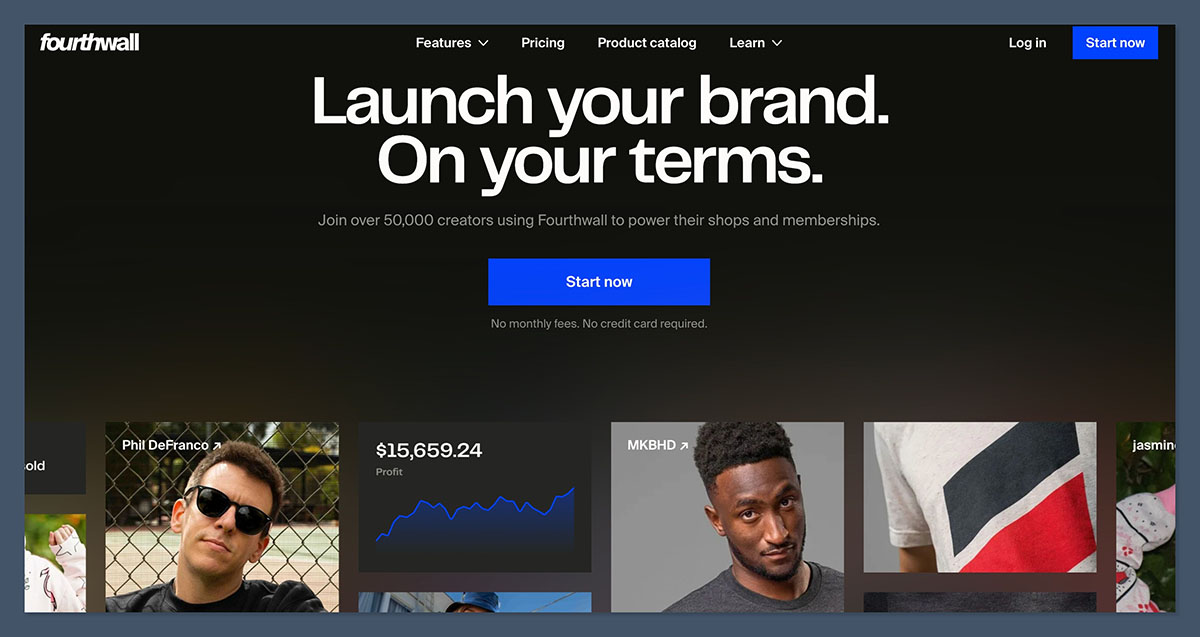
Fourthwall is a brand building platform that gives you your website, checkout, product catalog, fulfillment, memberships, digital selling tools, marketing options, AI assistance, plus everything else you need already bundled in. The only thing you really need to get yourself is your audience.
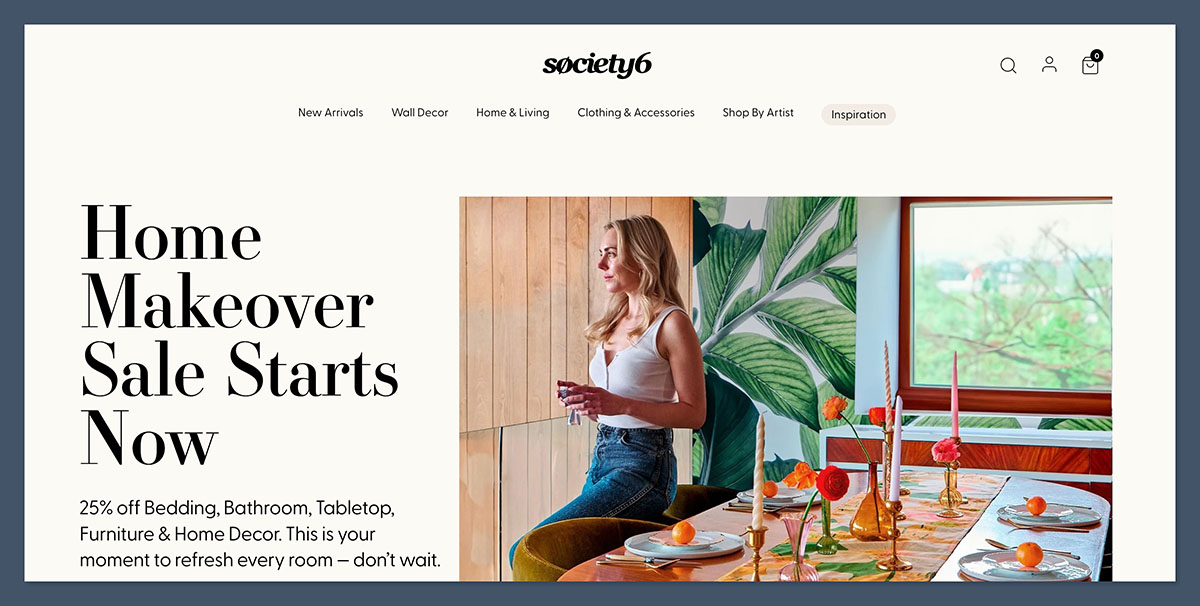
Society6 gives you immediate access to an audience, and handles fulfillment and printing for you, but it doesn’t give you a full store, or a lot of options for what you can sell.
Where Society6 controls everything from what products get approved, to how much you can reasonably charge, Fourthwall gives you more control and freedom, without the same stress you’d have to deal with setting up a separate Shopify store.
| Area | Fourthwall | Society6 |
|---|---|---|
| Business model | Full brand building platform | Curated art marketplace |
| Store | Branded website with domain control | Artist page inside Society6 |
| Buyers | You generate traffic | Marketplace search plus your promotion |
| Pricing | You set the retail price | Society6 sets prices and royalties |
| Customer relationship | Seller can use purchase data for marketing | Society6 manages the transaction |
| Products | POD, owned stock, digital goods, memberships | Society6’s physical product catalog |
| Fulfillment | Fourthwall or the seller | Society6 |
Now I’m not saying Society6 is a bad platform. It’s great for artists looking for an online retail partner or distribution channel. Fourthwall just has enough substance to be the actual home of your business.
Fourthwall vs Society6: Pricing, Margins, and Total Costs
Fourthwall and Society6 might appear to be neck-and-neck here, because neither of them force you to pay a monthly subscription to sign up. Still, there’s a big difference in what the free plans give you.
What Fourthwall costs
Fourthwall’s free plan gives you your branded website, options for selling any digital or physical products you want, an extra team member account, plus assistance with things like tax. You don’t pay any fees for selling physical products, and you only pay the base cost for the POD products you choose from the catalog, keeping the profit from the markup price you choose.
There is a 5% fee on digital download and membership sales. The Pro plan, at $19 per month or $180 per year (which works out at $15 per month), removes the digital download fee. It also gives you $10 in sample credits a month, premium support, unlimited team members, and more storage and product listing options than the free plan.
What Society6 costs
Society6’s free plan lets you sign up and start listing products. You can list up to ten items, and your earnings are locked at 10% of the profit margin. If you want more income, the Basic plan costs $4.99 per month and supports up to 100 design uploads, while giving you more pricing and markup control. You also get quarterly reports.
The larger Pro plan for $12.99 per month supports 10,000 design uploads, gives you complete pricing control, and gives you a sales analytics dashboard with a 20% personal product discount bundled in.
That’s the issue, really. Fourthwall gives you everything you need to create a profitable brand on the free plan. Society6 locks in your earnings, unless you’re willing to spend.
Fourthwall vs Society6: Store Building and Integrations
Another easy win for Fourthwall here. Society6 mainly allows you to list your items on an existing marketplace: you get an avatar, a banner, bio, and social links. The platform decides how products are going to be sorted in your shop, and you can’t add external website links there either. You’re basically just adding your logo to a small part of the Society6 ecosystem.
Now, Society6 has improved the experience for customers, raising average add-to-cart rates by 60% with a Shopify rebuild, but that doesn’t really help artists much.
Fourthwall gives you a complete store builder, with custom-domain support, and absolute control over layouts, fonts, navigation, plus product pages. You get to design your store and run it however you like, and you also get to own the audience you attract, collecting email addresses, and using integrations to keep them engaged in the future.
Society6 doesn’t let you do any of that. It gives you access to its audience, but that audience never truly belongs to you. The most you can do is hope they visit your social media links.
Integrations are very different too. Society6 is a closed marketplace, with no ecommerce plugins, open APIs, or anything else to help you connect other sales channels. Fourthwall, on the other hand, integrates with all the major social selling channels like TikTok Shop and Twitch. It also works with Klaviyo, Mailchimp, or Kit, to help you build and run automated email marketing campaigns.
That’s the deal with these two. Society6 gives you the audience, but almost no control. Fourthwall asks you to bring the audience, but actually helps you earn their trust, develop a brand you own, and maintain the relationships that keep bringing sales to your door.
Fourthwall vs Society6: What Can You Sell?
Society6’s narrow catalog can either be a blessing or a weakness depending on how you look at it. For artists, it’s brilliant. You’ve got the option to place your work on some really impressive home décor pieces, ranging from curtains and bedding, to murals, and wallpaper. The range is fantastic, and from what I’ve seen, the quality is hard to beat, too.
Plus, since Society6 is very specific about what artists can actually upload and sell, you have the benefit of knowing your customers are going to get excellent results every time. That’s great for your reputation as a growing creator.
Fourthwall, though, is a lot broader. It does offer a print on demand service, and its curated catalog is pretty broad, covering things like home décor, accessories, or clothing. Everything is retail-grade, so you don’t have to worry about poor quality here either.
What’s more important is how much extra you can sell through Fourthwall if you decide that you want to go beyond POD merch. You can combine merch sales with custom products you source yourself, digital downloads, memberships, gift cards, and donations. You can even create bundles that spread across multiple categories. For instance, you might sell a digital brush pack for a design studio alongside an actual print.
From a print on demand perspective, Fourthwall also gives you a bit more control over production. You don’t get to choose a supplier like you would with Printify, neither platform offers that. However, you do get to pick things like whether you want DTG or embroidery for clothes, or screen printing for something else. Society6 doesn’t give you that option. It chooses what’s approved.
Fourthwall vs Society6: Overall Support
From a seller support angle, Society6 does reasonably well. It has a lot of great online resources for artists, and email support with most users getting responses within about 1 to 2 hours. Also, it handles most of the more complicated parts of selling for you, including production, fulfillment, finding your audience, handling payments, and so on.
As your Merchant of Record, it also calculates, collects, and remits sales taxes for customer orders. Plus, it deals with buyers for you. Pretty much all you need to do is upload your pieces, wait for them to be approved, and wait for your royalties to come in.
Fourthwall is great for customer support too, but it’s slightly different. The work you need to do depends on the product you’re selling. For products from its catalog, Fourthwall processes the payment, produces and ships the order, collects and remits sales tax as Merchant of Record, plus handles customer questions.
Fourthwall also automatically delivers digital products for you, and helps you keep track of memberships, while ensuring everyone actually gets what they pay for. If you’re selling self-fulfilled products, the work comes back to you.
That’s actually a pretty fair deal really. Society6 does generally take more work off your plate, but it sort of cuts you out of a big part of building your own business. You feel more like a contractor than a business owner. Fourthwall lets you create a brand without taking on too much extra work, and ensures you can actually keep control.
Fourthwall vs Society6: Which Should You Choose?
Before I close this comparison, I should say that both of these platforms are changing a little. I’ve already mentioned that Society6 is tightening the marketplace, which is a bit problematic for artists right now, but it might give them more credibility if they can get an account in the future.
Fourthwall’s updates are a lot more immediately relevant. You’ve got:
- The new Eli AI assistant, to help you build promotions, adjust prices, or check sales reports.
- A Spotify connection, for selling paid audio subscriptions.
- Custom gift cards, alongside extra features like wishlists (through a Throne collaboration).
- Dashboards for tracking sales by country or Twitch gifting, plus granular team roles.
Both platforms are still good in their own right, but I can’t make Society6 my top recommendation. It’s fine if you already have an approved shop, want to sell premium art, and need help building out your audience. But even then, you’re going to feel boxed in quite quickly.
The Verdict
Fourthwall is just the better all-around option if you want a real business that doesn’t feel exhausting to run. It won’t find your audience for you, but it’ll give you far more when people actually start coming your way, from the freedom to sell whatever products you want and sell them for any price, to a brand home you can actually own.