You have seen the guides that make selling stickers sound like free money. What they skip is the math: a $4 die-cut sticker on Etsy nets about 57 cents once production, shipping, and fees come out, a 14.3% margin nobody warned you about.
This guide shows how to sell stickers with Printful the honest way. We are BootstrappingEcommerce.com, not Printful, so you get the real base prices, the recently increased shipping costs, and the places Printful falls short. Selling stickers online with print on demand (where a supplier prints and ships each order for you, so you hold no inventory) is a real opportunity: the global sticker market is climbing from about $4.88 billion in 2025 toward $5.16 billion in 2026.
What follows is a complete-beginner, eight-step walkthrough covering both your own storefront and Etsy, with exact button paths, design specs, and real margin math. Start with your niche.
Step 1: Pick a Profitable Sticker Niche and Validate Your Designs
Die-cut vinyl stickers make up roughly 70% of all sticker sales on Etsy. That single stat should shape your first decision: choose a niche, then commit to die-cut as your core format before you open Printful.
Your goal here is one focused niche and a small, validated set of designs. A specific niche lets you charge more and earn repeat buyers, while a generic “cool stickers” shop competes with everyone on price.
Work through three moves:
- Pick a niche you can speak to: plants, fandoms, humor, pride, eco-friendly living, or small-business branding all sell. Choose one you understand, because you will design dozens of concepts for it.
- Lead with die-cut, treat holographic as a premium upsell: die-cut dominates Etsy at that 70% figure, so it is your safe core. Holographic is the fastest-growing sticker material at a 9.6% annual growth rate through 2033, which makes it a higher-priced add-on rather than your main product.
- Validate before you mass-produce: post rough concepts to the niche’s Instagram, Pinterest, or a relevant subreddit and watch for saves and comments before you build the full set.
What makes a sticker niche work
- Specific beats broad: “trail-running dog breeds” outsells “animals.”
- Repeat-purchase potential: collectors and hobbyists come back; one-time gift buyers do not.
- You can create for it: you know the references, the jokes, and the aesthetics.
- Low copyright risk: avoid trademarked logos, characters, and fan art you do not own.
How many designs should you launch with? Advice online conflicts: some guides say 50-plus, others 10 to 15. For a beginner with no audience, start with 10 to 15 validated designs. Sticker margins are thin (more on that in Step 4), so proving demand on a small set beats sinking weeks into 50 designs nobody wants. Expand the catalog once the data shows your winners.
The opportunity is real, and it favors the format you just chose: the die-cut sticker market alone is projected to hit $191.1 million by 2028.
Top Tip: Fan art of copyrighted characters is the fastest way to get a listing pulled or your shop suspended. Build original designs, or stick to public-domain and clearly licensed material.
By now you should have one niche locked and a shortlist of 10 to 15 die-cut concepts ready to become Printful products.
Step 2: Know Printful’s Sticker Products and Real Base Prices
Printful’s own pages do not agree on what a sticker costs. Its custom-stickers marketing page advertises $2.20 to $5.05, while the die-cut product page lists $2.72 to $6.35 for the same category. When the supplier’s own site contradicts itself, check the live price before you commit.
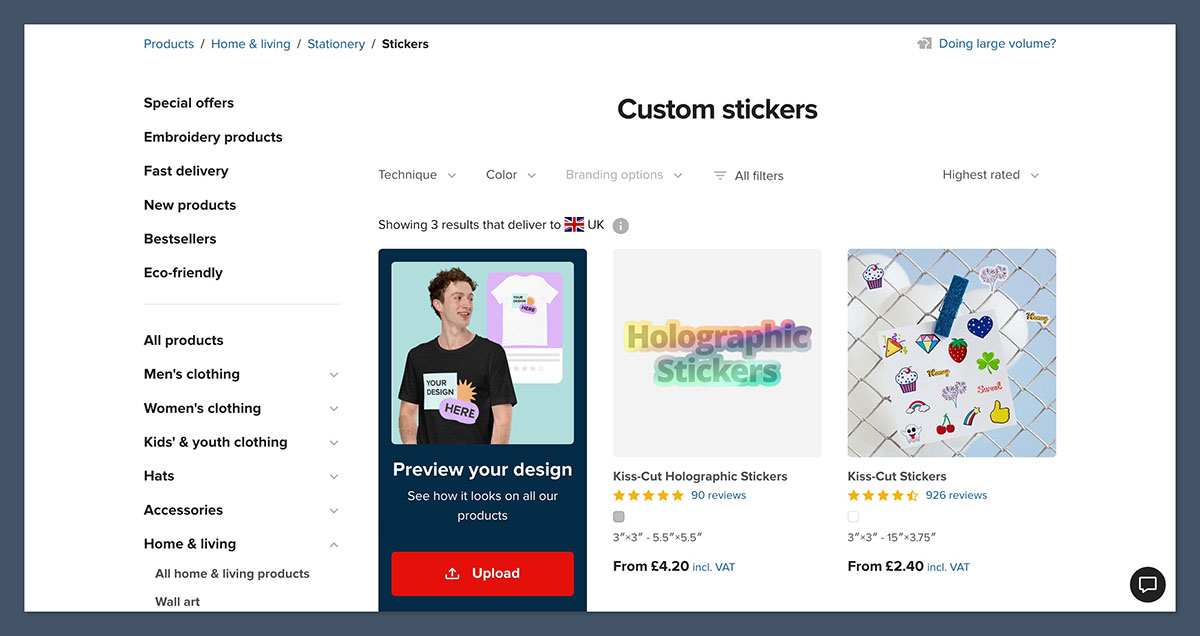
Your goal in this step is to know exactly which sticker product your designs will become and roughly what each one costs you. That base cost, meaning what you pay Printful per unit, is the foundation for every margin calculation later.
Printful prints its stickers on white premium sticker paper and offers three main product types:
- Kiss-cut and die-cut singles: your core format, sold one design per sticker.
- Sticker sheets: several smaller designs arranged on one sheet, each design adjustable.
- Kiss-cut holographic: the same singles with a premium holographic finish.
Singles come in three sizes: 3″x3″ (8x8cm), 4″x4″ (10x10cm), and 5.5″x5.5″ (14x14cm). Bulk discounts kick in once you order 25 or more of a design, and there is no fixed discount table: Printful’s on-page bulk calculator generates the per-unit price live as you change the quantity. Order fewer than 25 and you simply pay the standard per-unit rate shown on the product page.
Printful Sticker Products and Base Prices
| Product type | Sizes offered | Approx. base price (per unit) | Best for |
|---|---|---|---|
| Kiss-cut / die-cut single | 3″x3″, 4″x4″, 5.5″x5.5″ | ~$2.72 to $6.35 (size dependent) | Your core SKU: singles and multipacks |
| Sticker sheet | Multiple designs per sheet, adjustable | Priced by sheet size (check the live calculator) | Higher order value, design collections |
| Kiss-cut holographic | Single sizes, holographic finish | ~$4.75 | Premium upsell, limited editions |
Which type should you start with? Tie it back to Step 1:
- Start with a 3″x3″ die-cut single: lowest base cost and the format behind ~70% of Etsy sticker sales.
- Add a sheet or two once you have a design family that belongs together.
- Save holographic for later as a higher-priced variant, not your opening product.
Note: Every price above is base production cost, meaning what you pay Printful, not what you charge the customer. Retail pricing and real margins come in Step 4.
By now you should have a specific Printful product and size chosen for each of your top designs, plus a ballpark base cost for each.
Step 3: Create Your First Sticker in Printful’s Design Maker
You can build your first sticker product without paying a cent up front. Printful’s Free plan has no monthly fee, and you only pay the base production cost after a customer orders. That is the whole appeal of print on demand: Printful prints, packs, and ships each sticker per order, so you carry no inventory and no upfront risk.
Your goal here is to turn one design into a finished, print-ready product sitting in your Printful account.
- Create a free Printful account: sign up with an email address. The Free plan carries no subscription cost and no card is required, so you can build and preview products and only pay once you actually sell.
- Prep your artwork to spec: export each design as a PNG or JPEG at a minimum of 300 DPI. Download Printful’s print template for your chosen size first, since it marks the customizable area and the bleed (the margin around the cut edge so nothing important gets trimmed).
- Build it in the Design Maker: open the Design Maker, pick your sticker product and size, then upload your artwork or build from scratch using Printful’s free design assets. Position the design inside the template guides, generate a mockup, and write an SEO-friendly title and description. Stop before pricing and publishing; those come in Steps 4 and 5.
Your sticker file checklist
- Format: PNG or JPEG.
- Resolution: 300 DPI minimum, so the print stays sharp.
- Template: downloaded for your exact size (3″, 4″, or 5.5″).
- Safe area: design kept inside the bleed and cut guides.
Once the product is built, remember the fulfillment clock: Printful’s average production time is 2 to 5 business days before an order ships, separate from carrier transit. Your customer’s total wait is production plus delivery, so set that expectation in your listing.
Top Tip: Design at the largest size you plan to sell, then scale down. Shrinking a high-resolution file keeps it crisp, but blowing up a small one turns it blurry.
By now you should have one finished, spec-compliant sticker product in your Printful account, not yet priced or connected to a store.
Step 4: Calculate Your Real Margin Before You Set a Price
Sell a single die-cut sticker for $4 on Etsy and you keep about 57 cents. That is a 14.3% margin after production, shipping, and platform fees, and it is exactly the number the “easy sticker money” guides leave out. Price from the real numbers and you avoid working for free.
Your goal here is a defensible retail price for every product, one that clears a real margin once every cost is counted.
Shipping is the margin killer. Stickers sit in Printful’s “always ship separately” category, so if a customer buys a sticker and a t-shirt in one order, that generates two shipments and two shipping charges. Printful raised US sticker shipping in February 2026, with the first item now running roughly $3.99 to $4.29 depending on destination and each additional sticker adding around $1.25 to $1.80. On a low-ticket item, that shipping line is often larger than your production cost.
The channel changes everything. The same underlying product nets 14.3% as a single sticker on Etsy but 59.1% as a sheet sold through your own Shopify store, because you skip the marketplace fee stack. Step 5 covers that decision in full.
Real Sticker Margin Scenarios
| Scenario | Sale price | Production | Shipping absorbed | Platform fees | Net profit | Margin % |
|---|---|---|---|---|---|---|
| Single die-cut on Etsy | $4.00 | $1.80 | $1.00 | $0.63 | $0.57 | 14.3% |
| 5-sticker pack (own store) | $15.00 | $7.50 | $1.50 | $0.74 | $5.26 | 35.1% |
| Sticker sheet on Shopify | $10.00 | $3.50 | included | $0.59 | $5.91 | 59.1% |
| Printful 3″x3″ single at retail | $5.99 | $3.25 | not counted | not counted | ~$2.74 | ~46% gross |
These use illustrative production and shipping figures. Recompute each row with your own live Printful base cost and shipping before you set prices.
Notice the pattern: single stickers are a low-margin traffic play, while packs, sheets, and an owned store carry the profit. Use a simple pricing formula, the same one most profitable sticker shops lean on, to stay above water:
- Single stickers: 2.5 to 3 times your production cost.
- Sheets and multipacks: 2 to 2.5 times production cost.
- Minimum margin floor: 30% to 50% after all fees, or rework the price.
Most new sellers fail here for one reason: they underprice, or skip the math entirely and discover the shortfall after fees land.
Note: Build platform fees and shipping into your retail price from day one. Retrofitting a higher price after launch trains your earliest buyers to expect the low one.
By now you should have a retail price for each product that clears at least a 30% margin after real shipping and fees.
Step 5: Choose Your Sales Channel and Connect Your Store
In Step 4, the same sticker earned 14.3% on Etsy but 59.1% on your own store. So is Etsy ever worth it? Yes, and the reason is traffic. Etsy hands you millions of ready buyers; your own store hands you higher margins but an empty room to fill.
Your goal: pick the channel that fits your situation, then connect Printful to it.
Etsy gives you traffic and takes heavier fees. The current stack is a $0.20 listing fee (active four months or until the item sells), a 6.5% transaction fee on the item price plus shipping, and in the US, 3% plus $0.25 for payment processing. That is roughly 10% to 12% before advertising.
If a sale comes through Offsite Ads, add 12% (mandatory once your shop passes $10,000 in trailing-year sales) or 15% (optional below that, with an opt-out), capped at $100 per order. When that triggers, total Etsy fees can reach 20% to 26% of the sale.
Your own store trades a flat fee for much lower per-sale fees, but you supply the traffic. Shopify’s Basic plan is $39/month ($29/month billed annually) with a 2.9% plus $0.30 transaction fee through Shopify Payments, and no listing fee, marketplace percentage, or offsite ads fee. Wix is a cheaper builder if you want a lighter start.
Etsy vs Your Own Shopify Store for Stickers
| Factor | Etsy | Own store (Shopify) |
|---|---|---|
| Upfront / monthly cost | $0.20 per listing | $39/mo ($29 annual) |
| Per-sale fees | ~10% to 12% baseline | 2.9% + $0.30 |
| Offsite ad fee | 12% or 15%, capped $100/order | None |
| Traffic source | Etsy’s built-in shoppers | You drive it |
| Best for | Starting with no audience | Sellers with any audience |
| Typical sticker margin | ~14% on singles | ~59% on sheets |
Which should you choose? Pick Etsy if you have no audience yet and want built-in buyer traffic while you learn. Pick your own store if you have any audience to send (a following, an email list, a community) and want the 30% to 50%-plus margins from Step 4.
Once you decide, connect Printful using the product from Step 3.
To connect Printful to Etsy

- In Printful, open your sticker product and finish the design in the Design Maker.
- Choose a mockup style (flat or lifestyle), edit the listing name, description, and tags, then set your price.
- Push the listing to Etsy, where it lands as a Draft under Shop Manager > Listings > Drafts.
- Open the draft, confirm Printful is set as the production partner, and click Publish.
To connect Printful to Shopify
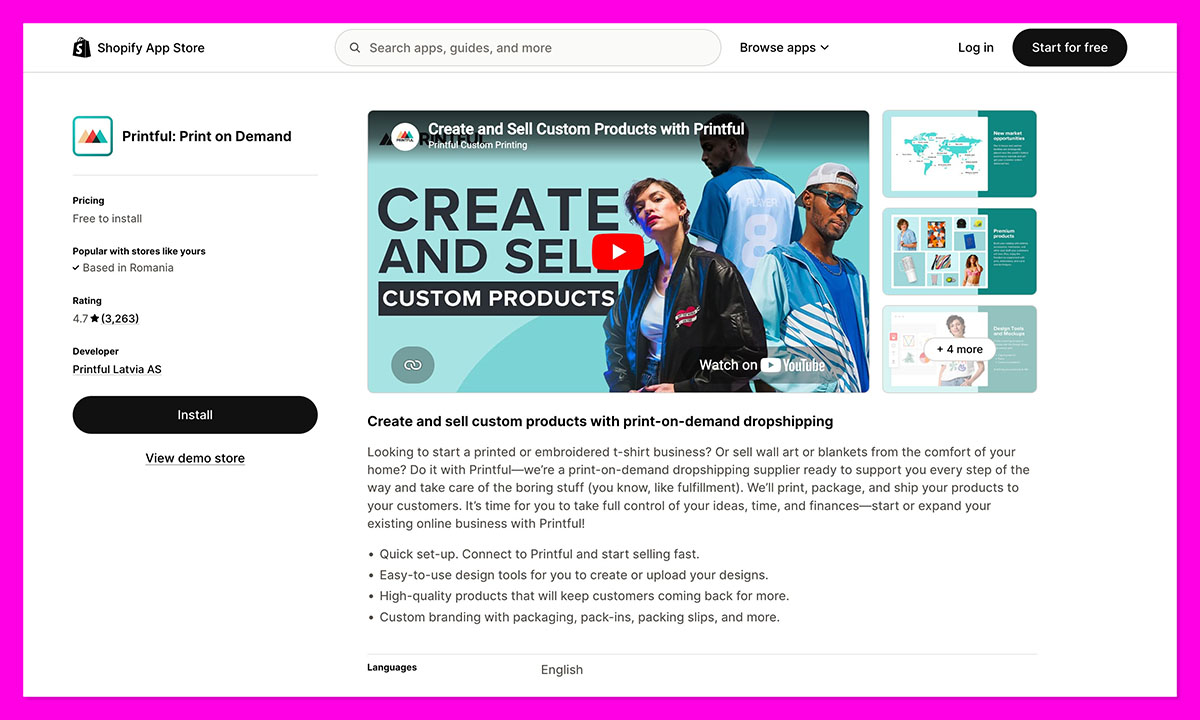
- Install the Printful app from the Shopify App Store and follow the on-screen setup.
- Browse Printful’s catalog (517 products) and select your sticker product.
- Design it, set your price and margin, then publish it straight to your store.
By now you should have a live or draft-ready sticker listing on your chosen channel, correctly synced to Printful.
Step 6: Order Samples and Check Quality Before You Launch
A sticker that looks flawless on your screen can arrive with off colors or micro-peeling edges, and a vocal minority of Printful customers report exactly that: crooked prints, weak color, and adhesive that lifts. Catch it before your first buyer does, not after a one-star review.
Your goal here is to hold a physical sample of your top design and inspect it against a checklist before you go live.
Know your sample allowance first. Printful discounts samples so you are not paying full retail to test:
- Free plan: 20% off, one sample order per month (up to 3 items).
- Scaling allowance: the limit rises as your accumulated monthly sales pass $100, $300, $500, and $1,500, capping at 5 sample orders (15 products) per month.
- Growth plan: 25% off, plus free digitization on sample orders.
Order your best-seller candidate first. Sample the one design you expect to sell most, at the exact size and finish you listed, rather than spreading a small allowance across weaker concepts.
When it arrives, inspect it properly
- Print sharpness: no blur or pixelation at 300 DPI.
- Color accuracy: matches your original file, not a faded version.
- Cut alignment: the die-cut or kiss-cut follows the design and is not crooked.
- Adhesive and edges: sticks cleanly with no lift or peel.
- Durability: survives water and scratching if you are selling it as outdoor vinyl.
- Packaging: arrives flat and undamaged.
Note: Because stickers always ship separately, your sample arrives in its own parcel, the same way each customer order will. That separate shipment is the shipping cost you priced in back in Step 4.
By now you should have held, inspected, and either approved or redesigned your top sticker, so you trust exactly what customers will receive.
Step 7: Launch Your Store and Land Your First Sale
Waiting three to six months for a first Etsy sale is described as normal. Yet some sellers reach it in under a month by front-loading strong SEO and planning before launch. The gap between those outcomes is almost entirely about how well you set up and promote, so treat launch day as the start of the work, not the finish.
Your goal here is to publish, drive targeted traffic, and land your first sale with realistic expectations intact.
Run these final checks before you hit publish:
- Listings are live with keyword-rich titles and descriptions buyers actually search.
- Prices and margins match the numbers you set in Step 4.
- Printful is set as the production partner on every listing.
- Mockups are sharp and show the sticker at real scale.
- Shipping and policies are filled in, including the separate-shipment note for stickers.
With the store live, work the free channels before you spend a dollar on ads:
- Etsy or on-site SEO: the keywords in your titles and tags decide whether search ever surfaces you.
- Pinterest: visual, search-driven, and a strong long-term traffic source for stickers.
- Instagram and TikTok: short video of designs, application, and packaging suits sticker products.
- Your email list: if you already have one, tell it first; warm buyers convert fastest.
Add paid promotion (Etsy Ads or light social ads) only once your listings convert organic visitors, so you are amplifying something that works rather than paying to hide a weak listing.
Set your expectations honestly. Three to six months to a first sale is the norm, and the two biggest levers are how much traffic you drive yourself and how quickly organic search starts surfacing your shop. You will see viral claims like “$5k a week from stickers.” Treat those as outliers to fact-check, not the baseline your plan depends on.
Top Tip: Refresh your designs monthly and double down on early best-sellers. Your first winners tell you what your niche actually wants, which is worth more than guessing at 40 new concepts.
By now you should have a live store with traffic flowing and a realistic timeline in mind, instead of refreshing your dashboard waiting for an overnight sale.
Step 8: Scale Up and Know Printful’s Limits
Printful may not stay the right sticker tool as you grow. Knowing when it stops making sense is honest advice Printful’s own guide will never give you, so here it is.
Your goal: recognize Printful’s ceiling, then make the moves that lift your margins past it.
Printful’s real limits for stickers:
- Higher base price than rivals: a 3″x3″ runs about $2.75 to $3.50, versus roughly $1.02 to $1.39 on Printify’s Premium tier. That gap compresses margin most on single Etsy sales.
- Stickers always ship separately, and the February 2026 rate increase squeezed sticker margins further, as covered in Step 4.
- Support has slowed through 2025 and 2026, with longer live-chat queues and complex issues taking days to resolve.
The counterweight is quality. Printful owns its fulfillment centers, which is why it holds about a 4.6 out of 5 average across 1,237-plus reviews. Consistent output means fewer returns and higher repeat-purchase rates, which can offset a lower on-paper margin.
Printful vs Sticker Alternatives for Sellers
| Provider | Approx. per-sticker cost | Quality / strength | Best for |
|---|---|---|---|
| Printful | $2.75 to $3.50 | Consistent owned-facility quality | Sellers with an audience, brand focus |
| Printify | $1.02 to $1.39 (Premium) | Low cost, big provider network | Margin-focused, high-volume sellers |
| Sticker Mule | Premium pricing | Best cut precision, free worldwide shipping | Stickers as the main product or promo |
| Gooten / Prodigi | ~$1.08 to $1.50 | Sheets, fast production | Budget and international fulfillment |
Sticker Mule’s cut precision and durability lead the field, but it does not natively sync to your storefront the way Printful does, so it fits as a rush or premium supplier, not everyday fulfillment.
Three moves grow your margin once orders are steady:
- Cross over to bulk when volume justifies it: once you sell roughly 20-plus units a month of one design, bulk printing beats per-unit POD. A 100-sticker order sold for $150 can net around $65 (43.3%) after production and shipping.
- Add a hybrid digital model: sell the same design as a physical POD sticker and as a zero-cost digital download. One design, two revenue streams, described as the highest-margin sticker business model available right now.
- Upgrade to Printful Growth when it pays: $24.99/month unlocks up to 33% product and 25% sample discounts. It is worth it around $300-plus a month in orders, and the fee is waived for a year once you reach $12,000 in annual sales.
By now you should have a clear view of Printful’s ceiling and three concrete moves to grow your margins beyond it.
Frequently Asked Questions About Selling Stickers With Printful
How long does it take to get your first sticker sale?
Three to six months is considered normal for a new Etsy sticker shop. Outcomes vary widely: some sellers report a first sale in under a month after front-loading strong SEO and design validation, while others wait longer. The two biggest levers are how much traffic you drive yourself and how quickly organic search surfaces your listings. Driving Pinterest and social traffic from day one is the fastest way to shorten the wait. See Step 7 for the launch playbook.
Do Printful stickers ship separately from other products?
Yes. Printful classifies stickers as an “always ship separately” product, alongside mugs, hats, and posters. A customer who buys a sticker and a t-shirt in one order generates two shipments and two shipping charges, not one. That is why the shipping line often outweighs production cost on low-ticket orders. Price each sticker to absorb its own shipping so a mixed order never quietly wipes out your margin.
Is Printful or Printify better for stickers?
It depends on your priority. Printful wins on quality consistency and branding because it owns its fulfillment centers, so print output stays uniform. Printify wins on raw price (roughly $1.02 to $1.39 versus Printful’s $2.75 to $3.50 on a 3″x3″) and on provider variety, though quality shifts depending on which print partner fulfills your order. Choose Printful for repeat buyers, Printify for thin-margin volume.
How much does Etsy take from a sticker sale?
Roughly 10% to 12% at baseline: a $0.20 listing fee, a 6.5% transaction fee (applied to shipping too, not just the item), and in the US, 3% plus $0.25 for payment processing. If a sale is attributed to Offsite Ads, add 12% (mandatory over $10,000 in trailing-year sales) or 15% (optional below that), capped at $100 per order. That pushes total fees toward 20% to 26%. See Step 5 for the full stack.
When should I upgrade to Printful’s Growth plan?
Around $300-plus a month in product orders. At that volume, the $24.99/month Growth plan pays for itself through up to 33% product discounts and 25% sample discounts. The monthly fee is also waived for a full year once your store reaches $12,000 in annual qualifying sales. Below roughly $300 a month, the Free plan is the better choice.
Are single stickers actually profitable to sell?
Barely, on Etsy. A $4 single die-cut sticker nets about 14.3% ($0.57) after production, shipping, and fees. Margins improve sharply with packs and sheets (35% to 59%), with your own store instead of a marketplace, and with bulk orders once you pass roughly 20 units a month of one design. Treat singles as a traffic play, not the profit center. Bundling three to five designs into a pack is the simplest margin fix for a beginner.