Best Overall
Printful
See pricing Visit Printful →Free plan: $0/month, pay per order
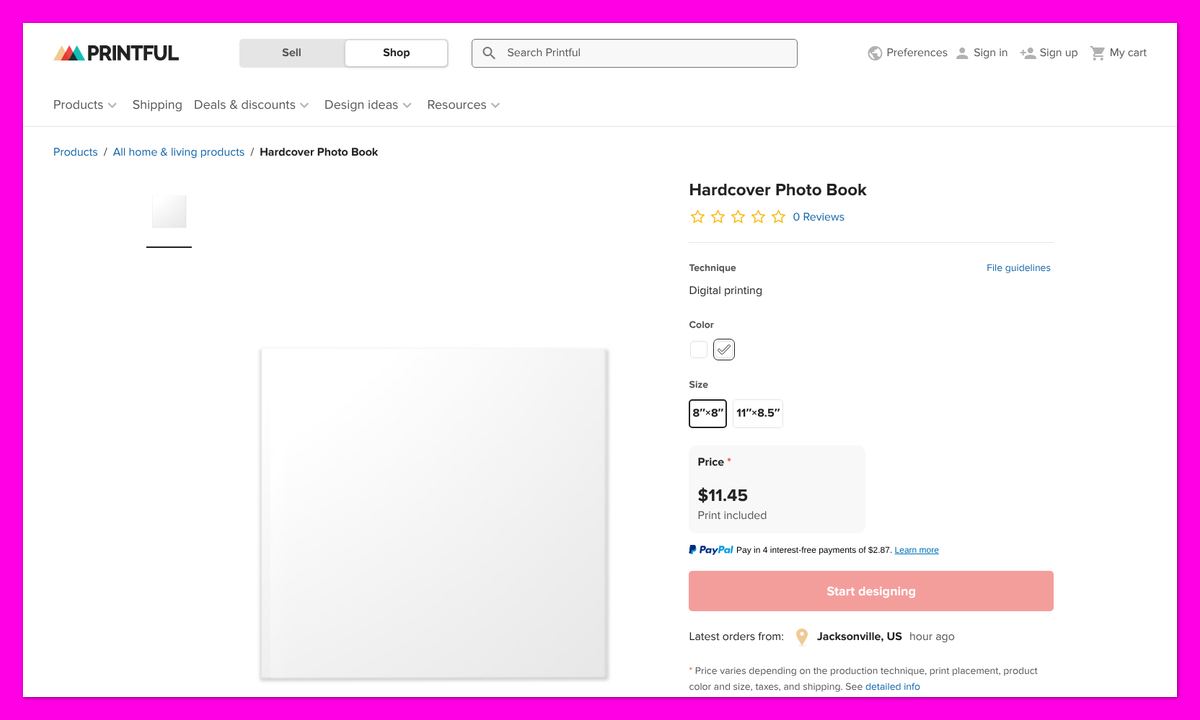
Hardcover photo book from $11.45
Growth: $24.99/month
- Photo books, calendars, cards, canvas and mugs
- Published US shipping rates
- Free branded packing slip
Lowest Base Costs

Printify
See pricing Visit Printify →Free plan: $0/month, 5 stores
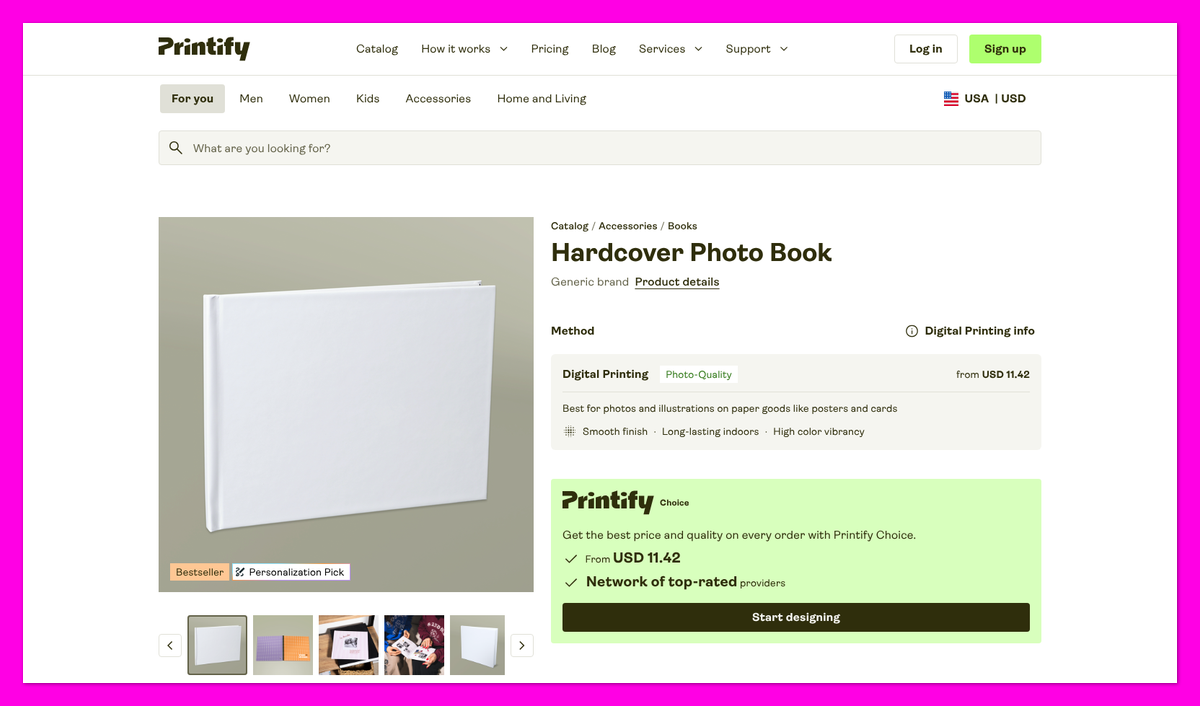
Hardcover photo book from $11.42
Premium: $24.99/month billed yearly
- Four hardcover photo book sizes
- 70+ print providers to choose from
- Up to 20% off with Premium
Best for Global Sales

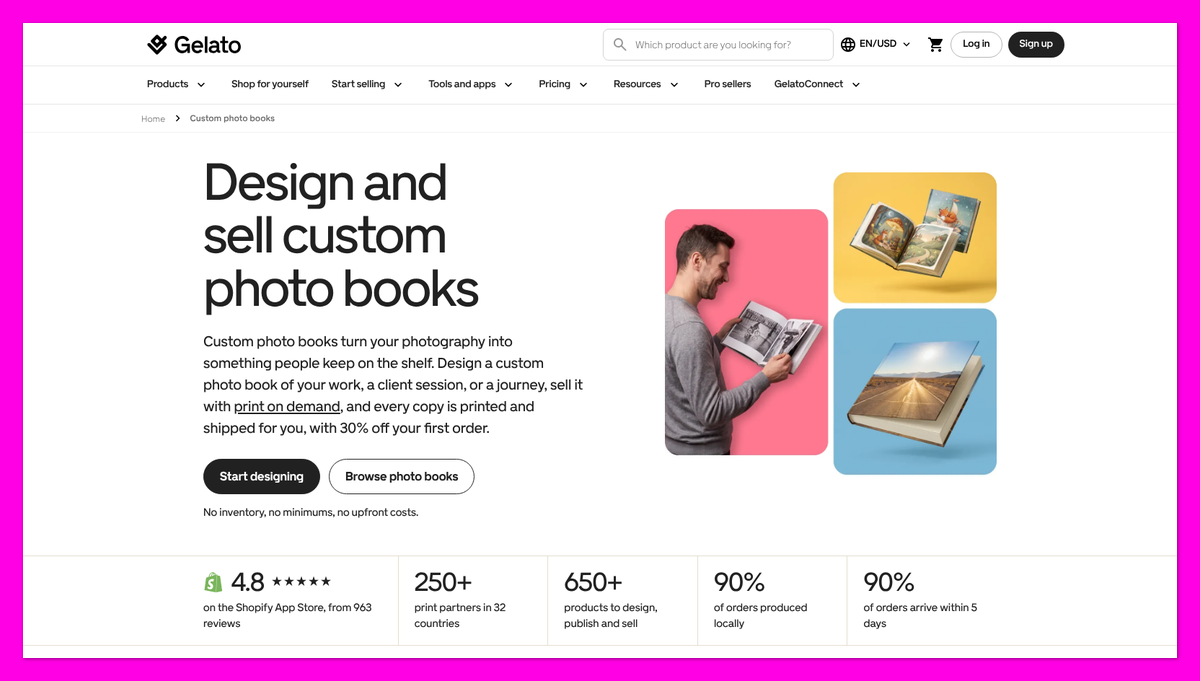
Gelato
See pricing Visit Gelato →Free plan: $0/month
Hardcover photo book from $13.17
Gelato+: $19.99/month billed yearly
- Local production in 32 countries
- 2027 wall calendars from $10.55
- Up to 33% off with Gelato+
We’ve reviewed dozens of print on demand companies at Bootstrapping Ecommerce, and after comparing 14 seller platforms, I recommend Printful as the best Shutterfly alternative for sellers. It covers photo books, wall art and photo gifts, with published base costs and US shipping rates.
Shutterfly’s terms restrict its sites and apps to “personal, noncommercial use” and prohibit running a photography business or reselling without written permission. Its consumer service has no seller storefront, wholesale pricing or fulfillment under your brand.
So which sites like Shutterfly actually let you sell? These seven offer a route from your photos to paying customers, rather than another place to order for yourself.
Key Takeaways
- Shutterfly works for personal photo books, but its terms bar commercial resale without written permission.
- Printful is my top pick: an 8×8 hardcover costs $11.45 plus $6.19 US shipping, against Shutterfly’s $39.98 list price.
- Printify has the lowest photo book base cost, from $11.42 for a 24-page hardcover, or $8.42 with Premium.
- Gelato prints in 32 countries, making it the strongest pick for buyers outside the US.
- Pixieset sells prints and albums inside client galleries, with 0% commission on paid plans from $8/month billed yearly.
- Lulu fulfills photo books and calendars white-label from Shopify for a $0.75 per-order fee, plus printing and shipping.
- Zazzle costs nothing to start: you earn a 5% to 50% royalty while it handles printing, shipping and customer service.
- Blurb offers layflat books, including a $109.00 10×8 with 20 pages, but its 2.6 Trustpilot score warrants a proof first.
Read about the recent changes for Shutterfly sellers
I checked every price on this page on November 26, 2026, following Shutterfly’s May 29 website and app “replatform”, which introduced a single creation path and new book builder alongside acknowledged slowdowns and missing or harder-to-find features. The 18-month ordering requirement for storage and commercial-use restrictions remain. Separately, Lifetouch’s Galion, Ohio school-photo plant closure affects 88 jobs, with production ending October 30 and closure scheduled by December 24, 2026; this does not concern consumer photo-book production. Printify also raised monthly Premium from $29 to $39 on February 17, 2026, while annual billing remained $299.
How I chose the best Shutterfly alternatives
I compared 14 platforms you can sell through, prioritizing Shutterfly product coverage and a workable sales channel. That includes store-connected suppliers, photographer galleries, book printers with distribution and marketplaces.
I also weighed published US costs, shipping, fees and package branding, alongside paper specifications and buyer reviews. Consumer-only services without seller fulfillment didn’t qualify, and a low base price alone wasn’t enough to win. The weighting in “How We Test Shutterfly Alternatives” below explains why Printful’s clearer cost picture puts it first.
Comparing Shutterfly Alternatives
Compare these Shutterfly competitors on seller costs and product coverage. Ratings below are our editorial scores; Shutterfly’s reference price is $39.98 for a 20-page 8×8 hardcover.
| Platform | Rating | Hardcover photo book base cost | Plan cost | Shutterfly products covered | Best for |
|---|---|---|---|---|---|
| Printful | 4.8/5 | $11.45 (8×8, 24 pages) | Free; Growth $24.99/month | Photo books, calendars, cards, wall art, mugs | A full photo product line |
| Printify | 4.6/5 | From $11.42 (24 pages) | Free; Premium $24.99/month billed yearly | Photo books, calendars, cards, wall art, mugs | The lowest base costs |
| Gelato | 4.5/5 | From $13.17 | Free; Gelato+ $19.99/month billed yearly | Photo books, calendars, cards, wall art, mugs | Selling worldwide |
| Pixieset | 4.4/5 | Set by your lab | Free (15% commission); paid from $8/month billed yearly | Albums, prints, wall art, cards | Photographers with clients |
| Lulu | 4.3/5 | From $14.76 | No plan fee; $0.75 per Lulu Direct order | Photo books, calendars | Photo books under your brand |
| Zazzle | 4.1/5 | None (royalty model) | Free; you earn a 5% to 50% royalty | Guest books, calendars, cards, wall art, mugs | Selling without a store |
| Blurb | 4.0/5 | $32.00 (7×7, 20 pages) | No plan fee; 0% Bookstore commission | Photo books, wall art | Layflat photo books |
Which Shutterfly Alternative Is Best for My Specific Needs?
For the widest product range, Printful covers all five categories with published US shipping.
If base cost matters most, Printify hardcovers start at $11.42. Our Printful vs Printify vs Gelato breakdown compares the leading suppliers.
For buyers outside the US, Gelato produces in 32 countries.
For photographers with clients, Pixieset combines galleries with lab fulfillment.
If the book is your product, Lulu offers white-label fulfillment and retail distribution.
Without your own store, Zazzle pays royalties on your designs.
For layflat pages, try Blurb after approving a proof.
1. Printful: For a Full Photo Product Line
Printful is my top pick because it makes every core Shutterfly product, from photo books to mugs, and publishes the base cost and US shipping rate of each.
- Pro: 8×8 hardcover photo book from $11.45
- Pro: Published US shipping rates
- Pro: Free branded packing slip
- Con: Hardcover books fixed at 24 pages
- Con: Books and calendars ship from the US only
- Best for
- A full photo product line
- Free plan
- Yes, pay per order
- Photo book
- 8×8 or 11×8.5 hardcover, 24 pages
- Integrations
- 20+, incl. Shopify, Etsy and Wix
Printful is my top pick for sellers because it covers the five core Shutterfly categories and publishes product costs and US shipping. Shutterfly sells to you at retail for personal use; Printful prints after your customer orders and ships with your logo on the packing slip.
What I Like
- Every core category in one catalog: Hardcover books come in 8×8 and 11×8.5, alongside an 8×8 softcover, calendars, three greeting-card sizes, canvas in 46 sizes, matte and luster posters, metal prints and 11oz, 15oz and 20oz mugs.
- Published US shipping: A book ships for $6.19, plus $2.40 per additional book; a 16×20 canvas costs $10.39 to ship, a calendar $8.79 and a mug $6.69. Calculate these costs before listing.
- Free branded packing slip: Add a message and a black-and-white logo measuring 3×2 inches at no charge. Pack-ins cost $0.50 each, plus a $25/month minimum storage fee.
- More than 20 store integrations: Connect Shopify, Etsy, WooCommerce, Wix, Squarespace or TikTok Shop, with unlimited stores, manual orders and an API available. Our guide explains how to connect Printful to Shopify.
What I Dislike
- Hardcover books stop at 24 pages: There are two sizes, no extra pages and no layflat option. Shutterfly offers 20 to 111 pages, sizes up to 12×12 and layflat binding.
- Books and calendars ship from the US only: International book orders cross a border. Canvas has broader production coverage across the US, Canada, UK, EU and Australia.
- Delivery and refund complaints: Trustpilot shows 4.1 from 8,025 reviews. November 2026 reviewers described a 3 to 5 day estimate becoming 8 to 10 days, and a late school order with a refused refund.
What’s New With Printful
- 2027 wall calendars: The 8.26×11.69-inch version costs $12.19; the 11×17-inch version costs $19.33.
- Seasonal surcharge: US-destination orders incur another $0.40 from October 15, 2026 to January 17, 2027.
How Much Does Printful Cost?
Free costs $0/month with no Printful transaction fees; Growth costs $24.99/month, becomes free at $12K in annual sales and offers up to 33% off products with a 14-day trial. Base costs are $11.45 for an 8×8 hardcover, $12.60 for 11×8.5, $8.11 for an 8×8 softcover, $28.56 for 16×20 canvas, $6.95 for an 11oz mug and $2.95 for a 5×7 card. The 8×8 hardcover totals $17.64 with shipping, or $18.04 during the surcharge period, against Shutterfly’s $39.98 list; canvas totals $38.95 before that surcharge against $109.98 retail. Our breakdown of Printful’s pricing explains membership costs.
How Does Printful Compare to Shutterfly?
- Built for resale: Printful fulfills customer orders under your brand; Shutterfly’s consumer terms restrict commercial use.
- Less book-design freedom: Shutterfly’s six sizes, layflat options and adjustable page counts beat Printful’s fixed hardcover format.
- Published costs instead of promotions: Shutterfly’s 50%-off promotion ends November 27, 2026. I wouldn’t build recurring margins around a temporary discount.
Should you use Printful instead of Shutterfly?
Yes, if you want one supplier for a full photo-product line under your brand. I’d start free, order a sample book and upgrade when Growth’s savings cover $24.99/month. Mugs leave less room against Shutterfly’s pricing: $6.95 plus $6.69 shipping totals $13.64 before surcharges, versus a list price from $15.99. I’d prioritize books, canvas and calendars when planning your range.
2. Printify: For the Lowest Base Costs
Printify has the lowest photo book base cost on my list and four hardcover sizes, but print quality and shipping depend on the provider you choose.
- Pro: Hardcover photo book from $11.42
- Pro: Four hardcover sizes up to 14×10.5
- Pro: Up to 20% off with Premium
- Con: Quality varies by print provider
- Con: Support works through a middleman
- Best for
- The lowest base costs
- Free plan
- Yes, up to 5 stores
- Photo book
- 8×8 to 14×10.5 hardcover, 24 pages
- Network
- 70+ print providers
Printify has the lowest photo book base cost here, starting at $11.42 for a 24-page hardcover, or $8.42 with Premium. It connects you to 70+ providers across 140+ facilities rather than printing itself, and its brand remains separate from Printful after they announced their merger. Unlike Shutterfly’s retail operation, you choose a provider, price and production location.
What I Like
- Four hardcover sizes: Choose 8×8, 11×8.5, 12×12 or 14×10.5, with 24 pages of 100 lb semi-gloss paper and a matte or glossy cover. For print on demand photo books, that’s a wider documented hardcover-size selection than Printful or Gelato.
- Low costs beyond books: Softcovers start at $8.08, stretched 1.25-inch canvas at $10.63, ceramic mugs at $5.02 and matte posters at $4.96. The catalog also includes wall calendars and greeting cards.
- Premium discounts: Most products receive up to 20% off, with up to 33% off newly launched products. The hardcover falls to $8.42, the mug to $3.75 and canvas to $7.94.
- Highest Trustpilot score among the three POD leaders: Printify scores 4.4 from 7,753 reviews, with praise for easy publishing to Shopify and Etsy. Free supports five stores; Premium supports ten.
What I Dislike
- A middleman when problems arise: Printify must coordinate with the provider handling your order. A November 2026 Trustpilot reviewer described waiting weeks for answers.
- Provider-dependent quality and location: Production varies between suppliers, and some products ship only from Australia, New Zealand or the UK. Sample the exact provider and product you plan to sell.
- Variable shipping and limited inserts: Book shipping starts at $5.49, rather than one guaranteed rate. Packaging inserts cost $0.15 on Free or $0.10 on Premium, through supported providers only.
What’s New With Printify
Printify raised Premium’s monthly price from $29 to $39 on February 17, 2026. Annual billing remained $299, advertised as $24.99/month, so monthly subscribers need more sales to justify upgrading.
How Much Does Printify Cost?
Free costs $0 for five stores; Premium costs $39/month or $299/year, advertised at $24.99/month, while Enterprise has custom pricing and a custom API. Printify charges no transaction fees: hardcovers start at $11.42 ($8.42 Premium), softcovers at $8.08 ($5.95), canvas at $10.63 ($7.94) and mugs at $5.02 ($3.75). A hardcover totals from $16.91 with shipping using the $5.49 starting rate, compared with Shutterfly’s $39.98 list. Saving $3.00 per hardcover means nine books monthly cover the annual-plan equivalent and 13 cover monthly billing; our guide to Printify’s pricing explains the remaining differences.
How Does Printify Compare to Shutterfly?
- Large sizes, fixed pages: Printify’s 12×12 matches Shutterfly’s largest square book, but its hardcovers contain 24 pages rather than up to 111.
- Lower production costs: An 8×8 softcover starts at $8.08 before shipping, against Shutterfly’s $24.98 retail list. That’s a cost comparison, not guaranteed profit.
- One printer versus provider choice: Shutterfly handles its own production; Printify lets you choose suppliers, making a sample from your selected provider essential.
Should you use Printify instead of Shutterfly?
I recommend Printify for price-sensitive Etsy or Shopify sellers willing to compare providers and order samples. Its 12×12 and 14×10.5 formats also suit larger coffee-table-style books. Skip it if you’d rather deal with one printer and avoid provider coordination; Printful is my preferred starting point for that setup.
3. Gelato: For Selling Worldwide
Gelato prints in 32 countries, so it’s my pick when a meaningful share of your buyers live outside the US.
- Pro: Local production in 32 countries
- Pro: Hardcover photo book from $13.17
- Pro: Shopify, Etsy, Amazon and TikTok Shop
- Con: One hardcover and one softcover book
- Con: Shipping is quoted per order
- Best for
- Selling worldwide
- Free plan
- Yes
- Photo book
- Hardcover from $13.17, softcover from $7.69
- Branding
- Inserts and labels from $0.49
Gelato uses production in 32 countries to route orders closer to customers. That addresses a Shutterfly frustration: a November 24, 2026 Trustpilot reviewer said the US and Canadian sites couldn’t share projects, and sending two books from the US site to Canada would cost over $300 with tariffs and delivery.
What I Like
- Local production network: Orders route to print partners near buyers, reducing reliance on international parcels. For customers in Toronto or Berlin, that gives Gelato an advantage over Printful’s US-only book fulfillment, subject to product availability.
- All five core product categories: Hardcover books start at $13.17, softcovers at $7.69, 2027 calendars at $10.55 and ten-card packs at $5.64. Canvas starts at $11.69, framed canvas at $32.70, aluminum at $14.32, acrylic at $20.94 and mugs at $6.26.
- Multiple sales channels: Integrations include Shopify, Etsy, WooCommerce, Amazon, TikTok Shop and Wix. Manual orders and an API are available, so you aren’t limited to a single storefront.
- Gelato+ savings and branding: Discounts reach up to 33%; hardcover books start at $9.88, mugs at $5.01 and card packs at $3.78. Branded inserts and labels start at $0.49 each.
What I Dislike
- Limited published book choices: The US catalog lists one hardcover and one softcover product, with no layflat option mentioned. I wouldn’t choose it for a business built around specialized book binding.
- Shipping needs an order quote: Price US book and canvas shipping against your actual order before setting a retail price. The listed product cost alone doesn’t establish your delivered cost.
- Recent quality and support complaints: Trustpilot shows 4.2 from 3,496 reviews. November 2026 reviewers reported two damaged test posters, low-saturation mugs and support conversations that felt automated and repetitive.
What’s New With Gelato
- 2027 calendars are available: US and Canadian wall calendars start at $10.55, wire-o versions at $10.77 and single-sided letter-size calendars at $7.91.
- Black Friday 2026 promotion: Code 50PLUS takes 50% off the annual Gelato+ plan. Treat that as a promotion, not the ongoing subscription rate.
How Much Does Gelato Cost?
Free costs $0 forever without product discounts; Gelato+ costs $29.99/month or $19.99/month billed yearly, and Platinum has custom pricing. Starting costs include $13.17 for a hardcover ($9.88 with Gelato+), $7.69 for a softcover, $10.55 for a calendar, $5.64 for ten cards and $6.26 for a mug. The hardcover base is $26.81 below Shutterfly’s $39.98 list, before shipping and without assuming identical specifications. Savings of $3.29 per hardcover cover the annual-plan monthly equivalent at seven books, or monthly billing at ten; our Gelato+ review covers the other benefits.
How Does Gelato Compare to Shutterfly?
- International production: Shutterfly runs separate US and Canadian sites that can’t share projects, while Gelato’s 32-country network prints close to overseas customers from one account.
- Fewer documented book options: Shutterfly offers layflat binding and up to 111 pages. Gelato’s catalog shows hardcover and softcover book products.
- Lower calendar starting cost: Gelato’s 2027 wall calendar starts at $10.55 before shipping; Shutterfly lists its 12×12 calendar at $47.99, although specifications differ.
Should you use Gelato instead of Shutterfly?
I’d choose Gelato when a meaningful share of customers live outside the US, since Printful’s books and calendars ship only from America. For mostly US buyers and clearer shipping calculations, I prefer Printful; our Printful vs Gelato comparison explains the trade-off. Order a test print before listing, particularly given the recent damage complaints.
4. Pixieset: For Photographers Selling to Clients
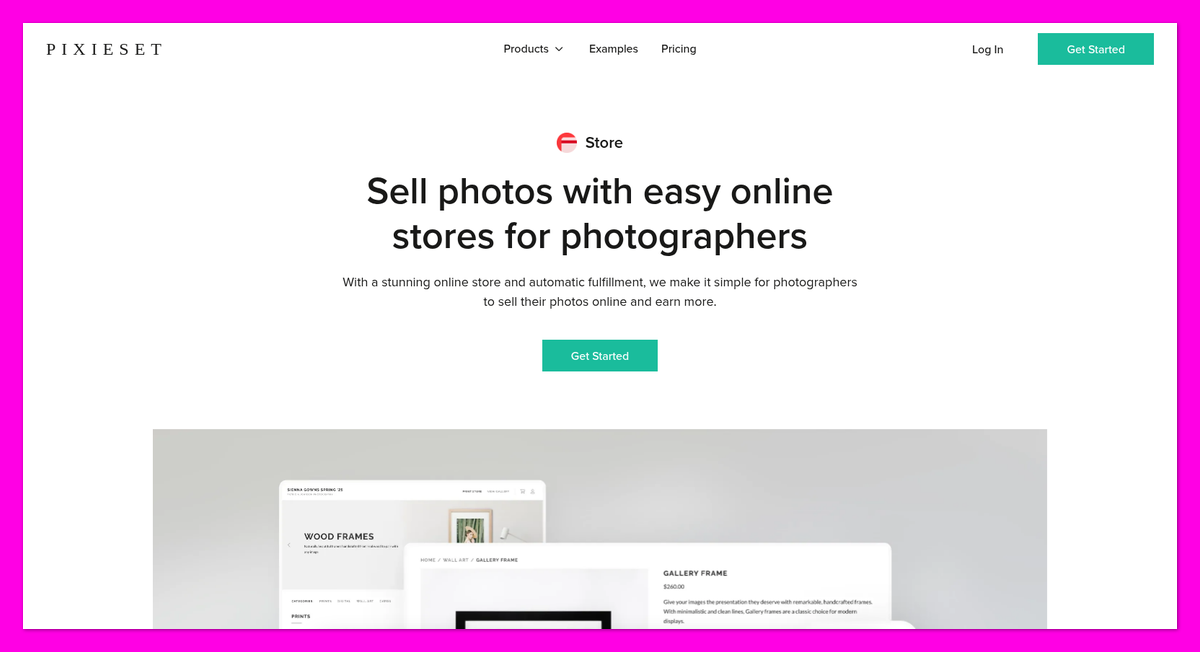
Pixieset turns your client galleries into a print store, and pro labs print and ship each order white-label.
- Pro: 0% commission on paid plans
- Pro: Pro labs incl. WHCC and Miller's
- Pro: White-label automatic fulfillment
- Con: Free plan takes 15% commission
- Con: No calendars, mugs or Shopify integration
- Best for
- Photographers with clients
- Free plan
- Yes, 15% commission
- Products
- Prints, wall art, cards, albums
- Labs
- WHCC, ProDPI, Miller's, Mpix and more
Pixieset turns your client gallery into a print store, where clients order photographs and albums that a professional lab prints and ships. Shutterfly’s terms forbid using it “to operate a photography business”; Pixieset is built for that purpose. If you’re deciding how to sell photography prints online, this is the gallery-based route I’d consider first.
What I Like
- Purchasing inside the gallery: Clients choose products while browsing their photographs, and Personalized Product Preview displays their images on those products. You don’t have to send them to a separate consumer printing service.
- Professional lab fulfillment: Options include WHCC, ProDPI, Miller’s, Mpix, Fujifilm Canada, Loxley Colour and Atkins Pro Lab. WHCC is the North American default, and automatic orders ship white-label.
- No commission on paid plans: Plans start at $8/month billed yearly, removing Pixieset’s sales commission. Lab production costs still apply, so commission-free doesn’t mean the full sale price becomes profit.
- Your own pricing: Build lab-specific price sheets to sell photo prints online, or choose Self Fulfillment with your own products and shipping methods. That flexibility helps if you already work with a preferred lab.
What I Dislike
- Free takes 15% commission: It’s useful for getting started, but the deduction grows with revenue. I’d move off Free once regular orders cover Basic’s subscription.
- Missing products and connections: There are no listed calendars or mugs, and no Shopify or Etsy integration. Automatic fulfillment depends on whether a partner lab serves your country.
- Small, mixed review base: Pixieset scores 3.1 on Trustpilot from just 29 reviews. Complaints mention upload failures and disappointing support, although a long-time user praised it over other gallery platforms.
What’s New With Pixieset
Pixieset’s lab list now includes Fujifilm Canada, which gives Canadian photographers a local option. Its Suite bundle starts at $28/month and combines Client Gallery, Studio Manager, Website, Store and Mobile Gallery App.
How Much Does Pixieset Cost?
Free includes 3 GB and 15% commission; Basic costs $8/month annually or $10 monthly for 10 GB, Plus $16/$20 for 100 GB, Pro $24/$30 for 1,000 GB, and Ultimate $40/$50 for unlimited storage, with annual/monthly rates respectively. All paid plans have 0% commission, and $70 in monthly sales incurs $10.50 commission on Free, exceeding monthly Basic. Lab costs appear inside your account’s price sheet, not a public price list. To price your products, consider ShootProof’s recommendation of at least 300% markup over lab cost, citing the PPA guideline that goods should cost a quarter of the selling price.
How Does Pixieset Compare to Shutterfly?
- Commercial use is the purpose: Pixieset supports client sales rather than prohibiting photography-business use.
- Storage isn’t tied to purchases: Shutterfly requires an order every 18 months to maintain unrestricted photo access. Pixieset provides 3 GB free, then 10 GB to unlimited on paid plans.
- A narrower product range: Pixieset supports prints, wall art, cards, albums and downloads. Shutterfly also sells calendars and mugs, which aren’t listed in Pixieset’s store.
Should you use Pixieset instead of Shutterfly?
For client photography, yes: I’d choose Pixieset to sell prints and albums without packing orders myself. Its gallery checkout keeps purchasing attached to the photographs clients already want. If the small, mixed review base concerns you, ShootProof offers 0% commission on every plan and a wider lab list that includes Bay Photo.
5. Lulu: For Photo Books Under Your Own Brand
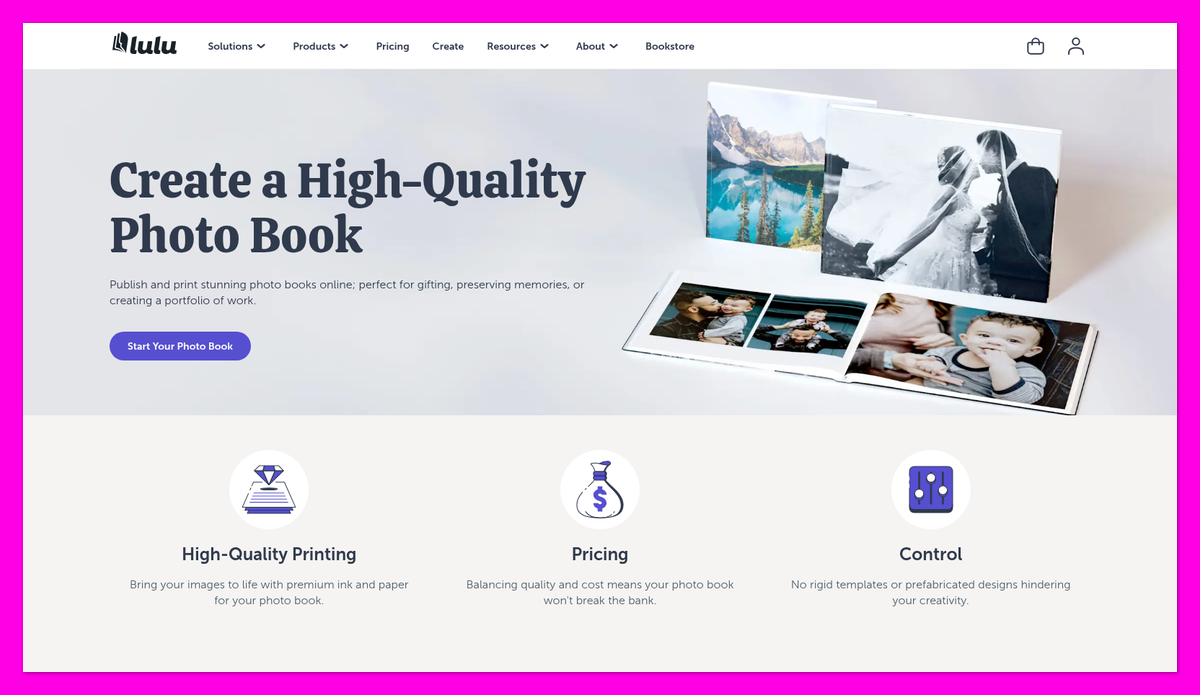
Lulu prints photo books and calendars one copy at a time and ships them white-label from your Shopify, WooCommerce or Wix store.
- Pro: White-label Lulu Direct fulfillment
- Pro: Amazon and Ingram distribution
- Pro: Best Trustpilot score here (4.5)
- Con: Only books and calendars
- Con: Starting prices are not full quotes
- Best for
- Photo books under your brand
- Plan fee
- None
- Photo book
- Hardcover from $14.76
- Integrations
- Shopify, WooCommerce, Wix, API
Lulu gives you several ways to sell photo books online: its Bookstore, Amazon and Ingram distribution, or white-label Lulu Direct fulfillment from Shopify, WooCommerce and Wix to 150 countries. Shutterfly’s BULKBOOKS program discounts at least ten identical books shipped to you, starting at 56% off for 10 to 24 copies. Lulu instead prints a single copy when your customer orders.
What I Like
- Automatic white-label fulfillment: Lulu Direct offers a free-to-install Shopify app, a WooCommerce plugin, Wix integration, Print API and Direct Buy Button. Orders from your store flow to Lulu and ship under your branding.
- Highest Trustpilot score on this list: Lulu scores 4.5 from 6,635 reviews, with buyers praising crisp text and durable binding. That supports my recommendation, but doesn’t replace approving your own proof.
- Calendars alongside books: The Standard Calendar measures 11×8.5 inches, uses wire-O binding and supports 12 or 18 months. Its free Calendar Creator produces calendars you can sell through the Bookstore or your site.
- Retail distribution: The Lulu Bookstore offers an 80% revenue share and handles shipping and taxes. Retail distribution adds Amazon and the Ingram network when your book meets approval requirements.
What I Dislike
- Only books and calendars: Lulu won’t supply wall art, cards or mugs. A mixed photo-gift shop needs another fulfillment partner, even if Lulu handles its main book product.
- Starting prices aren’t full quotes: Published photo-book starting prices don’t specify a page count. Use its calculator to price your actual book; calendar pricing also lives there.
- Shipping and distribution friction: Reviewers mention delays and unexpected delivery costs; retail distribution requires an ISBN, an approved proof and up to 12 weeks of review. The Shopify app separately scores 3.9 from 45 reviews.
What’s New With Lulu
As of November 2026, Lulu Direct still charges one flat $0.75 fulfillment fee per order, regardless of how many books it contains. There’s still no subscription or setup fee.
How Much Does Lulu Cost?
Lulu Direct has no subscription or setup charge: you pay printing, shipping, tax and a $0.75 per-order fee. Its 11×8.5 landscape and 8.5×8.5 square hardcovers start at $14.76 with Premium Color printing on 80# paper; the 9×7 paperback starts at $8.26, while Bookstore sales use an 80% revenue share. A hardcover’s starting cost plus fulfillment is $15.51 before shipping, against Shutterfly’s $39.98 list for a 20-page 8×8. Lulu doesn’t specify the starting page count, so this is a floor, not a matched-book quote.
How Does Lulu Compare to Shutterfly?
- Single-copy fulfillment: Shutterfly’s bulk deal begins at ten identical books. Lulu Direct fulfills one customer’s order at a time without requiring stock.
- Print-ready files rather than a consumer builder: Shutterfly uses drag-and-drop design. Lulu provides InDesign, Photoshop and Word templates, but expects you to prepare printable files.
- A publishing focus: Lulu prioritizes books and calendars rather than Shutterfly’s broader gift catalog. Choose it for a book-led business, not a complete photo-gift store.
Should you use Lulu instead of Shutterfly?
If the product is a photo book sold one copy at a time, Lulu is where I’d start for own-brand fulfillment. Pair it with Printful or Gelato for wall art. Order a proof before launching; our print on demand quality control guide explains what to inspect before customers see it.
6. Zazzle: For Selling Without a Store

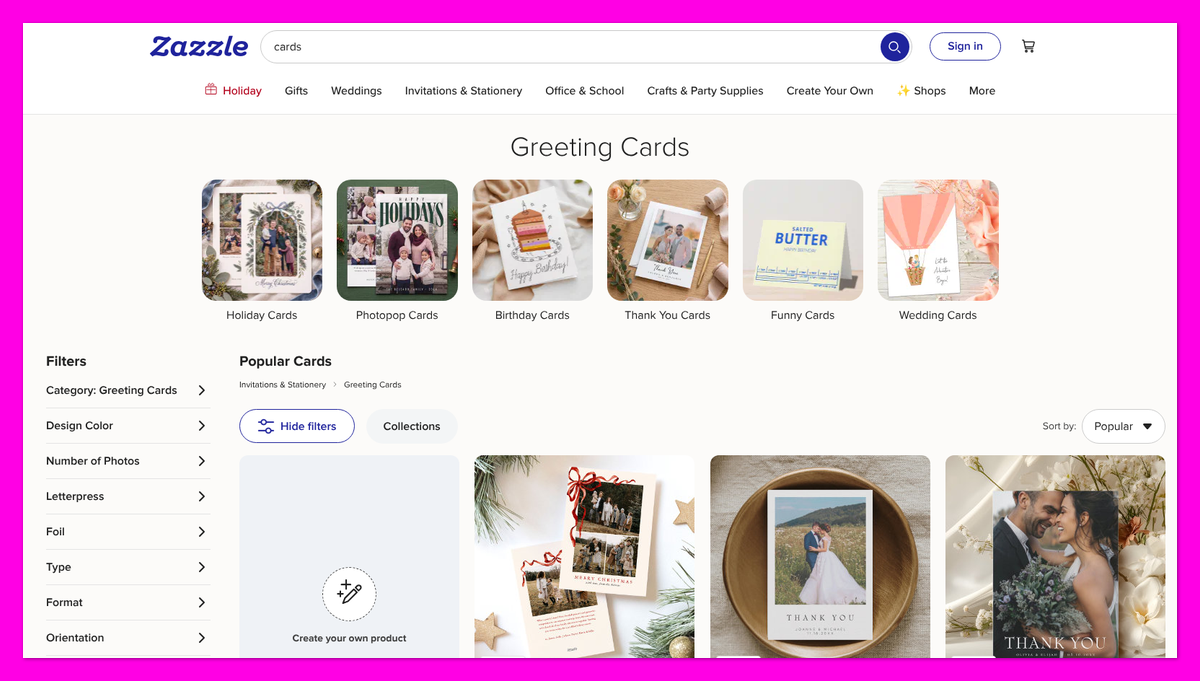
Zazzle sells your designs to its own shoppers and pays you a royalty, so you don’t need a store, stock or customer service.
- Pro: Free creator store
- Pro: Zazzle prints, ships and handles buyers
- Pro: Cards, calendars, canvas and mugs
- Con: Zazzle owns the customer and branding
- Con: Payouts within 45 days after month end
- Best for
- Selling without a store
- Free plan
- Yes
- Royalty
- 5% standard, up to 50%
- Payout minimum
- $50 PayPal, $100 check
Zazzle offers a Shutterfly-like personalization catalog that pays creators: you upload designs, shoppers personalize them and you earn royalties. On Shutterfly, customers create something for themselves; on Zazzle, they customize your template. Zazzle says shoppers use it for weddings, birth announcements and graduations, making event-focused designs a natural fit.
What I Like
- Broad photo-product coverage: Zazzle lists folded photo cards, canvas, faux canvas, posters, mugs including a 20oz jumbo version, and wire-bound calendars in 5.5×7, 8.5×11 and 11×14.25. Its photo-book category mainly contains event guest books and albums.
- No inventory or customer-service workload: Zazzle prints, ships and deals with buyers. I like the template model for selling print on demand greeting cards, where buyers supply their own names and photographs.
- Free entry and adjustable royalties: Opening a creator store costs nothing. The standard royalty is 5%, and physical-product royalties can reach 50%, although higher rates affect pricing and fees.
- An established shopper audience: Trustpilot shows 4.4 from 29,403 reviews, mostly from buyers. That supports Zazzle’s appeal as a shopping destination, but doesn’t establish what an individual creator will earn.
What I Dislike
- Zazzle owns the customer relationship: Checkout stays on Zazzle, packages carry its branding, and there is no white-label option or Shopify/Etsy synchronization. This is marketplace income, not an independent branded store.
- Fees reduce royalties: Rates above 10% trigger an excess royalty fee equal to 5% of gross royalty. Marketing-referred sales also incur a marketing royalty fee of 35% to 50% of gross royalty.
- Slow payouts: Payments arrive within 45 days after month-end, once earnings reach $50 for PayPal or $100 for checks. Don’t rely on those earnings for immediate operating cash.
What’s New With Zazzle
- April 1, 2025 changes: Zazzle launched its Ambassador Program, introduced Marketing Royalty and Excess Royalty fees, and retired the Volume Bonus.
- August 7, 2025 retirement: The Secondary Content feature was discontinued.
How Much Does Zazzle Cost?
Opening a store costs $0, with no production base cost for you to pay: Zazzle sets its product price and adds your royalty, from 5% standard to 50%. On an illustrative $10 gross royalty, a 35% marketing fee leaves $6.50, while a 50% fee leaves $5.00, before other applicable deductions. On a direct sale with a royalty rate above 10%, the 5% excess royalty fee leaves $9.50 from that same $10. Payout thresholds are $50 through PayPal or $100 by check.
How Does Zazzle Compare to Shutterfly?
- Similar products, different role: Both offer personalized cards, calendars, canvas and mugs, but Zazzle pays you when someone buys your design.
- Different price control: Shutterfly’s list price is what you pay. Zazzle combines its product price with your chosen royalty.
- Neither ships under your brand: If branded fulfillment matters more than marketplace convenience, our Zazzle vs Printful comparison explains why I’d choose a connected supplier instead.
Should you use Zazzle instead of Shutterfly?
I recommend Zazzle for designers making personalizable templates, especially wedding stationery and holiday photo cards. It’s the lowest-administration route here because Zazzle handles checkout and fulfillment. Skip it if your priorities are your own package branding, customer list and complete control over the final price.
7. Blurb: For Layflat Photo Books
Blurb is the only pick with layflat photo books you can sell, through its Bookstore, Amazon and the new Instant Store.
- Pro: Layflat and premium photo papers
- Pro: 0% Bookstore commission
- Pro: Amazon.com listing for eligible books
- Con: 2.6 Trustpilot score
- Con: No calendars, cards or mugs
- Best for
- Layflat photo books
- Plan fee
- None
- Photo book
- 10×8 hardcover from $41.00 (20 pages)
- Wall art
- 16×20 canvas $99
Blurb is my pick here for layflat photo books with premium paper choices. Its sales channels include the Bookstore, Amazon.com for eligible non-layflat photo books, Ingram distribution for eligible formats and the new Instant Store. Shutterfly also makes layflat books, but not as a self-serve seller platform; Blurb’s trade-off is the lowest Trustpilot score on this list.
What I Like
- Premium papers and bindings: Choices include Standard 80# semi-matte, Premium Lustre or Matte 100#, Mohawk Superfine Eggshell and proPhoto Pearl, with layflat on the latter two. Six sizes run from 5×5 to 13×11, with paperback, imagewrap and dust-jacket covers.
- Commission-free Bookstore: There are no listing fees or sales commissions. Set a markup above print cost and keep it, with monthly payments after meeting the payout threshold.
- Amazon and Instant Store: List eligible photo books on Amazon.com from the dashboard, excluding layflat. Instant Store provides a product page and checkout link with lower print costs than retail channels; Blurb handles printing, shipping and sales tax.
- Wall art and volume discounts: A 16×20 canvas costs $99, metal $129 and acrylic $139. Photo-book discounts are 20% at 10 to 49 copies and 25% at 50 or more.
What I Dislike
- Weak buyer feedback: Blurb scores 2.6 on Trustpilot from 4,655 reviews. October 2026 reviewers reported inaccurate colors, shadows bleeding into lighter areas and 25 defective photography zines; forum photographers also describe order-to-order color variation.
- Checkout complaints: An October 31 reviewer alleged an undisclosed 8% surcharge, while a November 1 reviewer said shipping added 20% and nearly doubled for a second book. Price shipping with your ZIP code before committing.
- High costs and limited range: A 7×7 hardcover costs $32.00, only $7.98 below Shutterfly’s $39.98 8×8 retail list. There are no calendars, cards or mugs, and removing Blurb’s logo requires a paid upgrade.
What’s New With Blurb
- 2026 launches: Blurb introduced Instant Store and the Blurb Online Editor.
- Black Friday offer: BF2026 discounts photo books by 50% and other formats by 25% through November 29, 2026, for books you order yourself, not seller pricing.
How Much Does Blurb Cost?
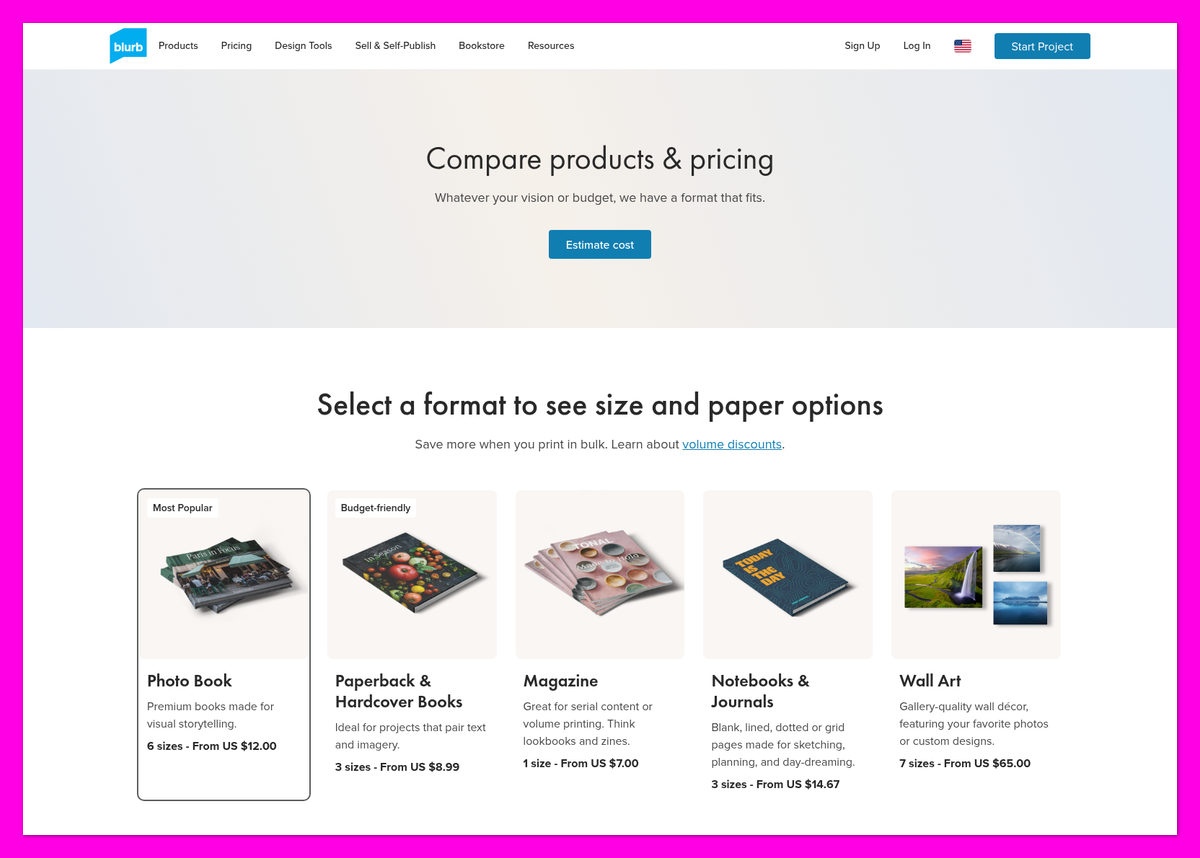
There is no plan fee: a 20-page 10×8 imagewrap hardcover costs $41.00 on Standard paper, $46.00 on Premium Lustre or Matte, $53.00 on Eggshell, $60.00 on proPhoto Pearl or $109.00 layflat, with $3.50 per extra layflat page. A 10×8 paperback costs $24.00; 7×7 and 12×12 hardcovers cost $32.00 and $67.00, with extra pages at $0.26 and $0.70 respectively. Amazon adds $1.35 plus 15% of list price, totaling $10.35 on a $60 book, on top of printing. I’d reserve Blurb for premium-priced products rather than competing with Shutterfly’s retail prices.
How Does Blurb Compare to Shutterfly?
- Sellable layflat books: Both make them, but Blurb provides sales channels; Amazon excludes layflat.
- A reputation gap: Shutterfly scores 4.1 from 30,400 Trustpilot reviews, against Blurb’s 2.6 from 4,655.
- Books and wall art only: Blurb won’t replace Shutterfly’s calendars, cards or mugs.
Should you use Blurb instead of Shutterfly?
Only if layflat or its Amazon listing route is essential, and a proof meets your standards. I’d skip it for volume selling, where a defective run could erase your margin, and consider Lulu or Printify instead. Our print on demand sites for high-quality prints guide offers more quality-focused choices.
How Do I Choose the Right Shutterfly Alternative for My Business?
Start with Shutterfly’s limitation: its consumer service offers no seller storefront or own-brand fulfillment.
Choose according to what you sell and where customers buy. Use these questions to narrow the shortlist:
- Can it make the products you want to sell? Lulu and Blurb are books-first; our personalized gift store guide covers tools for a broader range.
- What does one order really cost you, shipping included? Add production, delivery and per-order fees before calculating margin.
- Where will your customers buy: your own store, a marketplace or a client gallery? Match that channel to a connected supplier, Zazzle or Pixieset.
- Will the package carry your brand or the platform’s? Printful, Lulu Direct and Pixieset support branded or white-label fulfillment; Zazzle doesn’t.
- Can you order a sample or proof before you sell? All seven let you order a copy for yourself and inspect it before listing.
Fourthwall offers a free storefront and fulfillment for posters and mugs, without a platform fee on physical products. It lacks a dedicated photo book, and calendar, card and canvas coverage isn’t confirmed, so I wouldn’t choose it for a full photo-product line; our Fourthwall review explains its better-fit uses.
How Do I Move My Photos From Shutterfly to an Alternative?
Only your photos transfer: download the originals, re-upload them and rebuild your projects. Shutterfly doesn’t provide portable book or card projects.
- Download your originals: On Shutterfly’s Photos page, select photos or albums and click Download, then use the emailed ZIP link or links. Work album by album; downloads contain original, unedited files, and photos archived after 18 months without an order require a new order before downloading, even a free promotional one.
- Re-upload to your new platform: Add originals to supplier designs, Pixieset galleries or Lulu/Blurb book files, and keep local masters. In 2023, Shutterfly notified inactive customers of March 29 deletion, then restored access following complaints and NBC10 Boston inquiries.
- Rebuild your projects: Recreate books and cards in your new platform’s editor or templates; downloaded photos don’t include Shutterfly layouts or edits, and projects cannot be downloaded. Even Shutterfly’s US and Canadian sites couldn’t share projects according to a November 2026 reviewer, so allow time to rebuild rather than assuming an account transfer.
How We Test Shutterfly Alternatives
We score every pick against seven criteria weighted for bootstrapped photo-product sellers. Three of the four vendor blogs ranking for this topic put their own platform first, so publishing our weights makes our priorities visible.
- Product range vs Shutterfly: 30% Photo books, wall art, calendars, cards and mugs.
- Seller costs and margins: 20% Production, shipping, subscriptions and per-order fees.
- Selling channels: 15% Store integrations, marketplaces, galleries and bookstores.
- Print quality: 15% Paper and binding specifications alongside buyer reports.
- Branding: 10% White-label fulfillment, packing slips and inserts.
- Ease of use: 5% Designing, publishing and fulfilling orders.
- Reputation and support: 5% Trustpilot scores and recent complaints.
The ranking combines published US prices and documented capabilities with recent user reviews and Trustpilot scores, using the November 26, 2026 price snapshot. Our editorial scores measure seller fit; Trustpilot figures describe customer feedback and are not substitutes for product specifications or approving a proof.
Final Verdict: Which Shutterfly Alternative Should You Pick?
Shutterfly’s consumer service isn’t a seller platform. I’d choose according to your first product and sales channel:
- Printful is the best all-round pick, covering books, calendars, cards, canvas and mugs with published costs.
- Printify has the lowest base costs, with hardcover photo books from $11.42.
- Gelato is best for selling worldwide, with production in 32 countries.
- Pixieset is best for photographers selling prints and albums directly to clients.
- Lulu is best for photo books under your brand, fulfilled one order at a time.
- Zazzle is best without your own store, trading customer ownership for marketplace convenience.
- Blurb is the one to try for layflat books, after approving a proof.
All seven offer a start without a monthly subscription, although Pixieset’s Free plan takes 15% commission and production costs still apply. Order a sample or proof before putting a product in front of customers.
FAQs
Can I sell Shutterfly products?
Not without written permission: Shutterfly’s terms restrict its sites and apps to personal, noncommercial use and prohibit resale or running a photography business. BULKBOOKS discounts start at 56% for 10 to 24 identical books and rise to 62% at 100+, but that isn’t single-order seller fulfillment. Use a seller platform above rather than treating a bulk discount as resale authorization.
Does Shutterfly have a business account?
Shutterfly Business Solutions is a separate B2B division, not a seller upgrade to a consumer account. If you’re considering Shutterfly for business, its Storefronts offering adds a managed cart with your logo and Shutterfly co-branding through a contact-sales process, without public pricing or self-serve signup. For bootstrappers, I’d start with the free supplier plans at Printful, Printify or Gelato.
Which Shutterfly alternative is best for photo books?
Printify is best for low base costs and size choice, from $11.42 across formats up to 14×10.5. Lulu suits own-brand fulfillment, starting at $14.76 plus $0.75 per Direct order, while Blurb provides a 20-page 10×8 layflat at $109.00. Pixieset is the gallery-based choice for client albums from pro labs. Order a proof before listing whichever format you choose.
What is the cheapest way to start selling photo products?
Start with a free supplier account connected to a store or marketplace you already use. Printify hardcovers total from $16.91 using starting production and shipping rates; its rolled posters start at $2.98 before shipping, versus $3.99 for Gelato’s classic semi-glossy posters. Zazzle requires no production payment from you, but pays royalties instead. Our free print on demand sites guide compares further options.
Is Snapfish better than Shutterfly for sellers?
No: both are consumer services, and Snapfish belongs to the same ownership family as Shutterfly. Mixbook, Artifact Uprising, Picaboo, Amazon Photos and Walmart Photo are also personal-order services rather than the seller platforms covered here. None provides the combination of seller pricing and fulfillment under your brand that this shortlist prioritizes. Choose a supplier, gallery store or marketplace built to support sales instead.